GBP Ranked · template fleet sweep
What the fleet sweep changed
Every generated client site is built from one of 36 templates. This page shows the same deterministic test business built on the old code and on the new code, side by side, so you can see what each fix actually did to the page a customer lands on.
— The short version
The sweep audited all 36 sellable templates against one spec, then fixed what failed. The headline numbers below come from the project's own report. Where I could re-measure a number independently from the two sets of built sites, I say so and give my figure too.
<ul> rendered with no items. Independently re-measured on my own baseline: 661 → 0.Verification
| Check | Result |
|---|---|
| Fleet audit, light, with browser | 36 / 36 PASS |
Fleet audit, dark — all 36 variants, THEME-DARK measuring the painted background | 36 / 36 PASS, max luminance 0.021 |
One <h1> per page | 1540 pages, 0 violations |
| Unit + integration tests | 6489 passed, 16 skipped, 0 failed |
| Type-check + build | clean |
| Cross-vertical leak probe | 30 / 30 pairs |
| Lead-gen template sweep | 36 / 36 PASS |
About that dark row. An earlier 11-variant dark
run also reported 11/11 PASS, but the harness did not look at the page then — 7 of those 11 were in fact
still painting a light background. The THEME-DARK rule now measures the real painted background
in the browser, which is why the number above means something. Run report
20261117T214710Z-ec08f5e6.
How the "before" was made
A snapshot of the whole repository from before the sweep was checked out into a separate tree. The new audit harness and its fixtures were copied in unchanged and run against that old code, so both columns build the same fixture business, with the same mocked town facts and the same placeholder logos. Only the template and writer code differs.
34 of 36 variants built on the old code. Two could not build a client site at all:
whitmore-law crashed rendering its own service page
(Cannot read properties of undefined (reading 'toUpperCase')) and
regent-grooming failed to compile. Both build and pass today.
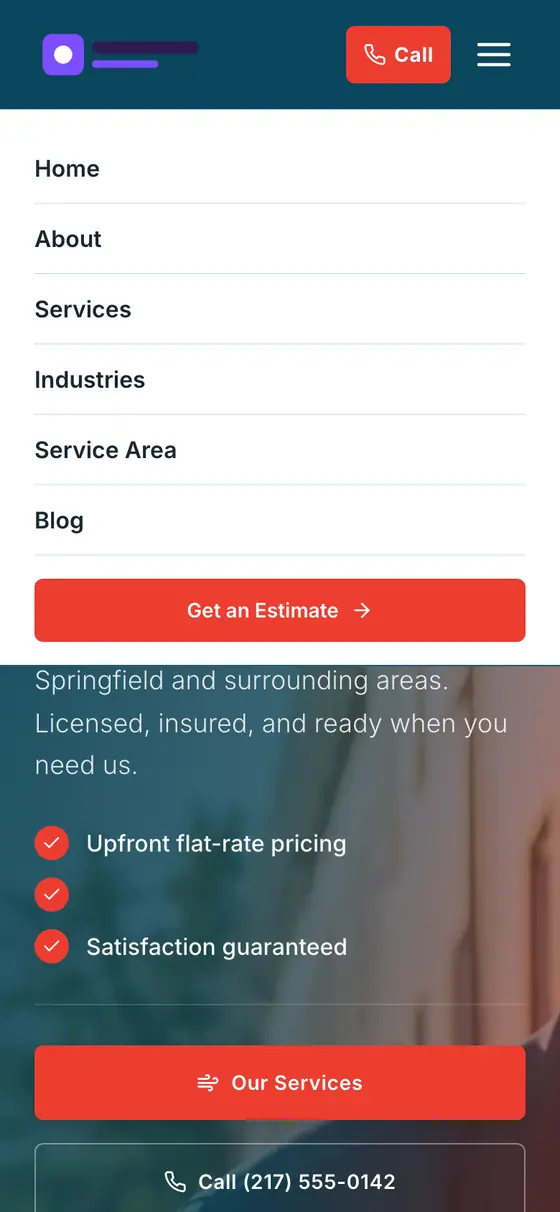
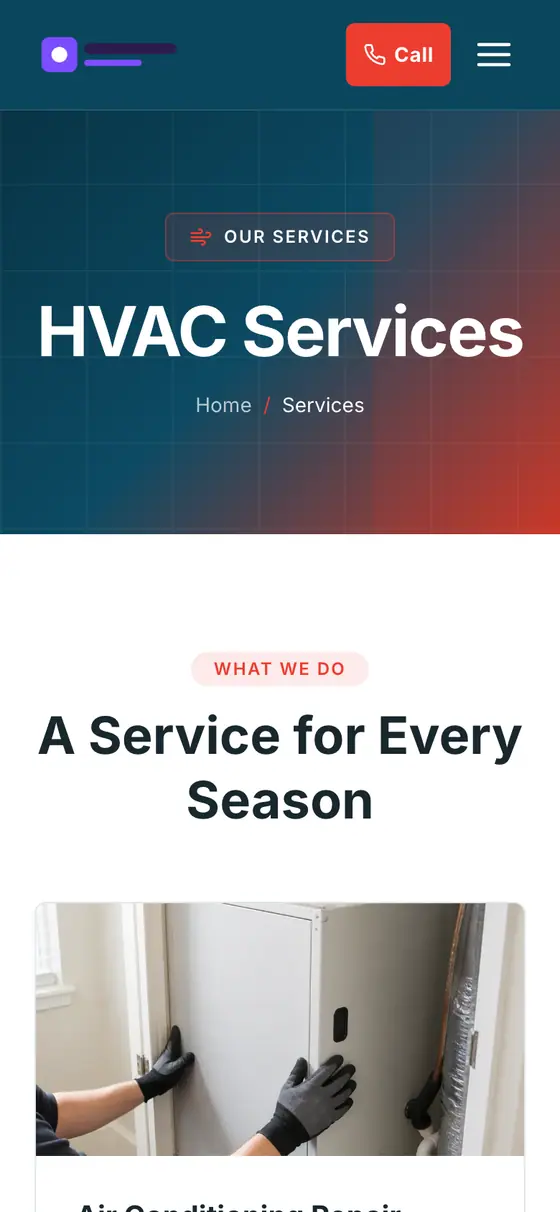
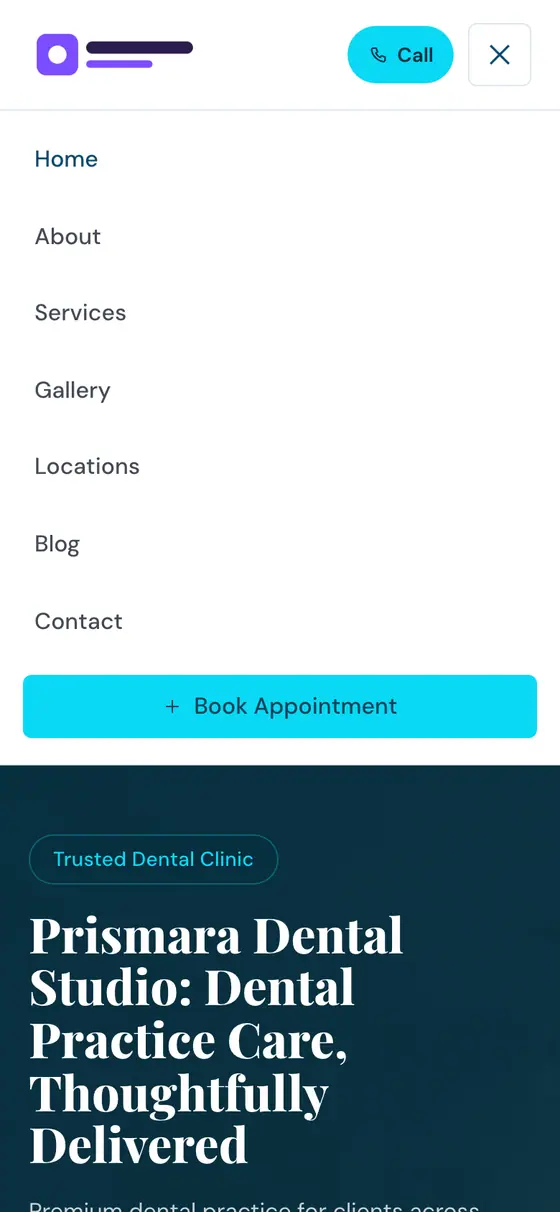
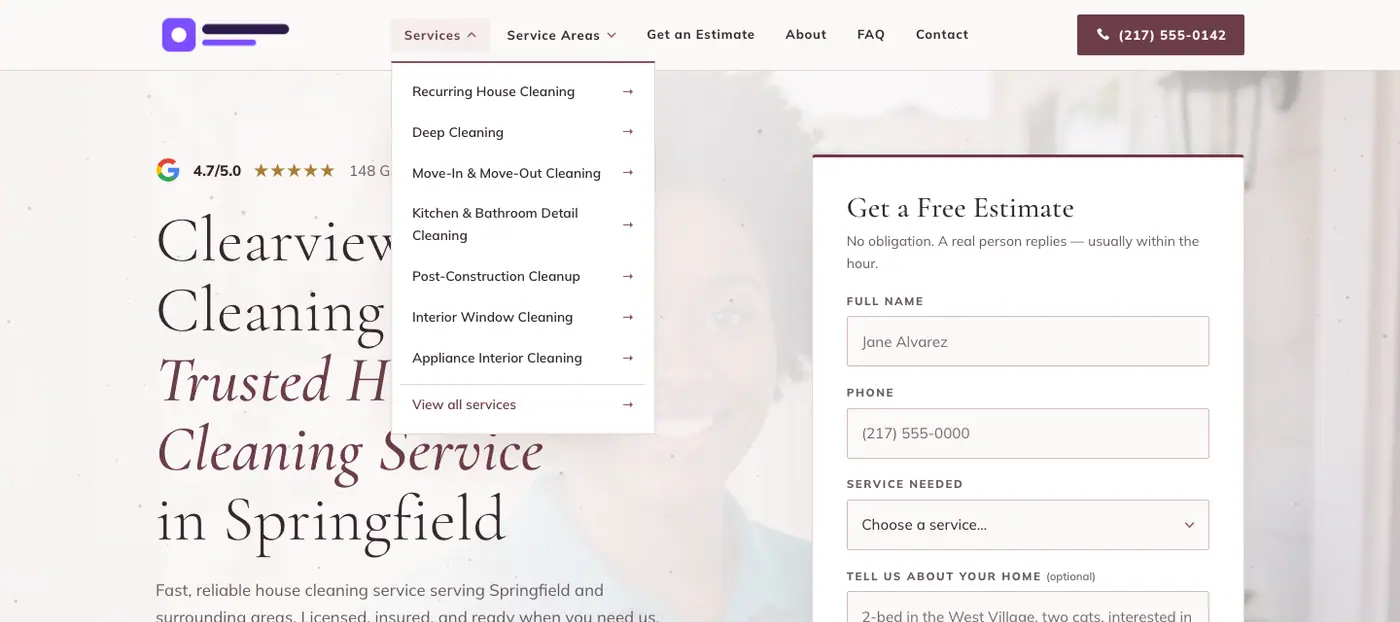
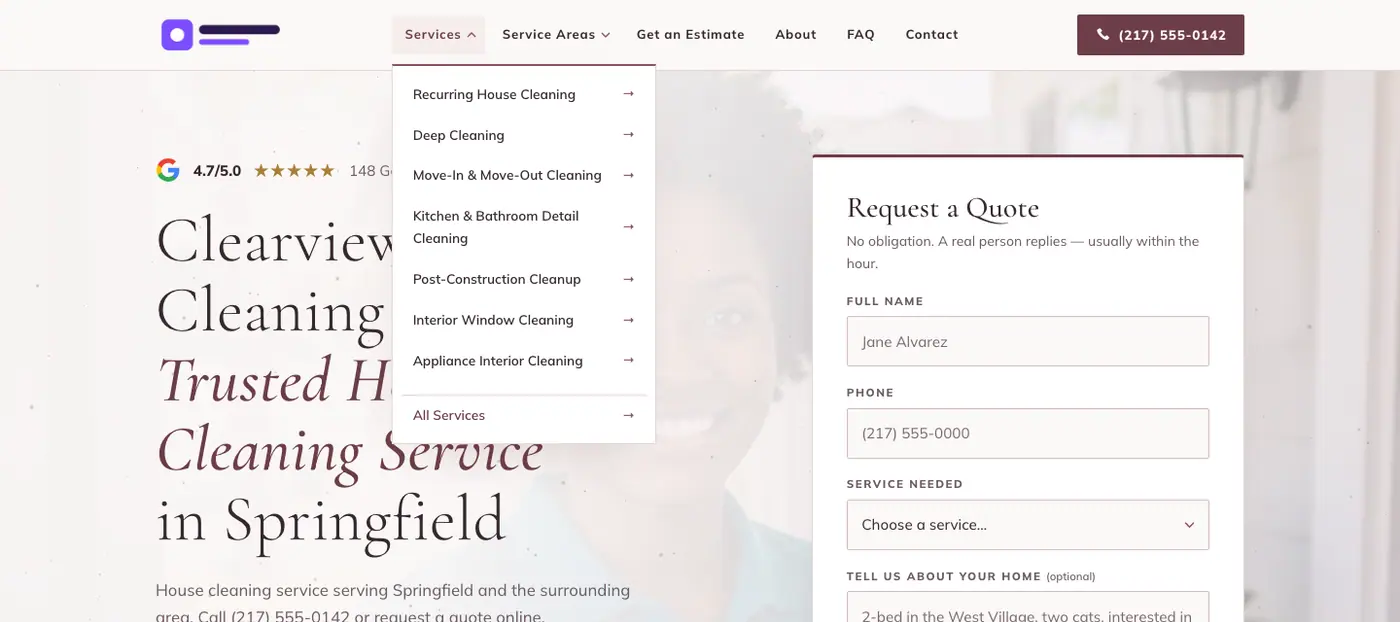
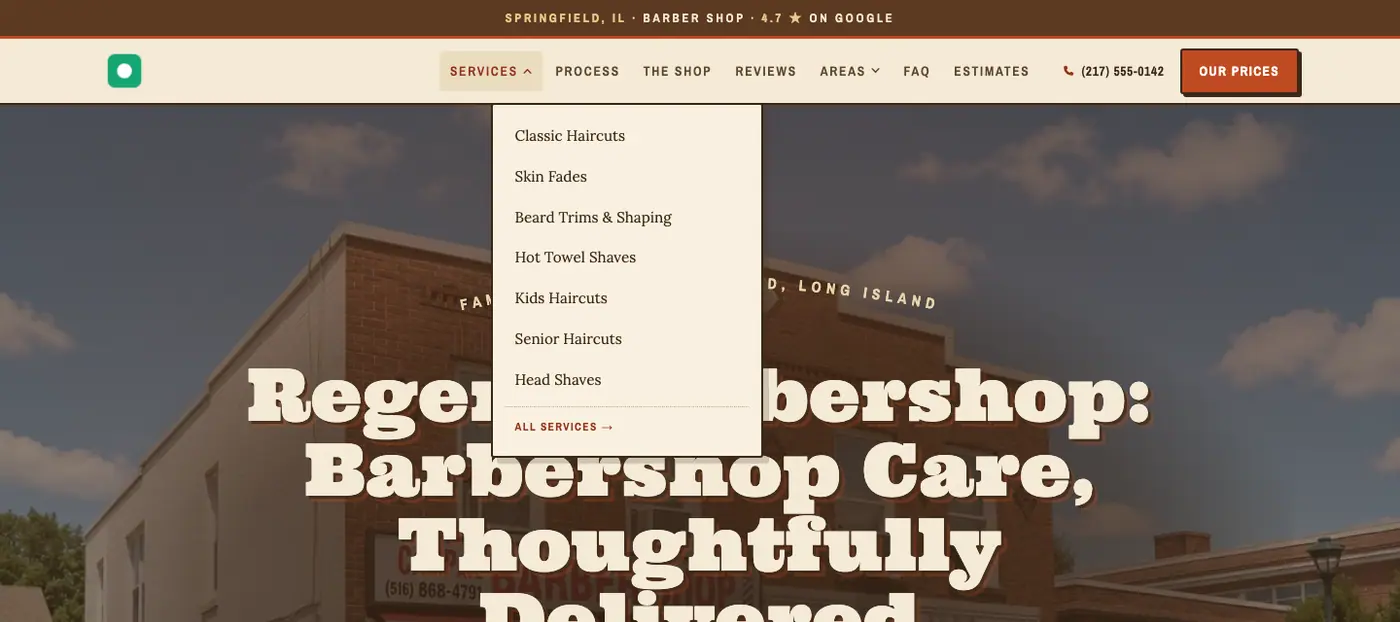
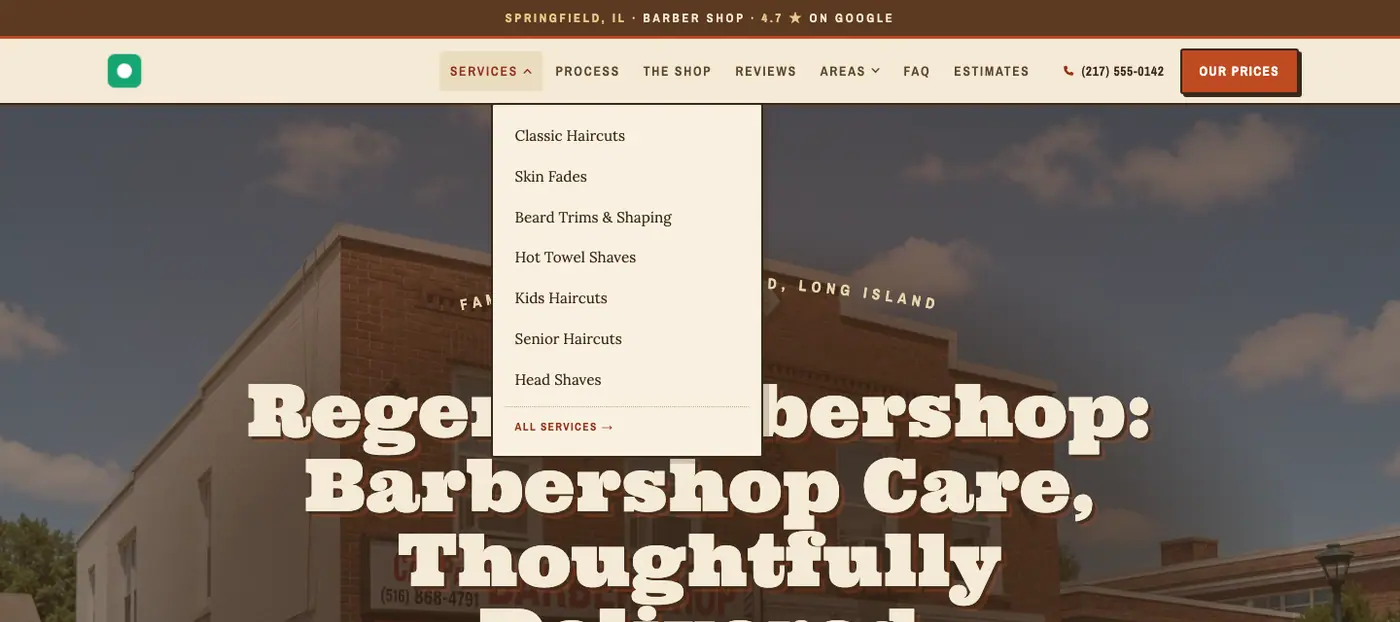
1 The Services menu is a real menu
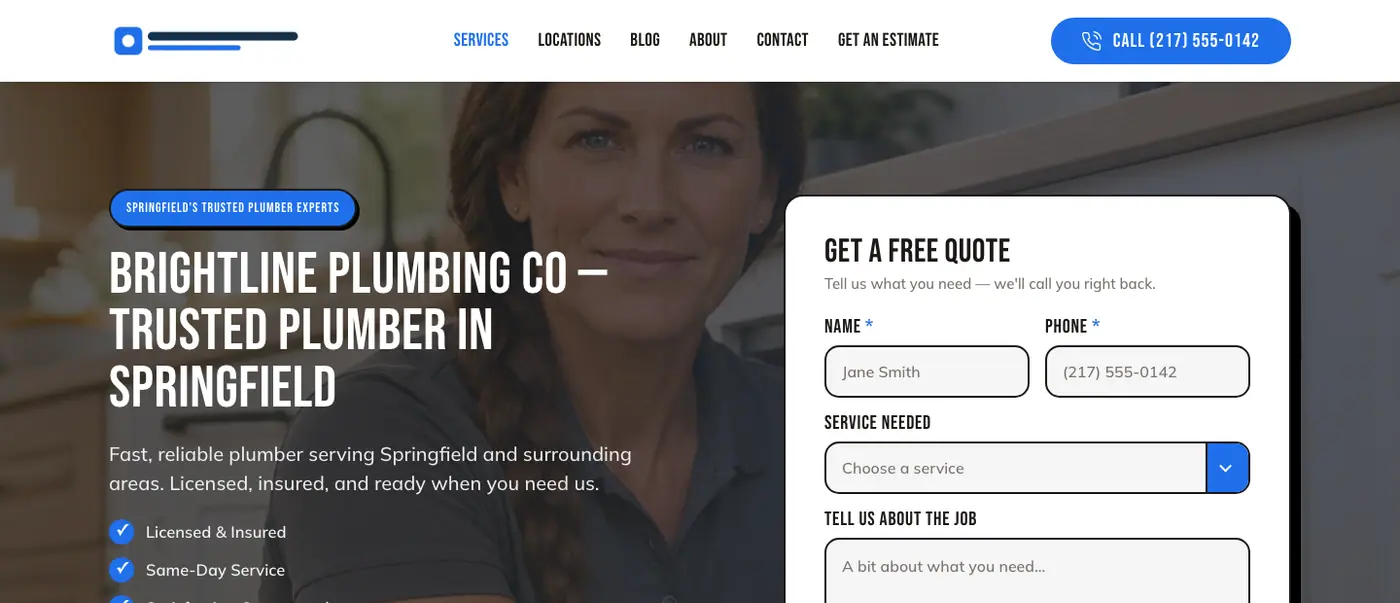
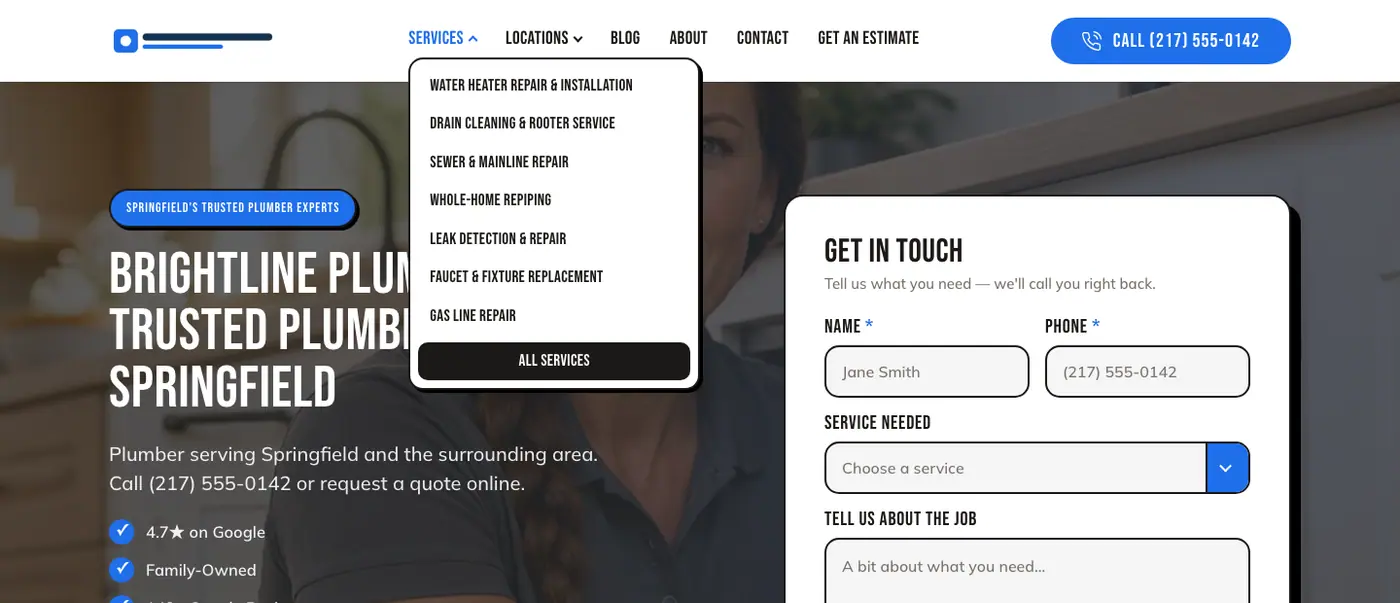
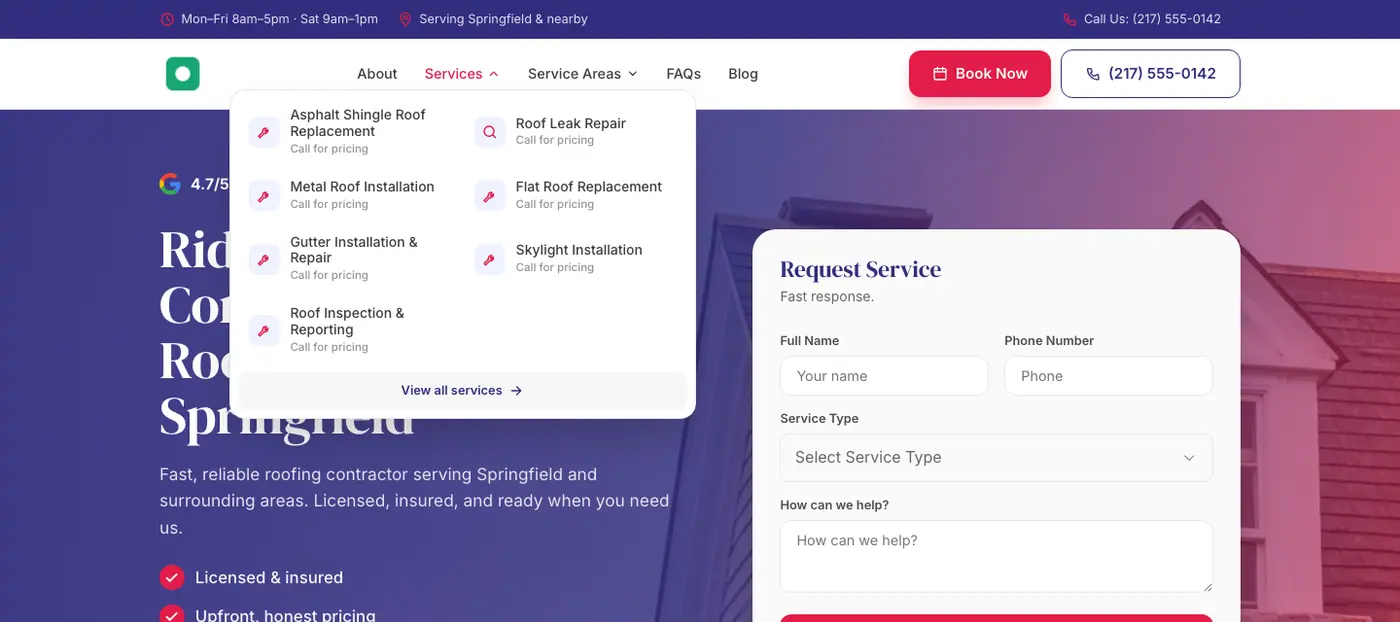
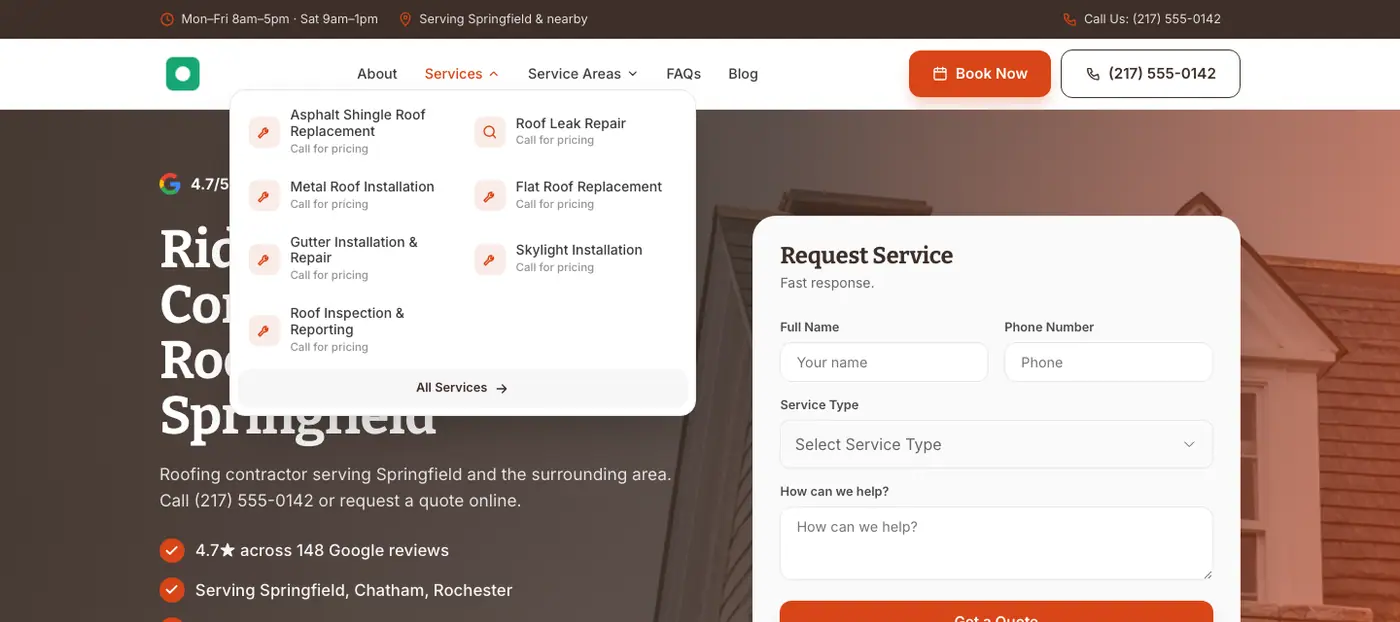
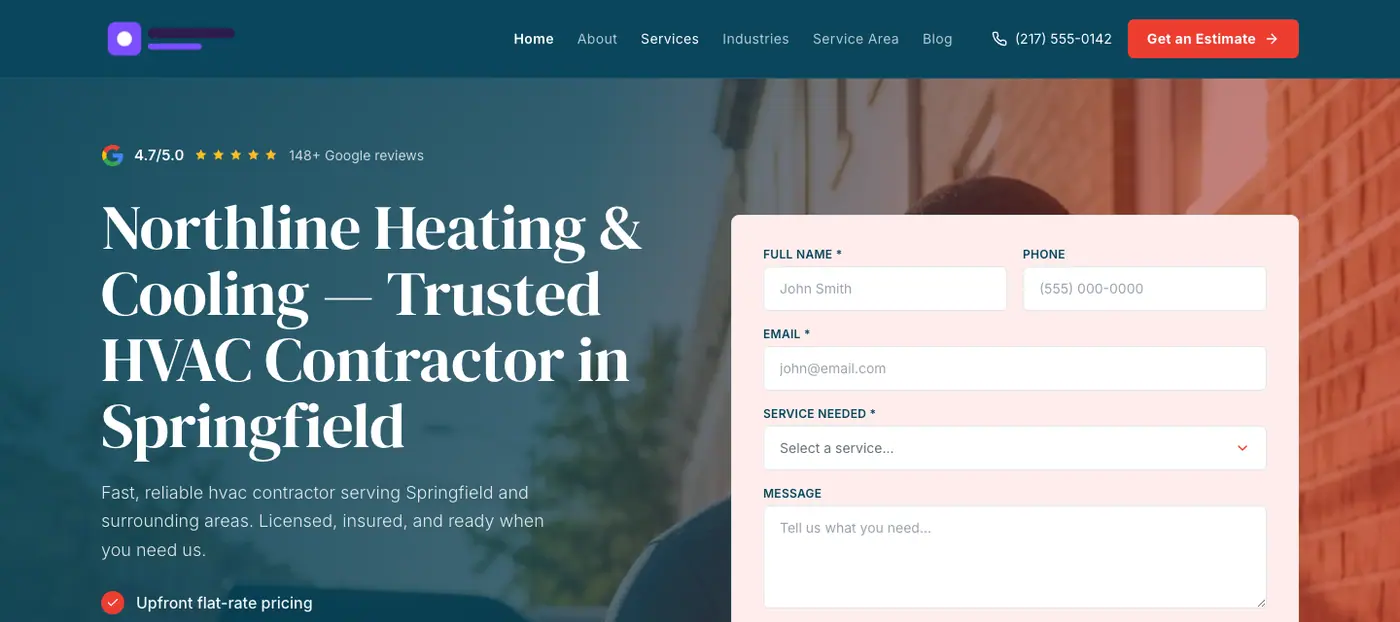
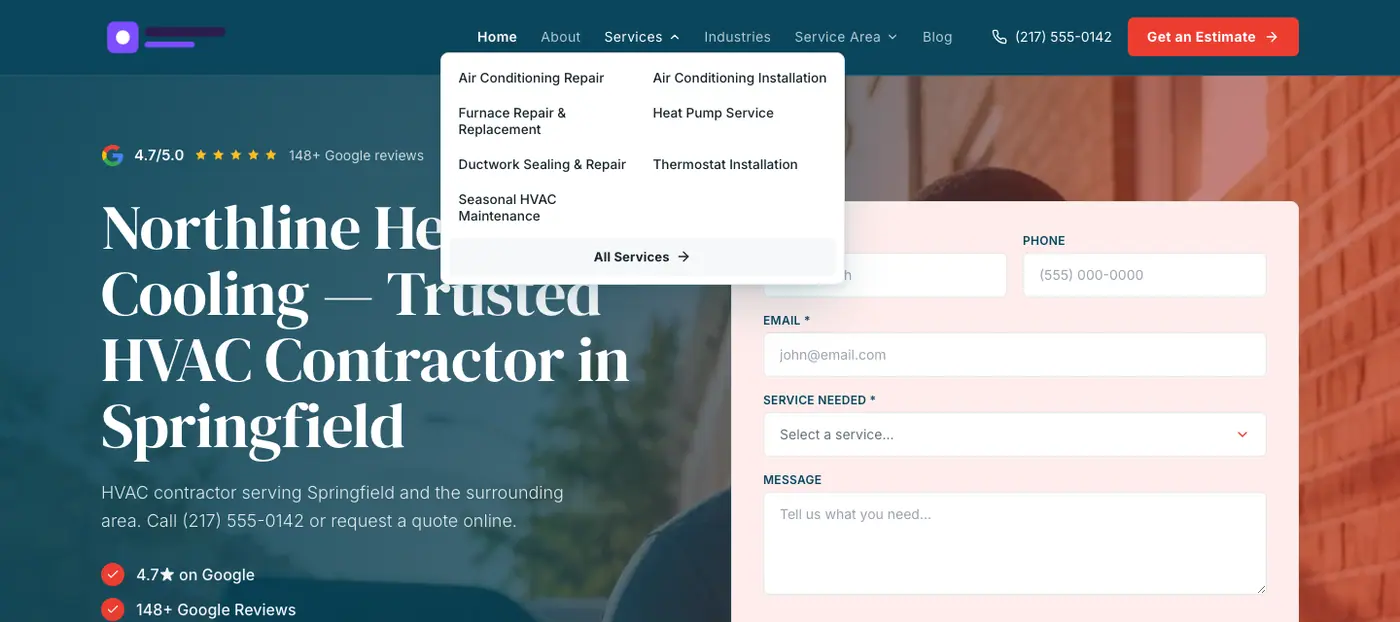
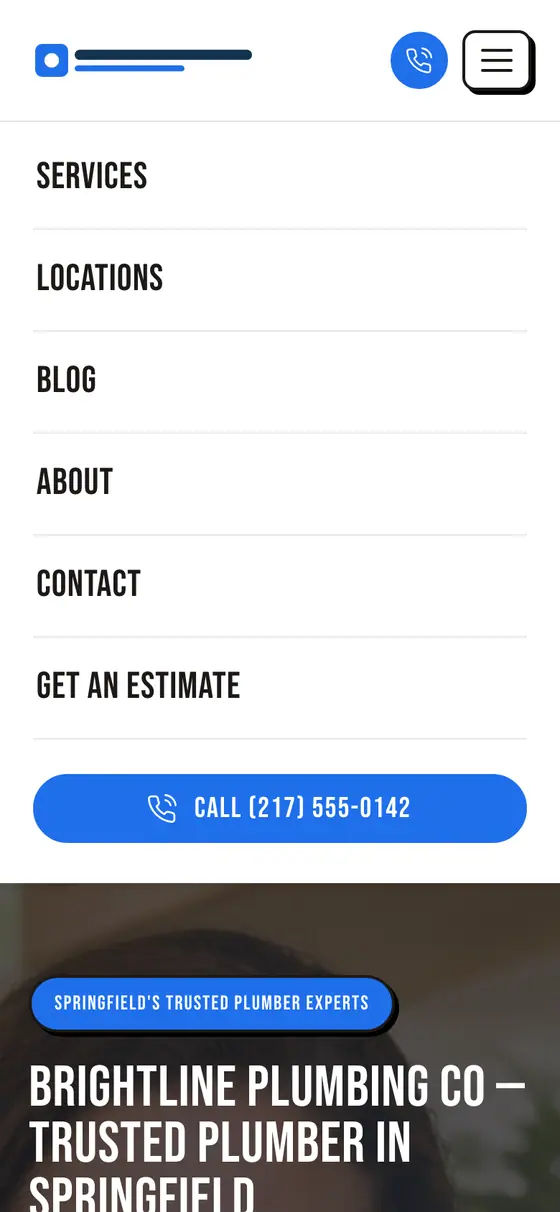
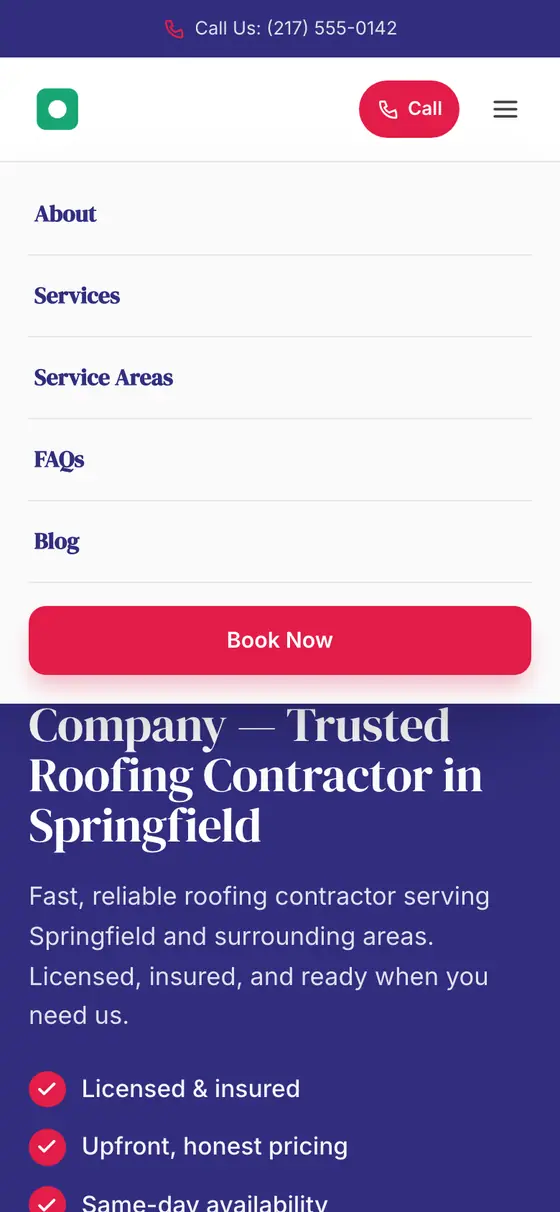
What was done. The top-level "Services" item is now a link to /services/ on every template, it opens a dropdown listing the business's own services, and the last row of that dropdown is always "All Services" — on desktop and in the mobile menu.
Why it matters. A visitor who wants the full list should never have to guess. For search, it also gives every service page a link from every page of the site, which is how a service page gets crawled and ranked instead of sitting orphaned.
Measured. Harness rules N1, N2 and D1. On the old code, home-1, home-2, pro-1 and pro-2 had no services dropdown at all; home-3 had one whose last row was a service, not "All Services".
home-1 "Bold Industrial", plumbing — hovering "Services" on the homepage. Before: nothing opens. After: seven services and an "All Services" row.
home-3 "Local Pro", roofing — the dropdown existed, but its last row was a service. Now it ends in "All Services".
home-2 "Clean & Trusted", HVAC — desktop.
home-1 at 390px, mobile menu open with the services group expanded.
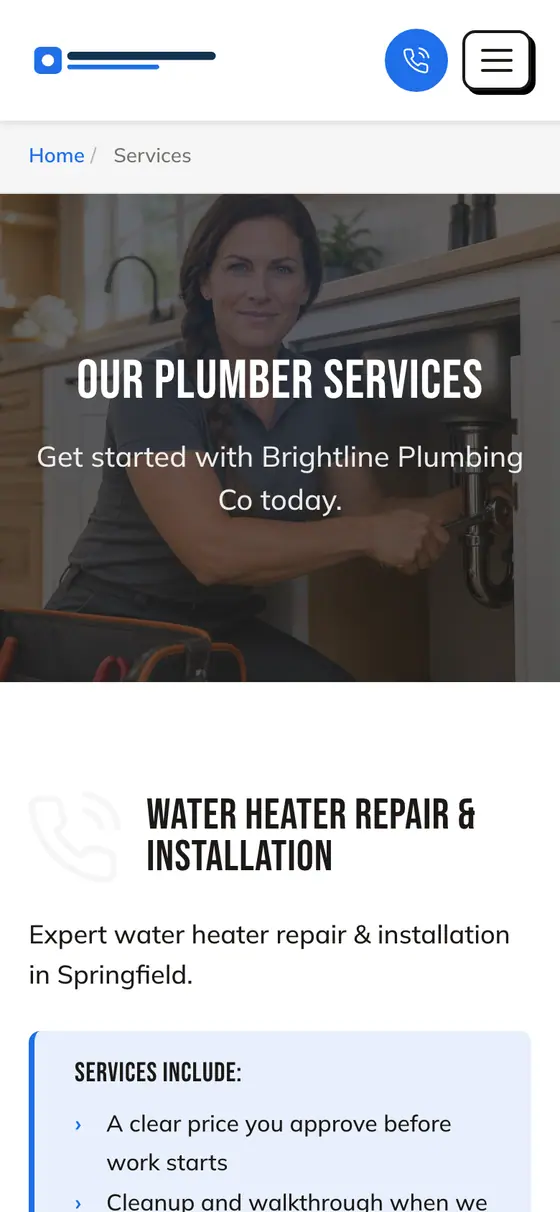
home-2 at 390px.
pro-2 "Modern Clinical", dental, at 390px.

primrose-cleaning (wave 4 showcase), cleaning.
campave-heritage (wave 6 showcase), barber.
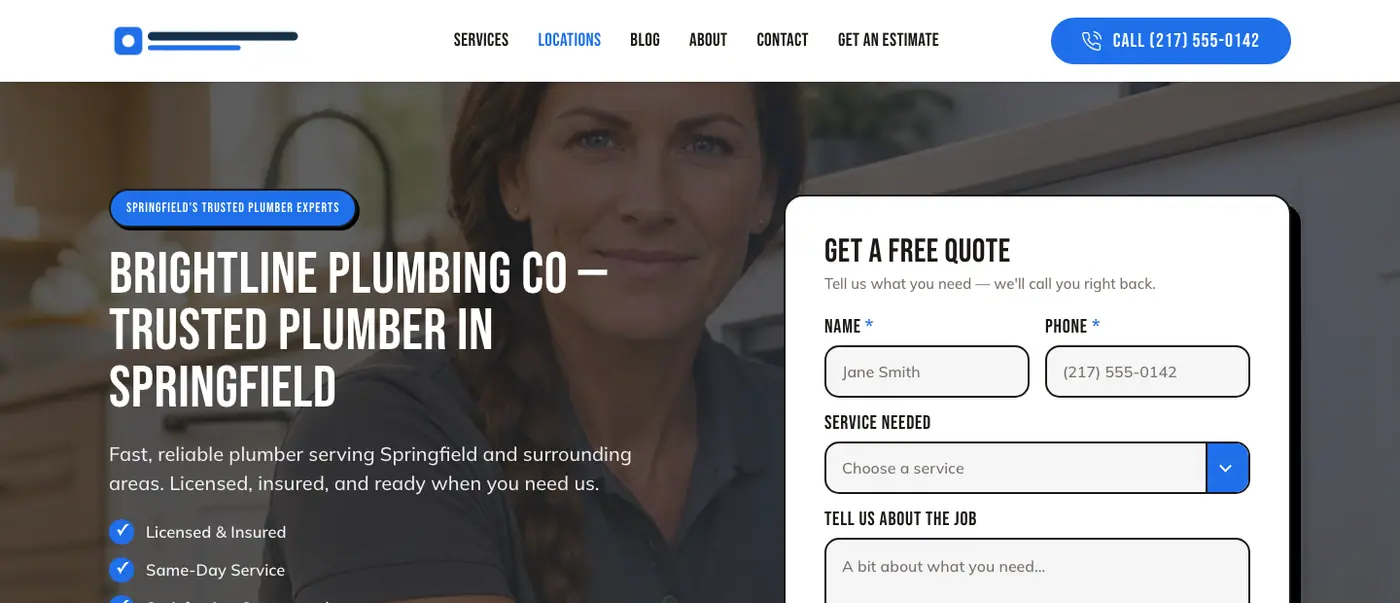
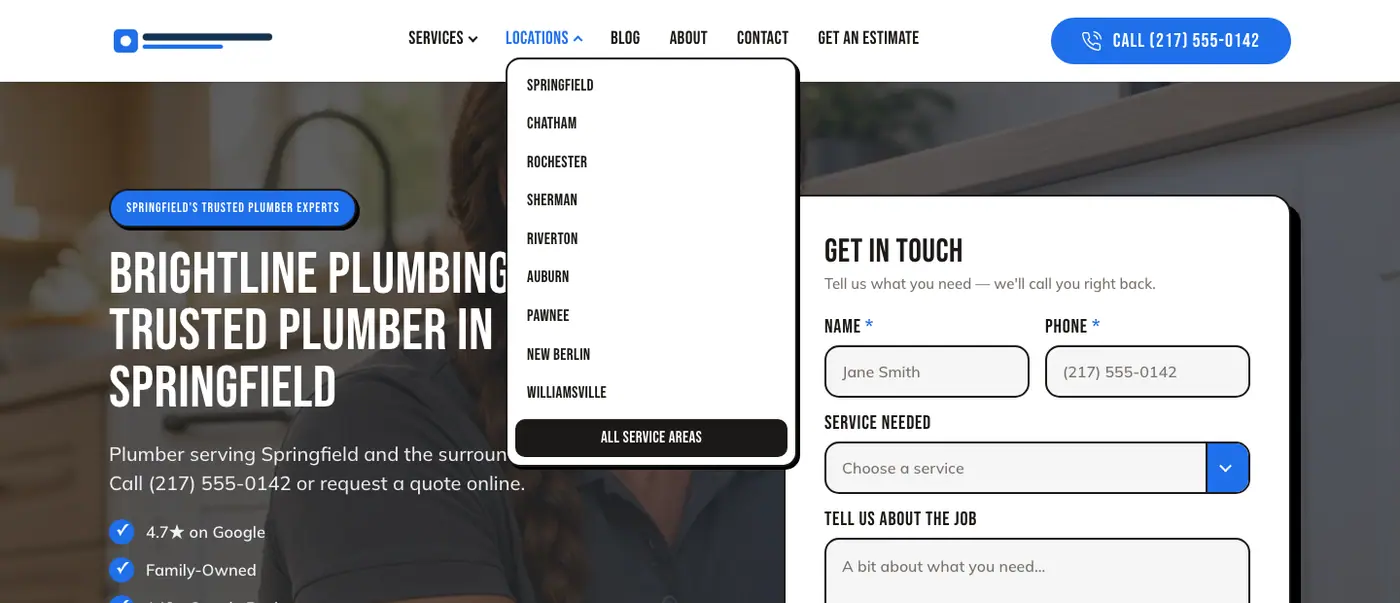
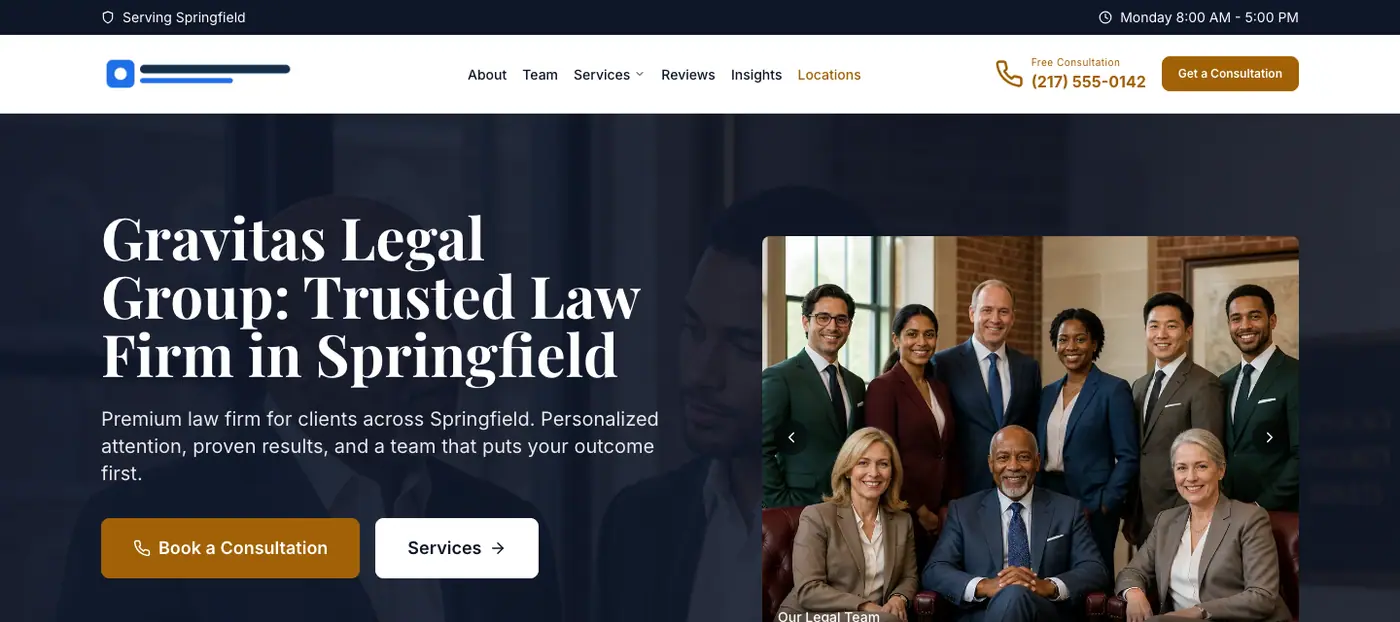
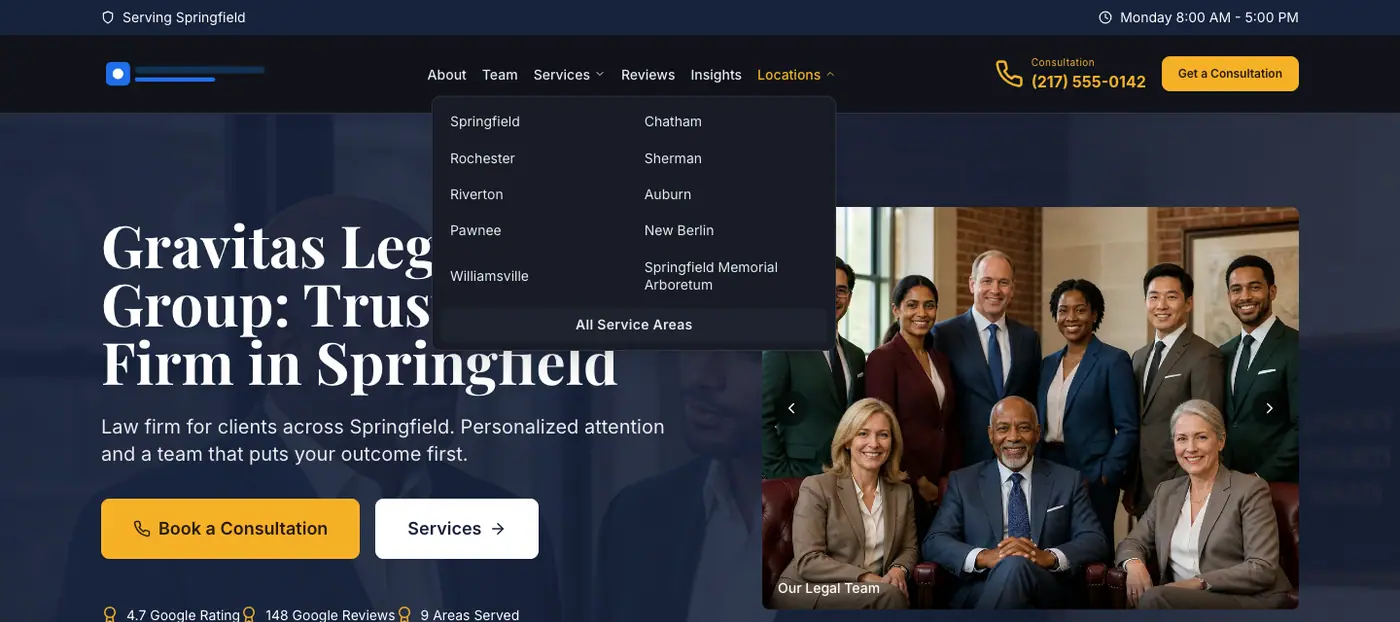
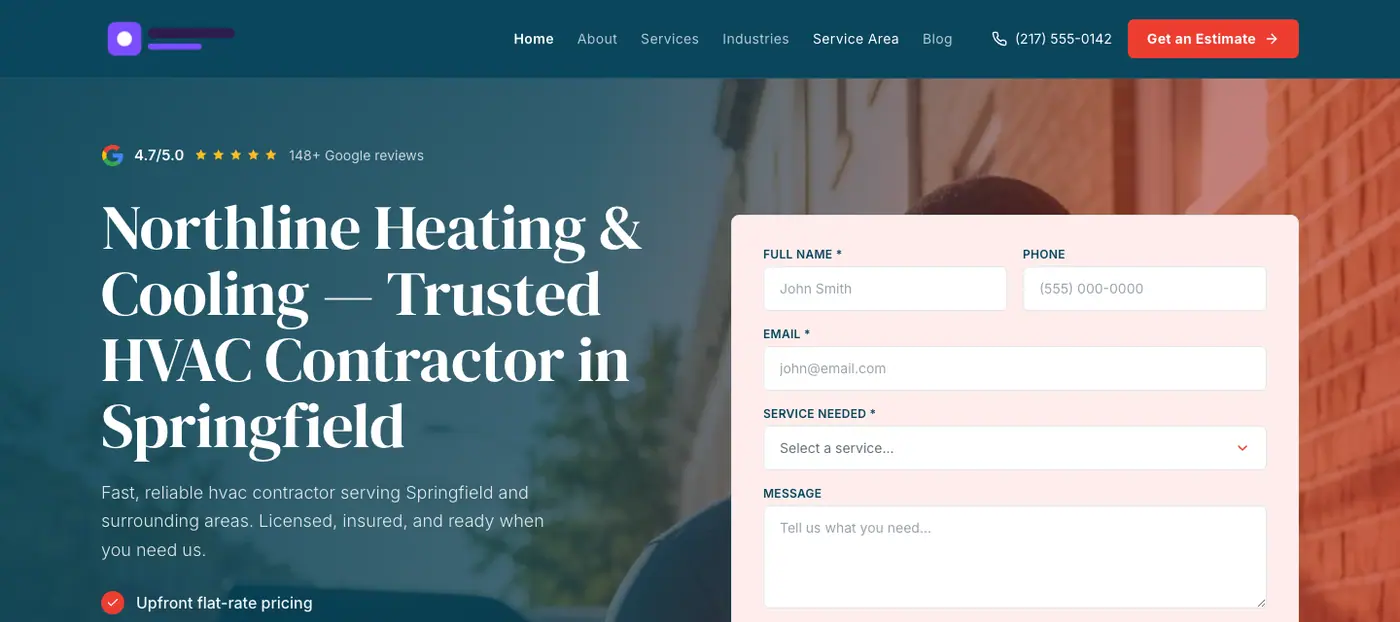
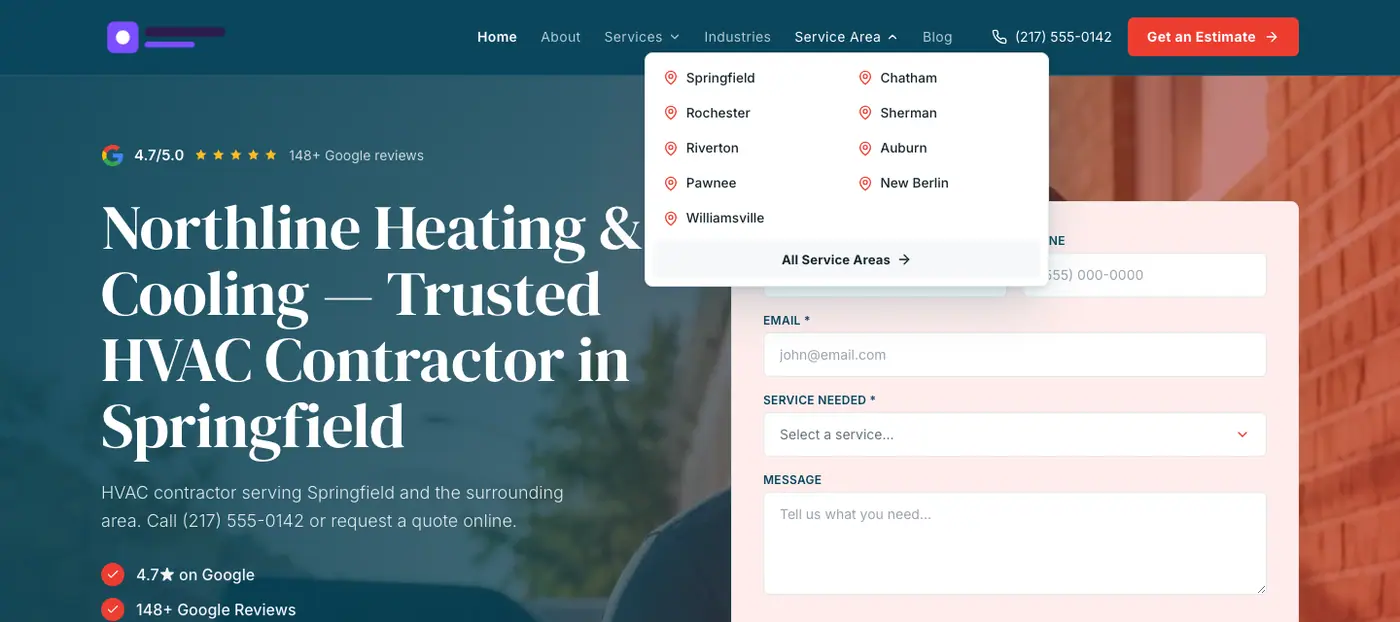
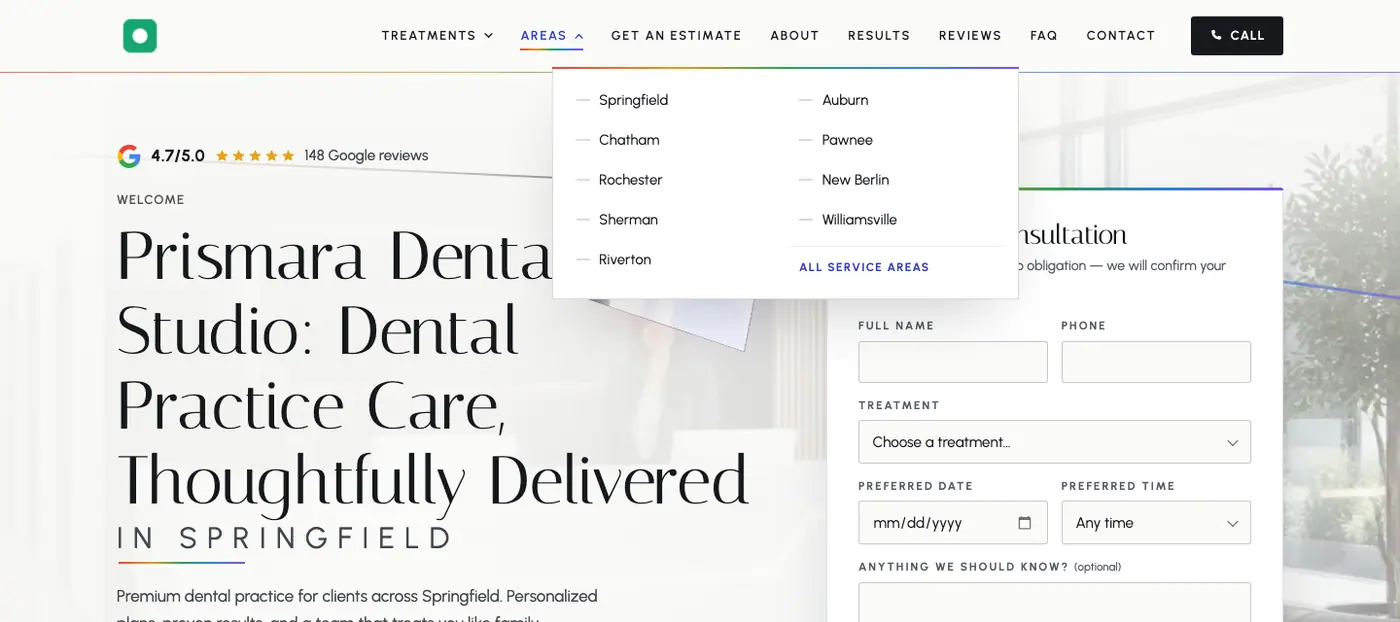
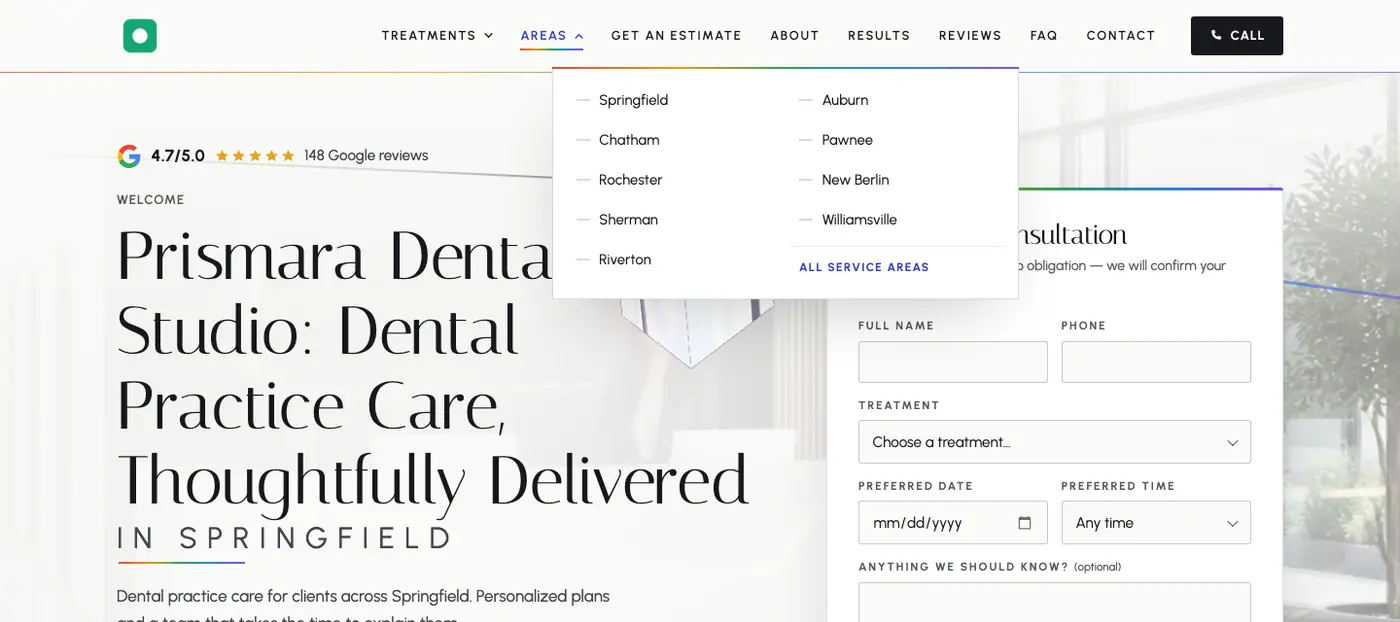
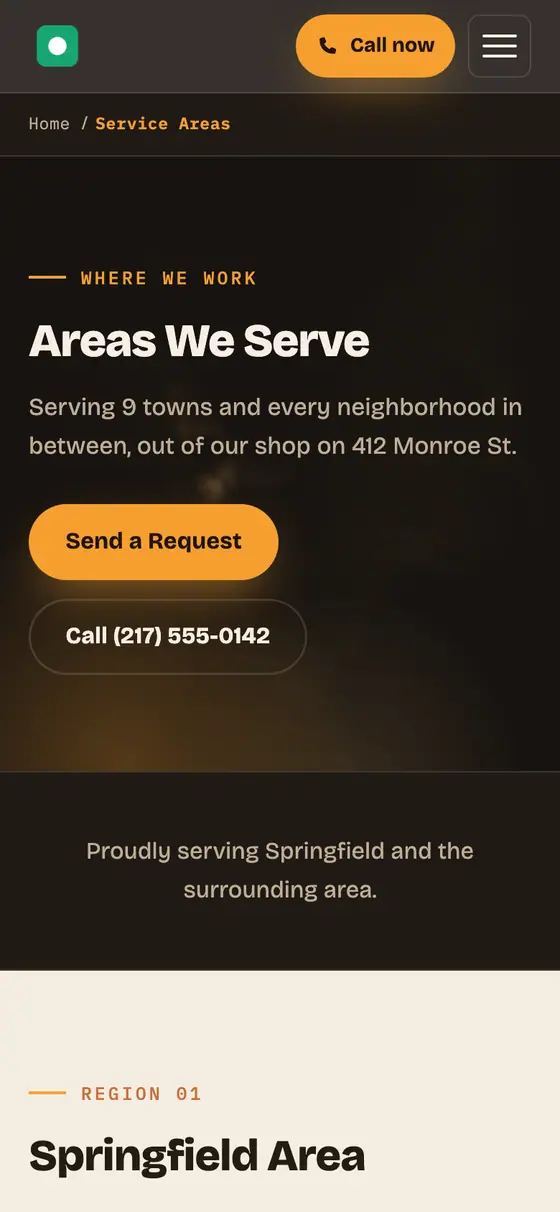
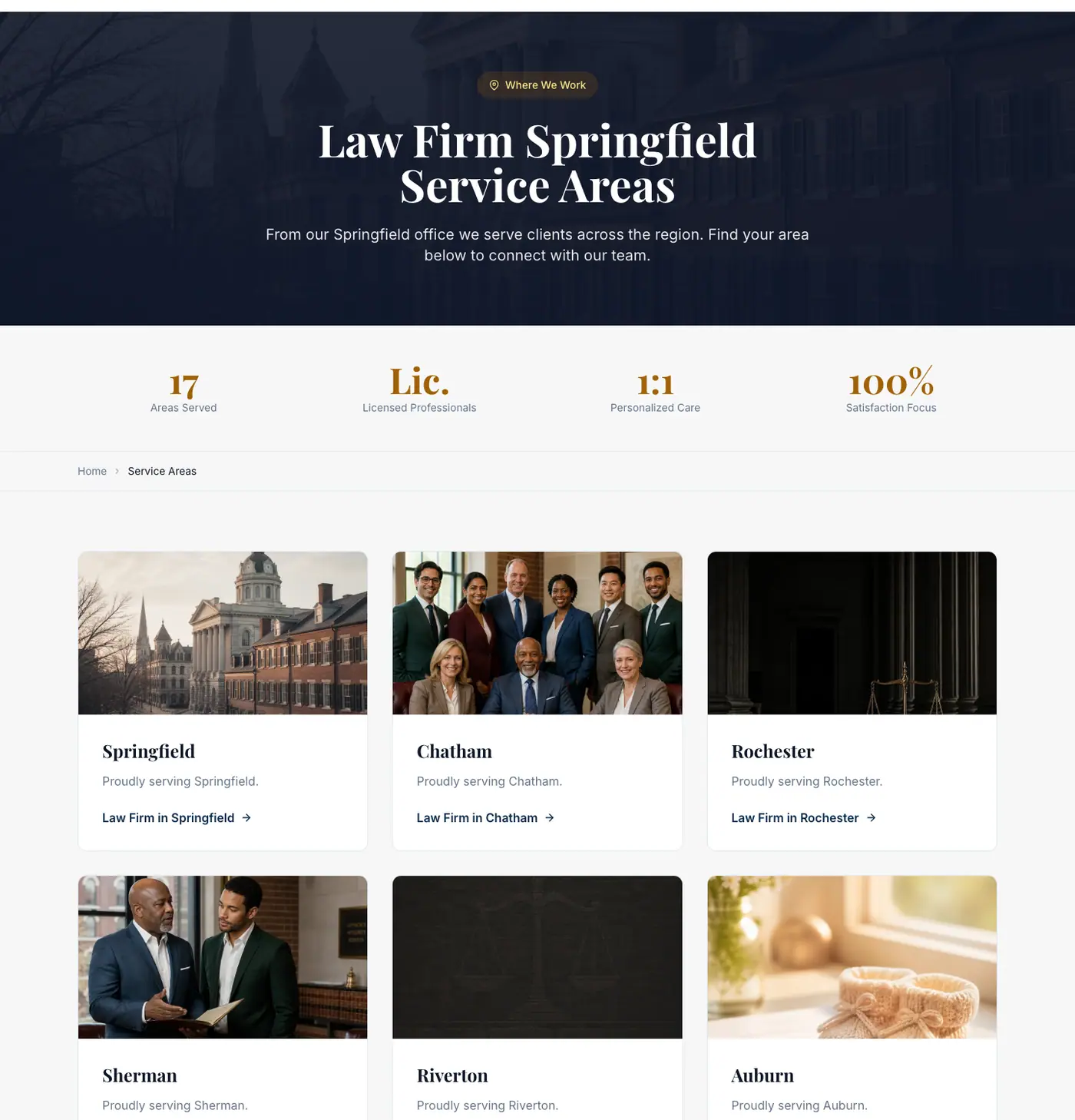
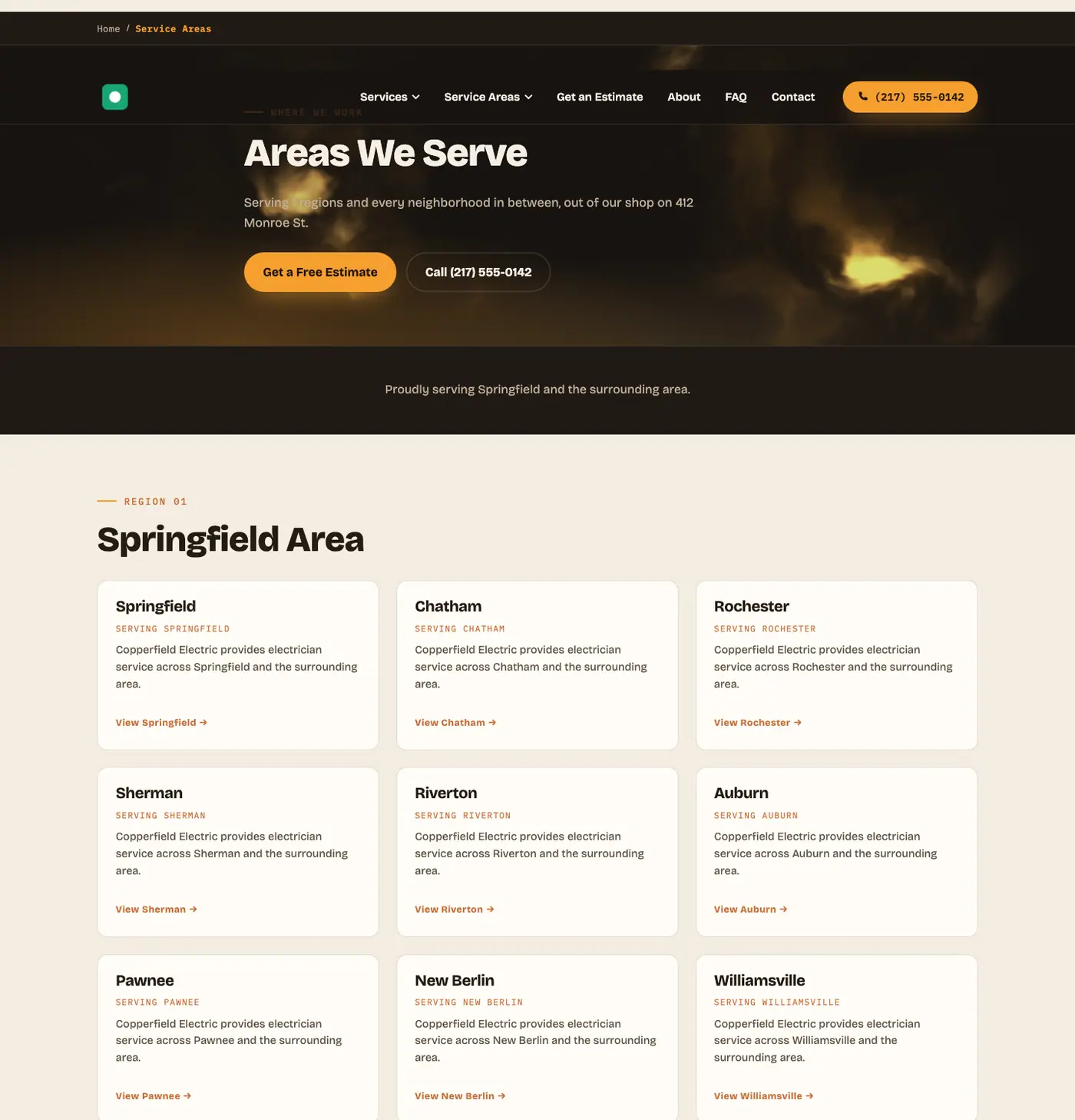
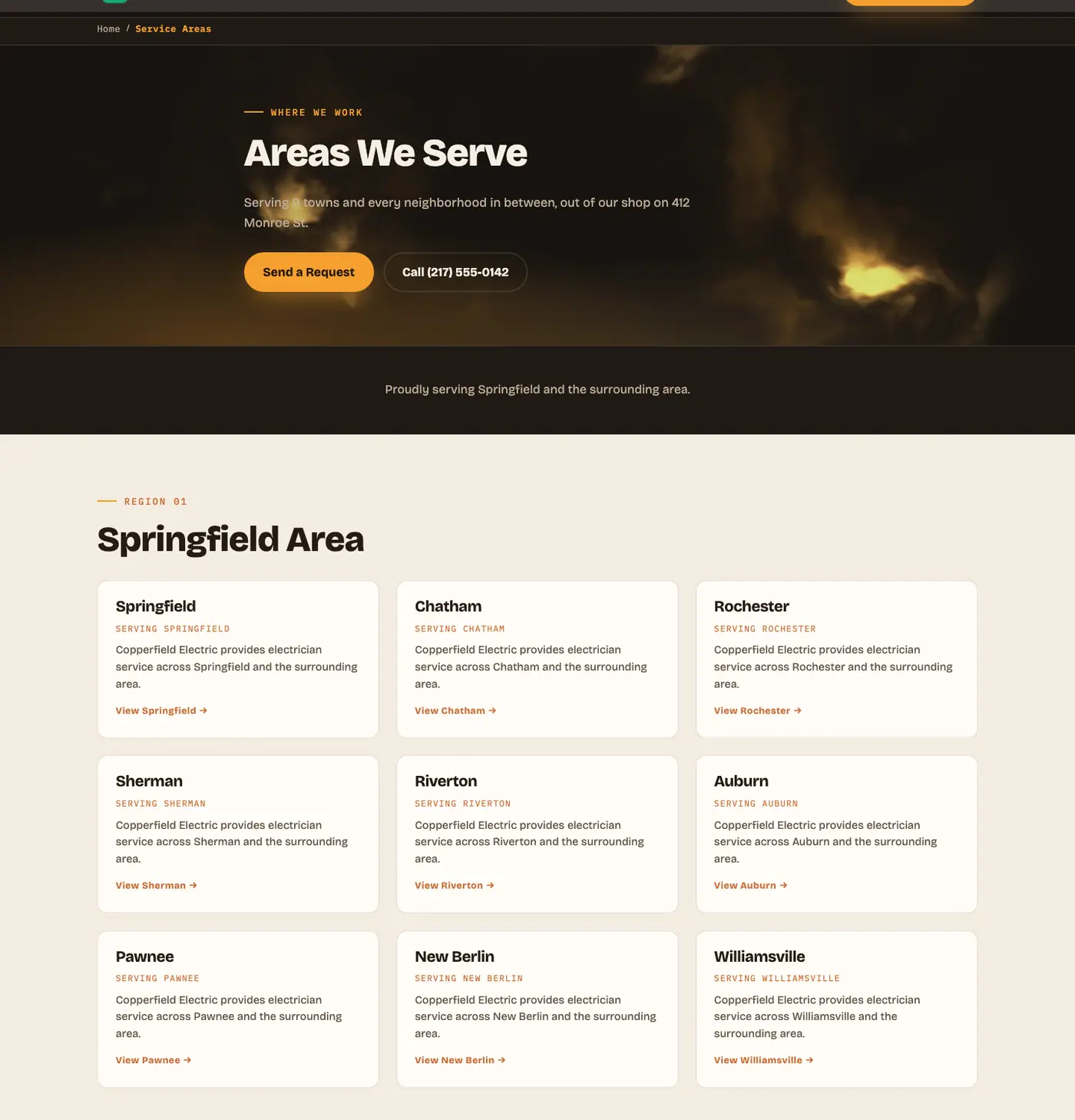
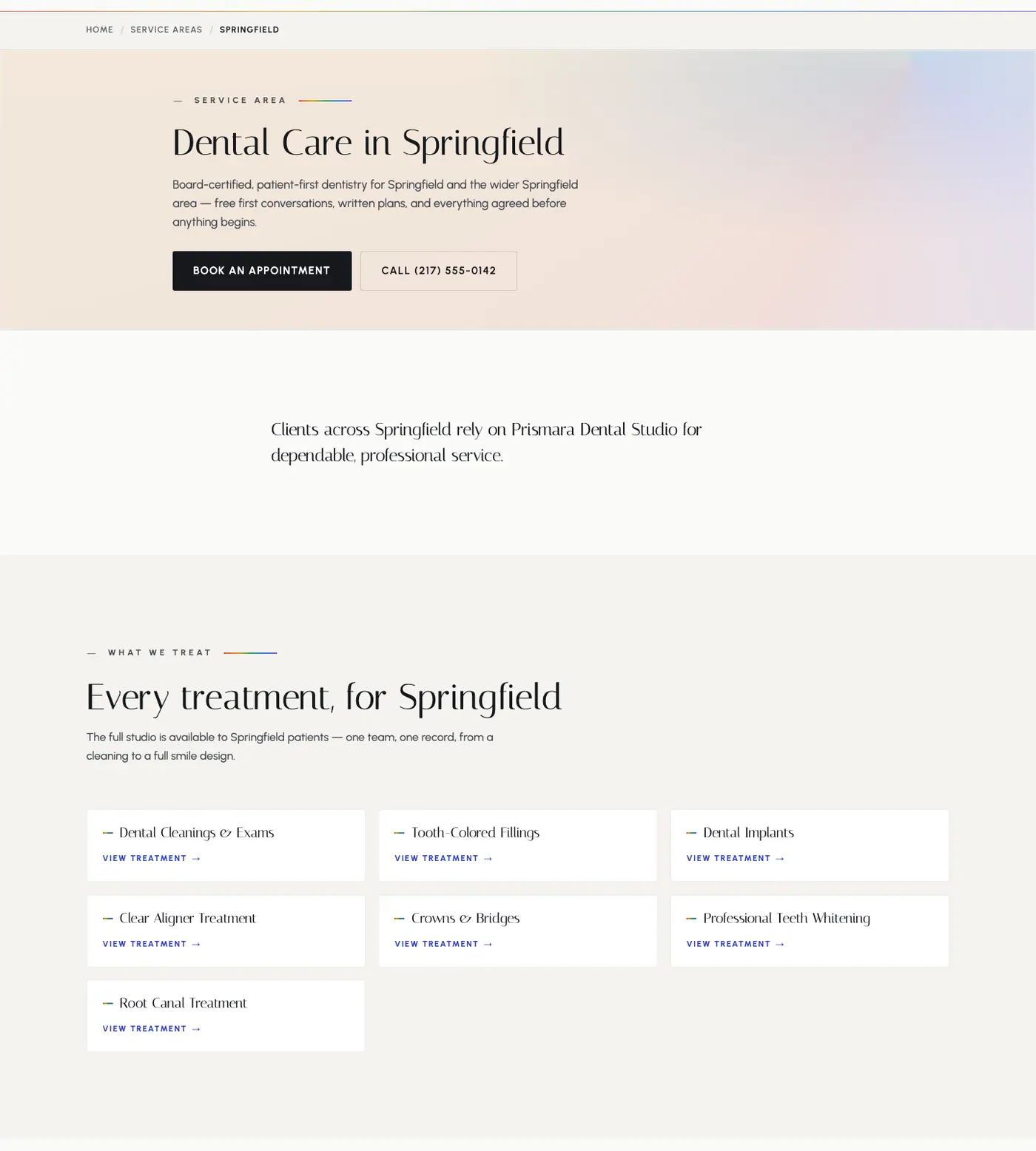
2 The Service Areas menu works the same way
What was done. Same rule for the areas menu: the top-level item links to the areas hub, the dropdown lists the towns, and the last row is "All Service Areas".
Why it matters. Service-area pages are the geographic half of the ranking plan. They only earn their keep if every page links to them, and if a visitor in a neighbouring town can find their own page in one hover.
Measured. Harness rules N1, N2, D1. Four of the five legacy families failed this before the sweep.
home-1 — "Locations" was a bare link with no menu.
pro-1 "Classic Authority", law.
home-2 — "Service Area".
prismara-dental (wave 5 showcase), dental.
copperline-electric (wave 4 showcase) at 390px, menu open.
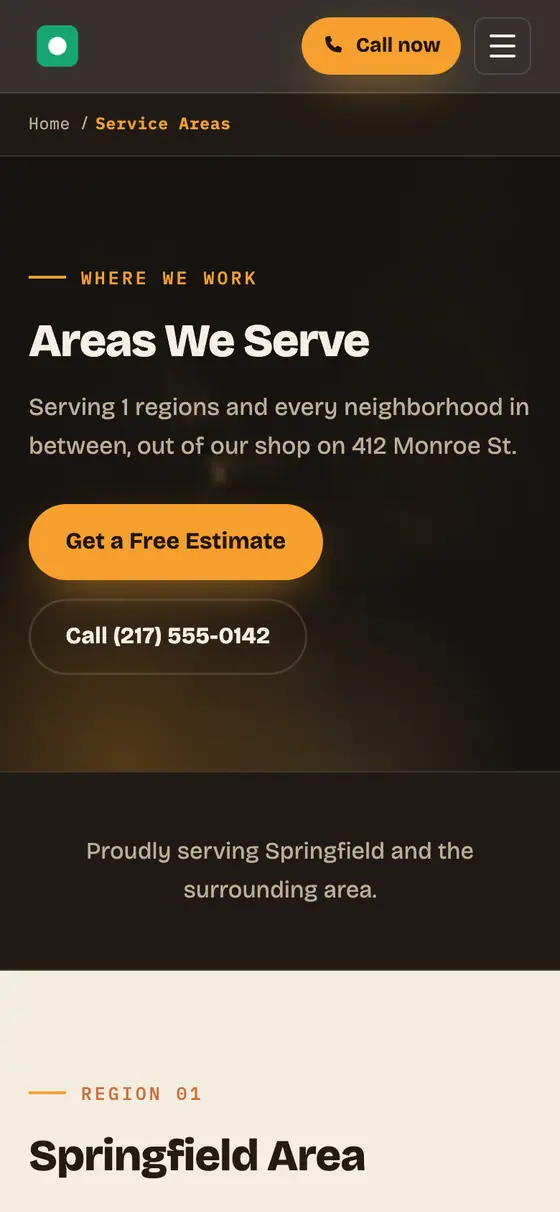
home-3 at 390px.
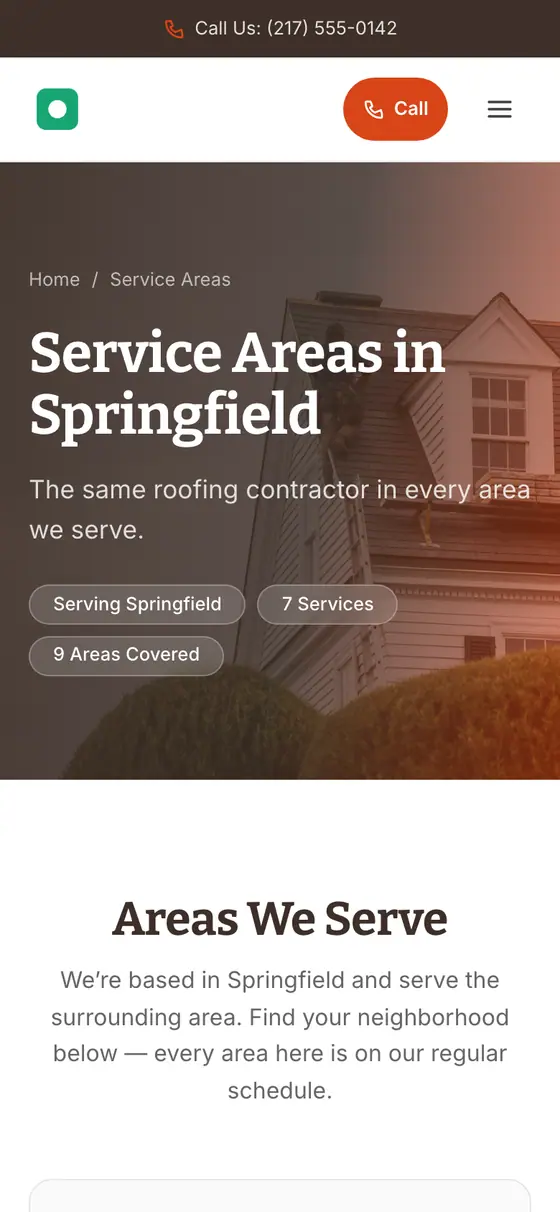
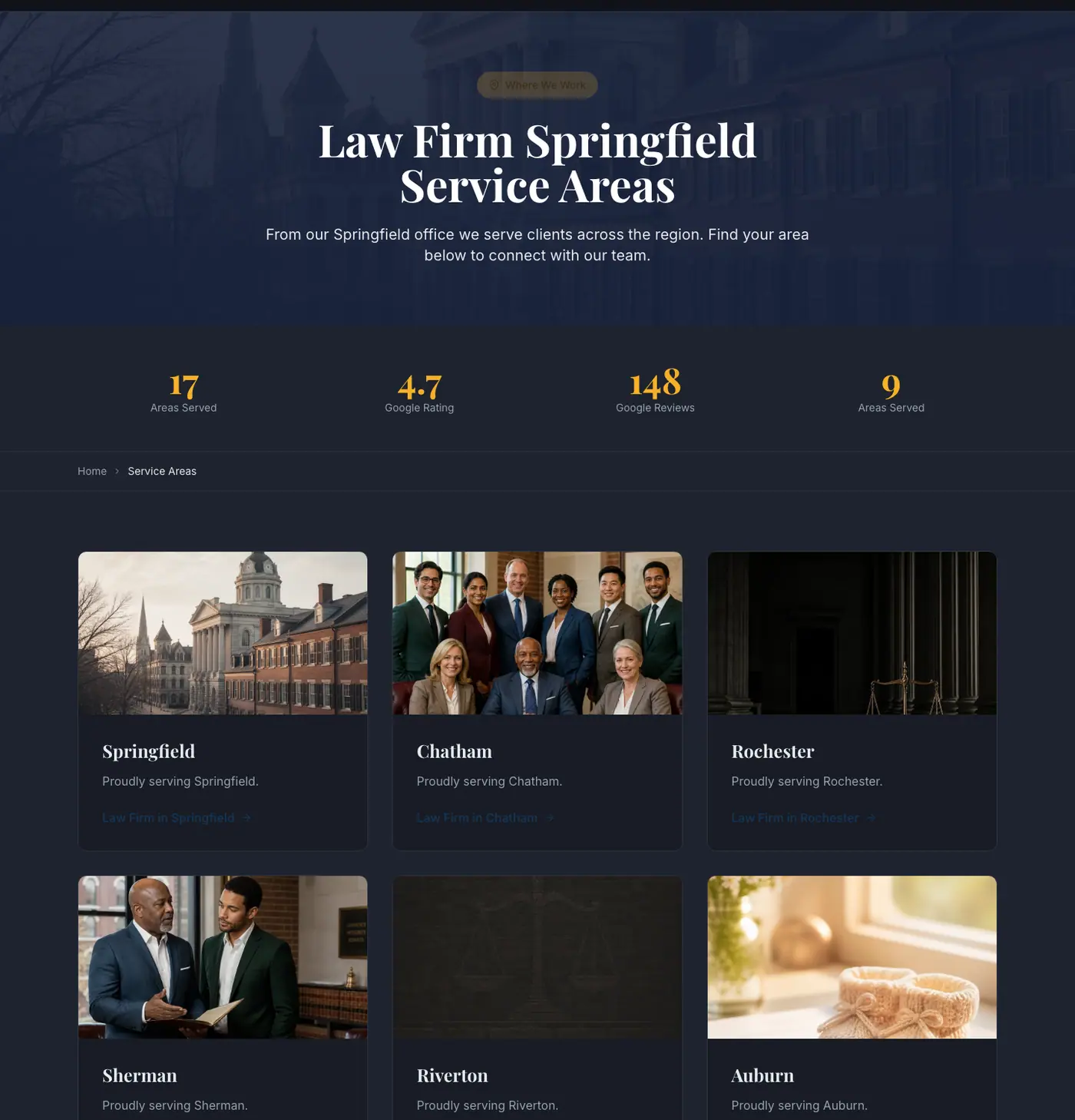
3 One area page per town, and every one of them linked
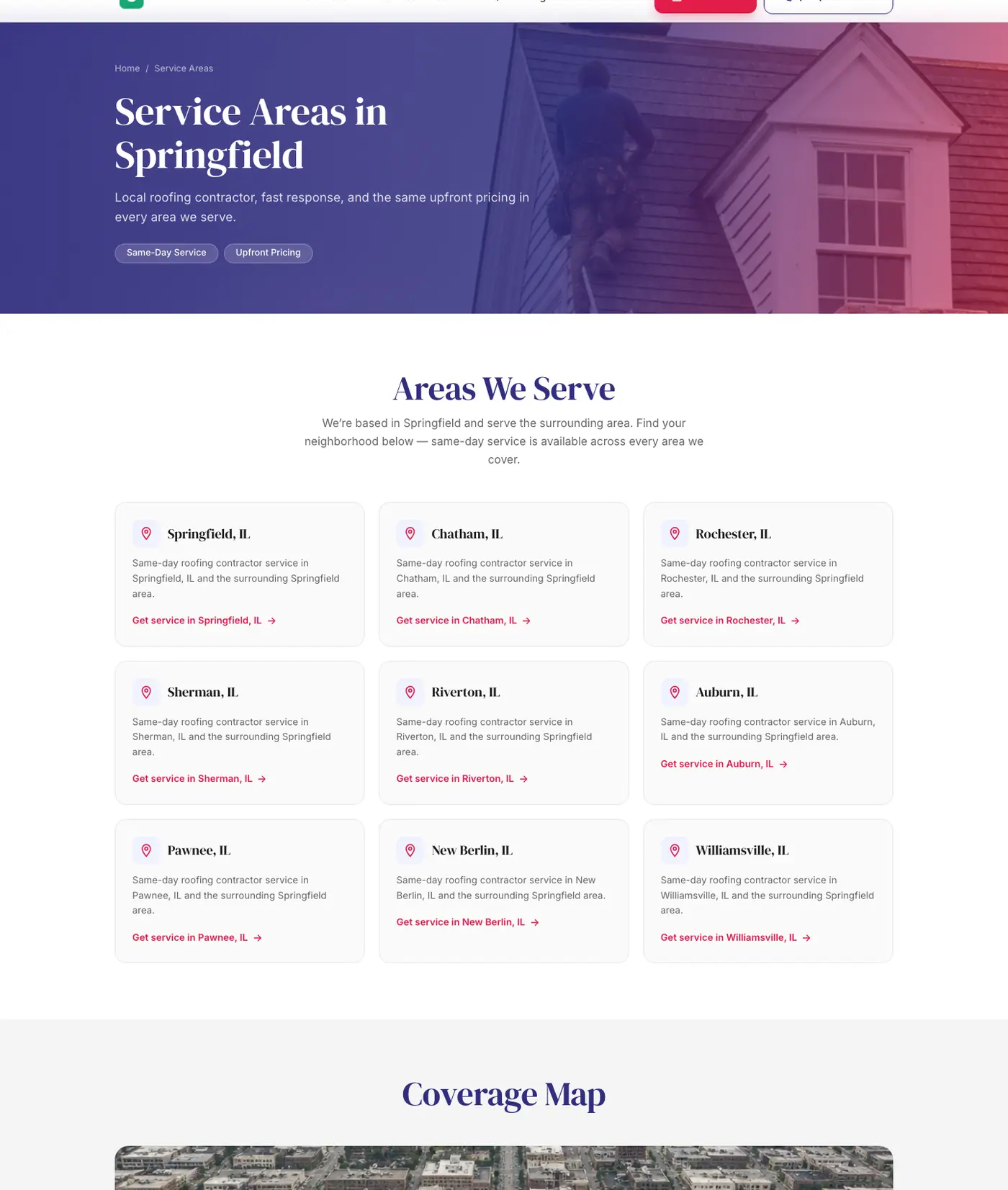
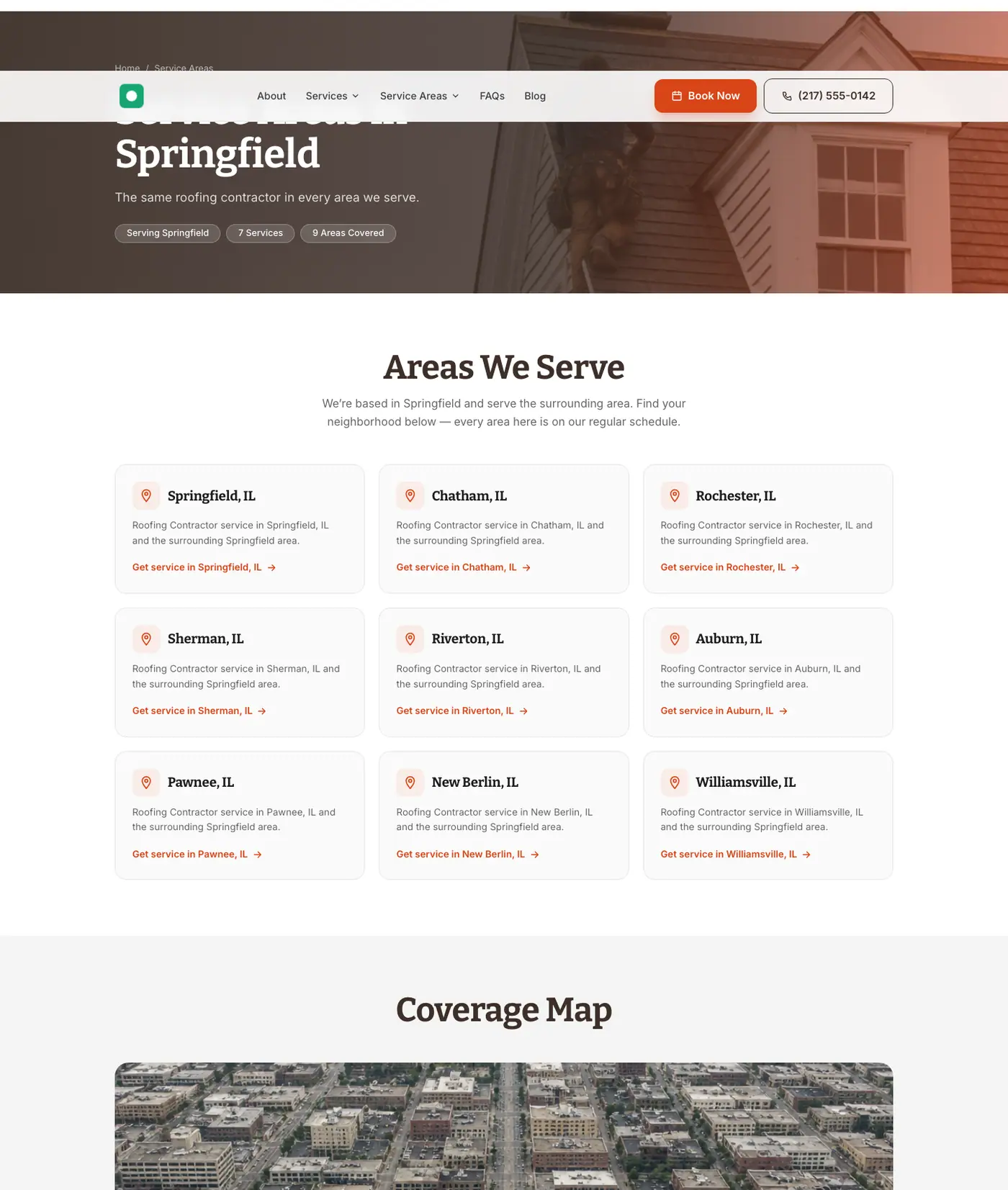
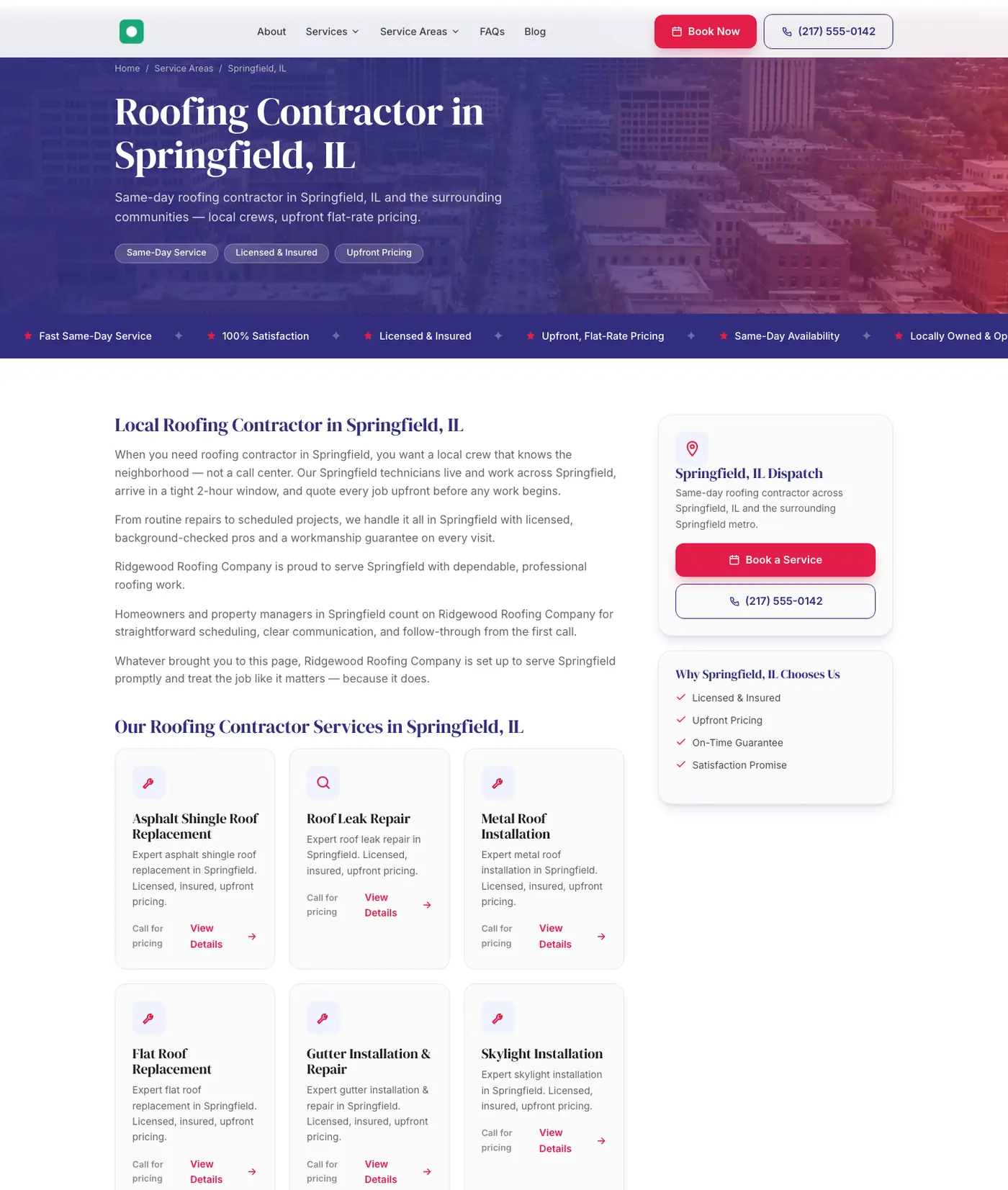
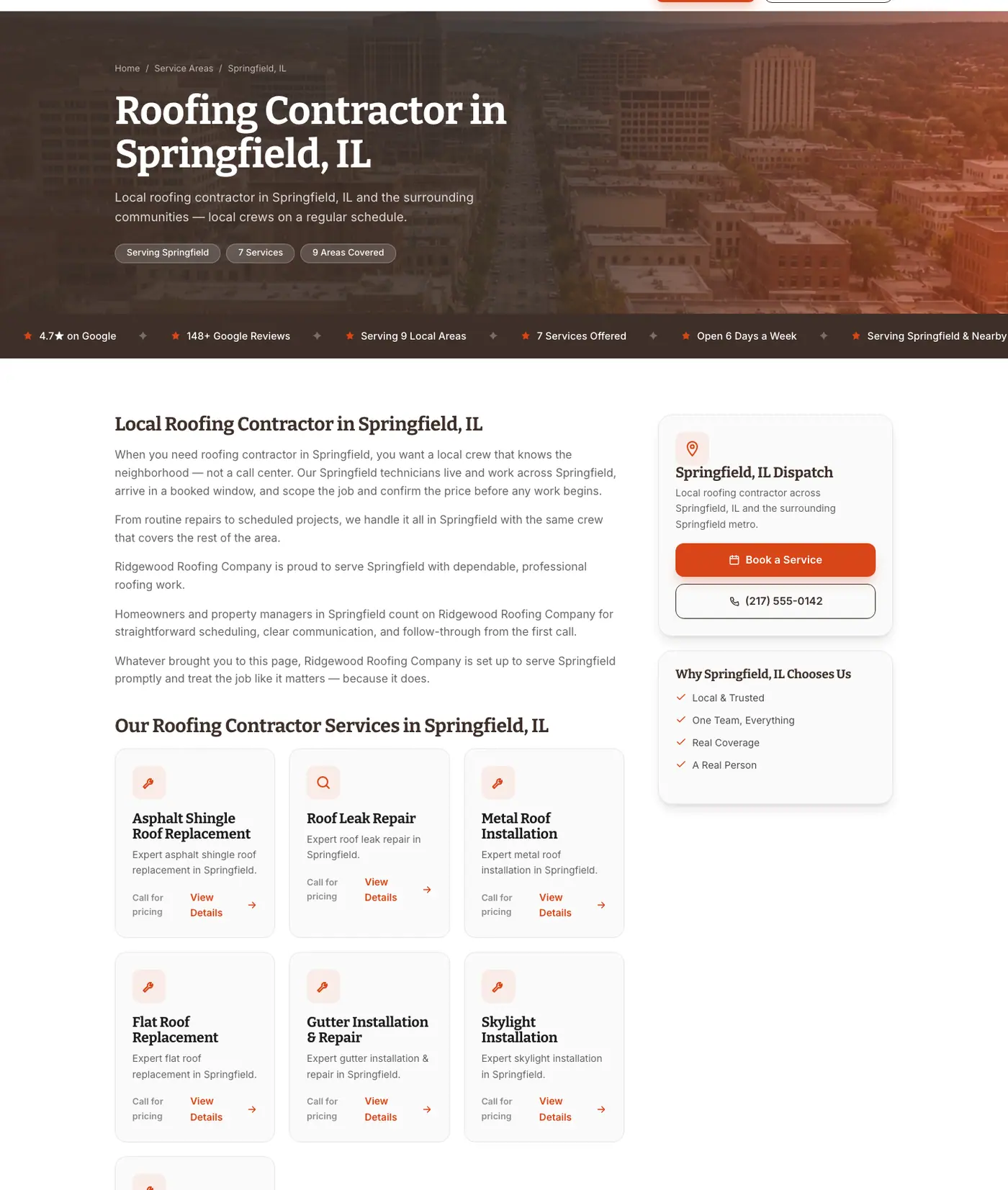
What was done. Every variant ships an areas hub plus one page per town. On the old code home-3 built two pages for every town — /locations/springfield/ and /locations/springfield-il/ — and the nine plain-slug pages were linked from nowhere at all.
Why it matters. Two pages for one town split the signal and compete with each other. A page nothing links to is, for a crawler, almost a page that does not exist. One town, one page, linked from the hub and the menu.
Measured. home-3 area pages: 27 → 18 (nine duplicates removed). Orphan pages on home-3: 9 → 0. Harness rules A1 and L3.
home-3 areas hub. The hub looked fine before — the damage was invisible on the page: a second, duplicate page existed for each of these nine towns.
home-3 area page for Springfield.
pro-1 areas hub.
copperline-electric areas hub.
prismara-dental area page.
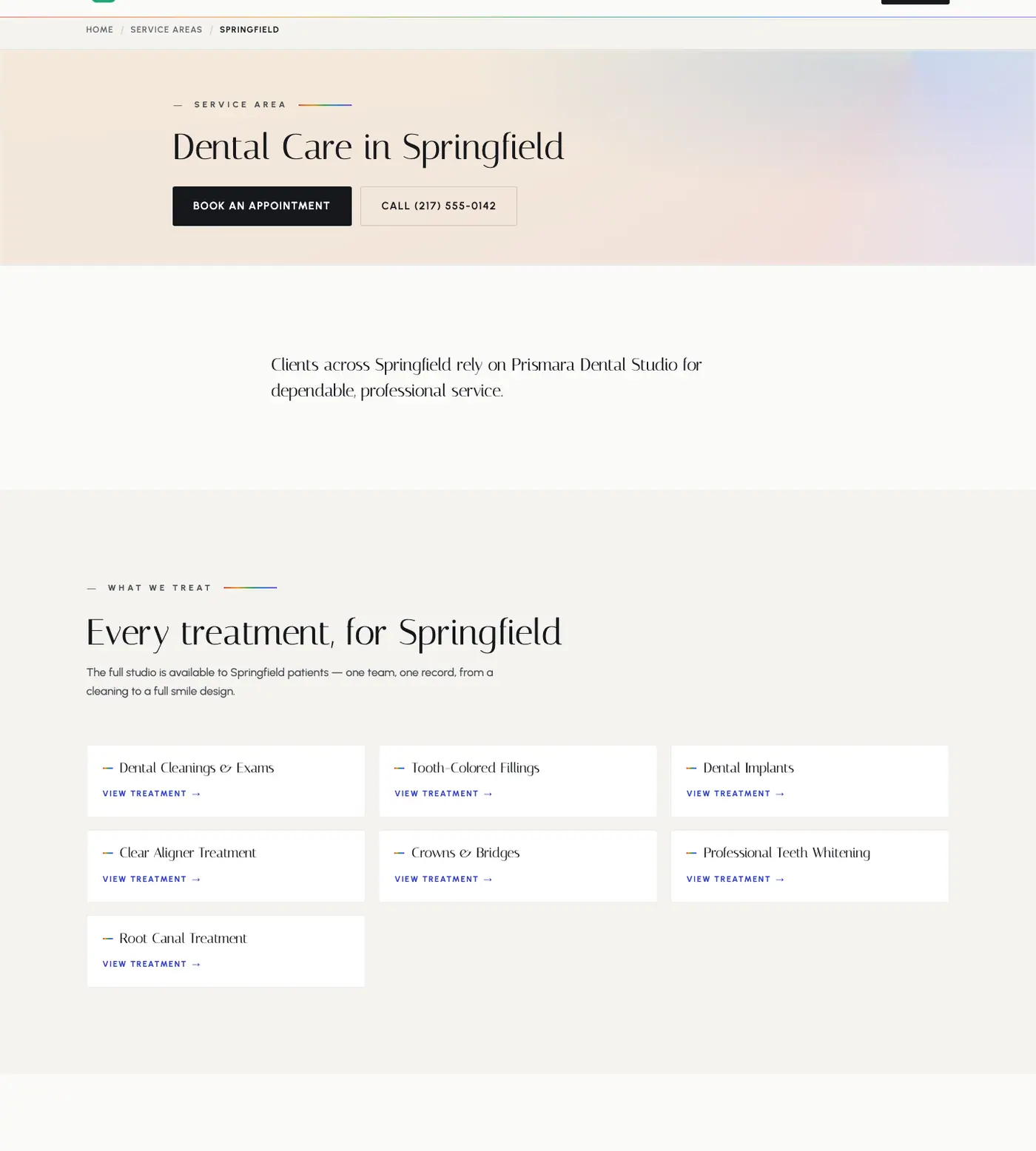
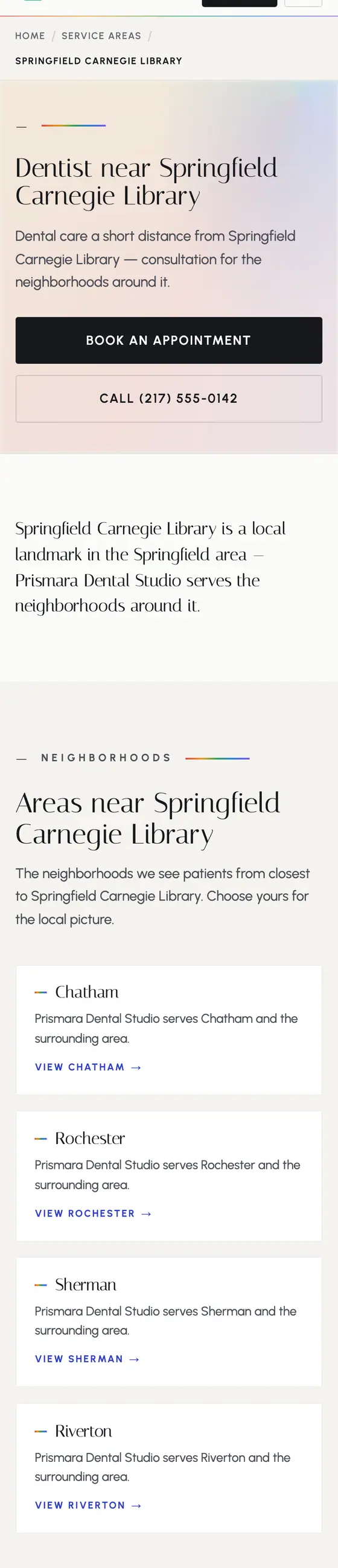
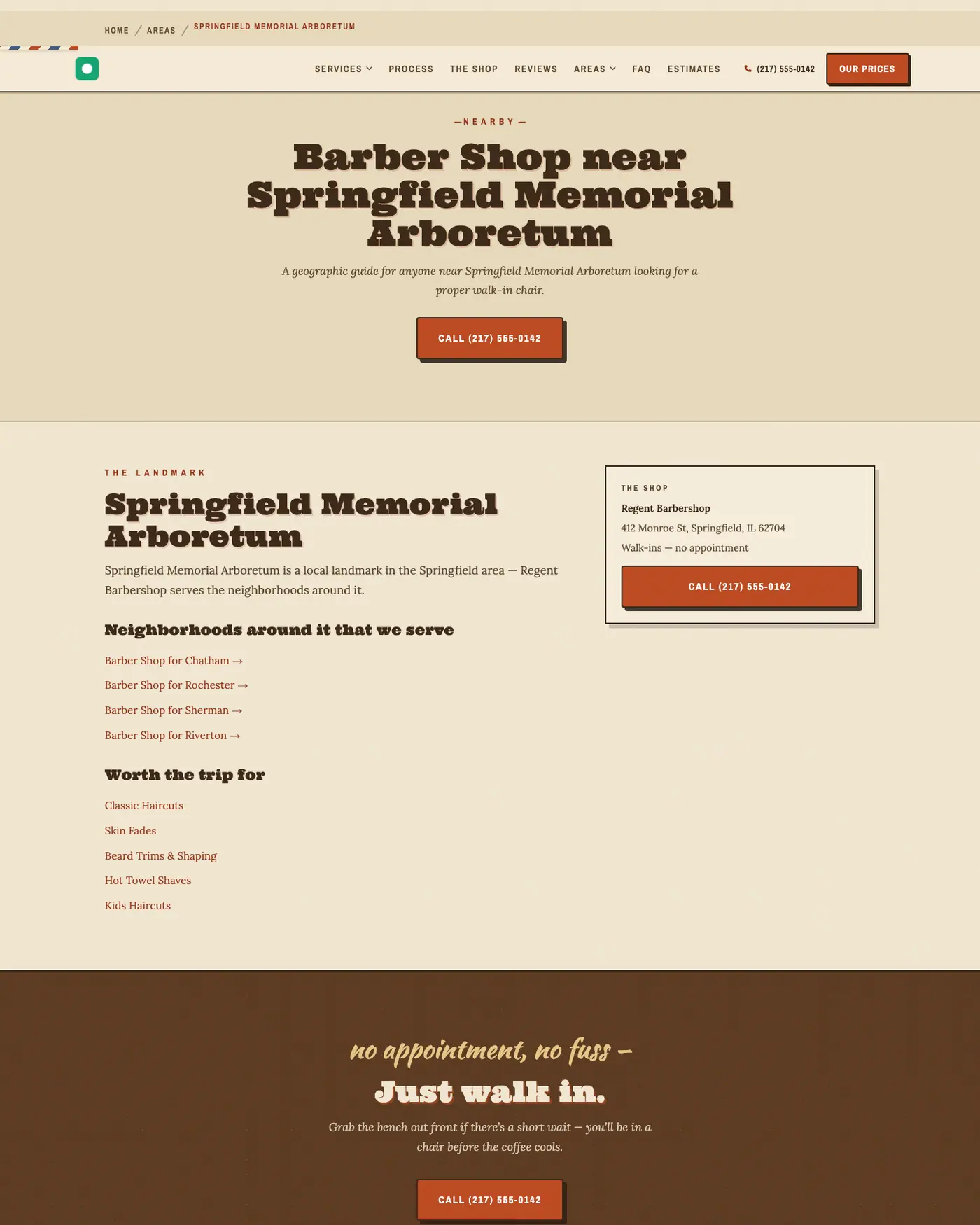
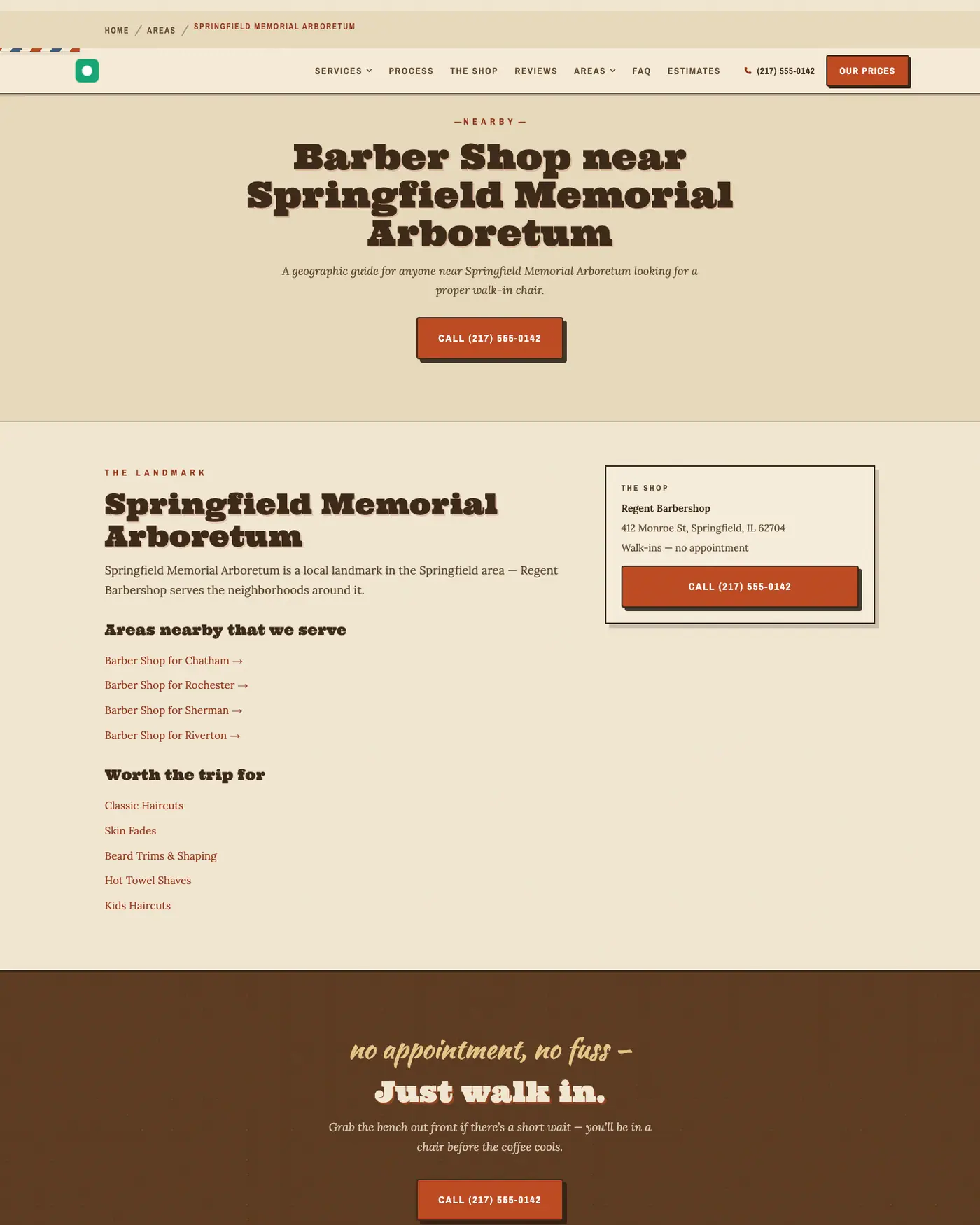
4 Town and landmark facts: a designed card, not a Wikipedia dump
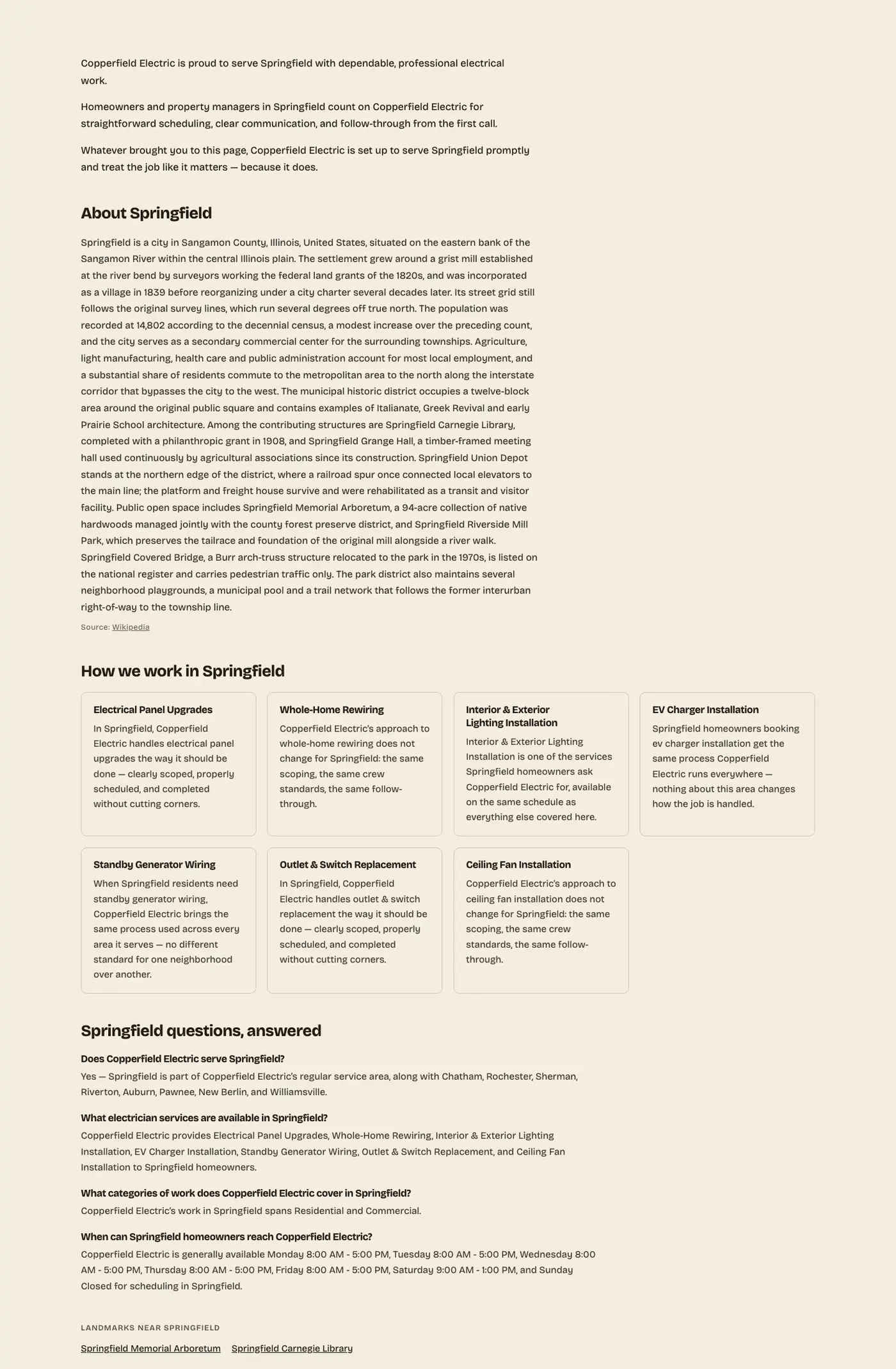
What was done. Area, landmark and neighbourhood pages now render through one designed system. The Wikipedia extract is capped at about two sentences, set in a "Local snapshot" card with landmark and nearby-town chips, and carries a proper CC BY-SA credit. The old build pasted the whole extract — over 2,200 characters, eleven sentences — as raw body text.
Why it matters. A wall of encyclopaedia text pushes the business's own content below the fold and reads as filler to both a visitor and a search engine. Two honest sentences of local colour plus real internal links do the local-relevance job without diluting the page.
Measured. Harness rule A2: Wikipedia blocks over the 260-character / 2-sentence cap. 7 per showcase variant before, 0 after. Caps live in conciseText / CONCISE.
copperline-electric, /locations/springfield/ — the same band of the same page. The after shot also shows the FAQ list turned into a designed accordion.
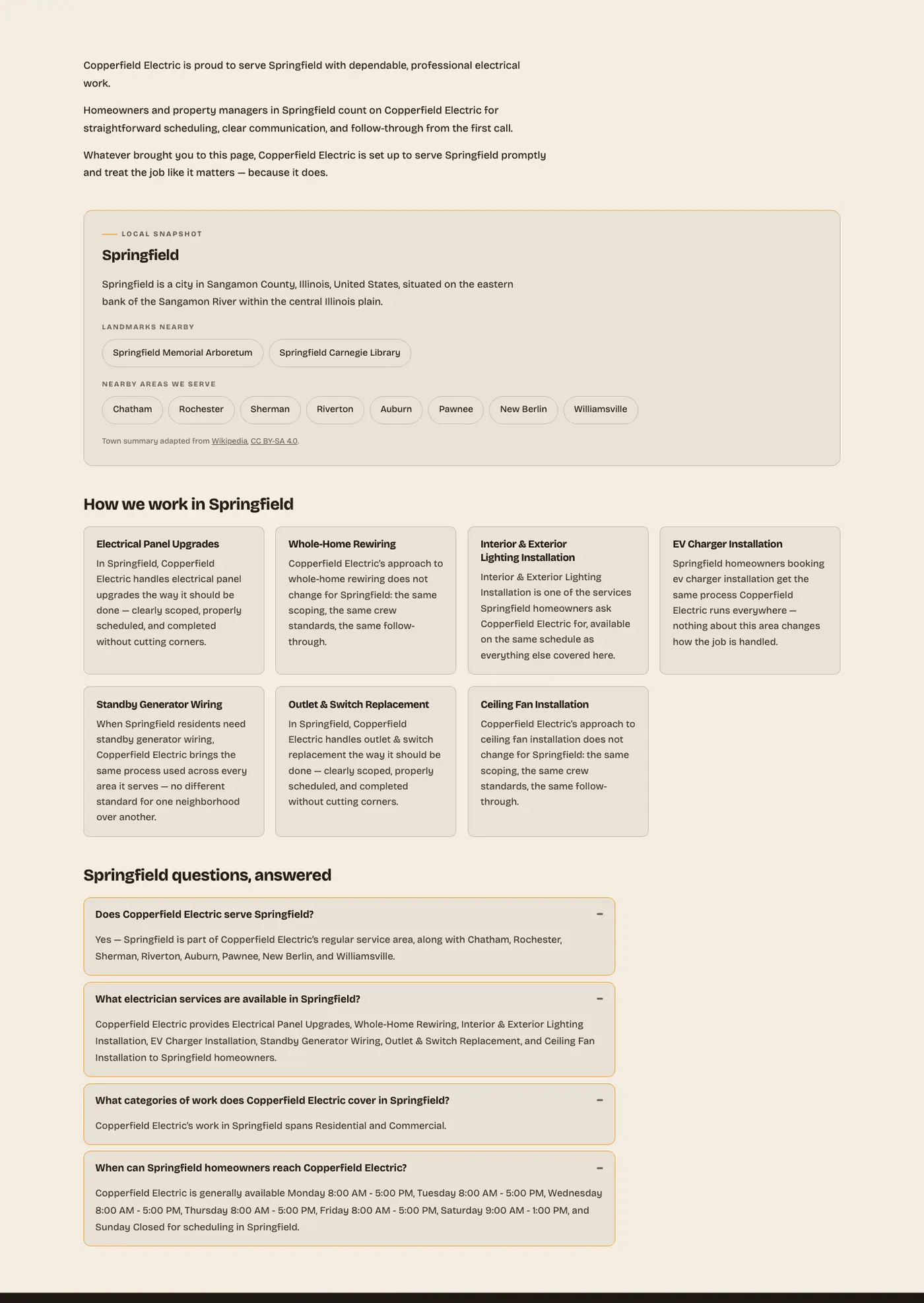
The same band at 390px.
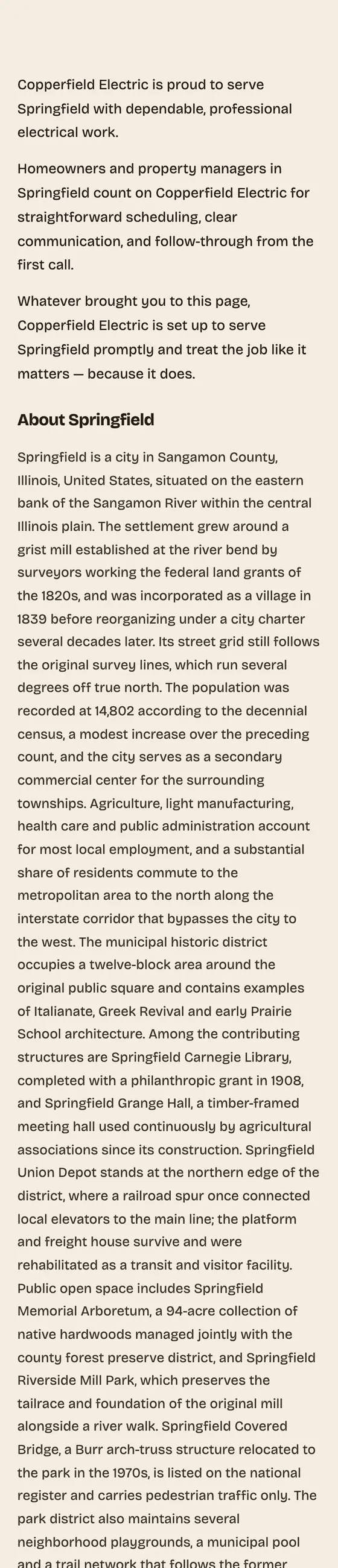
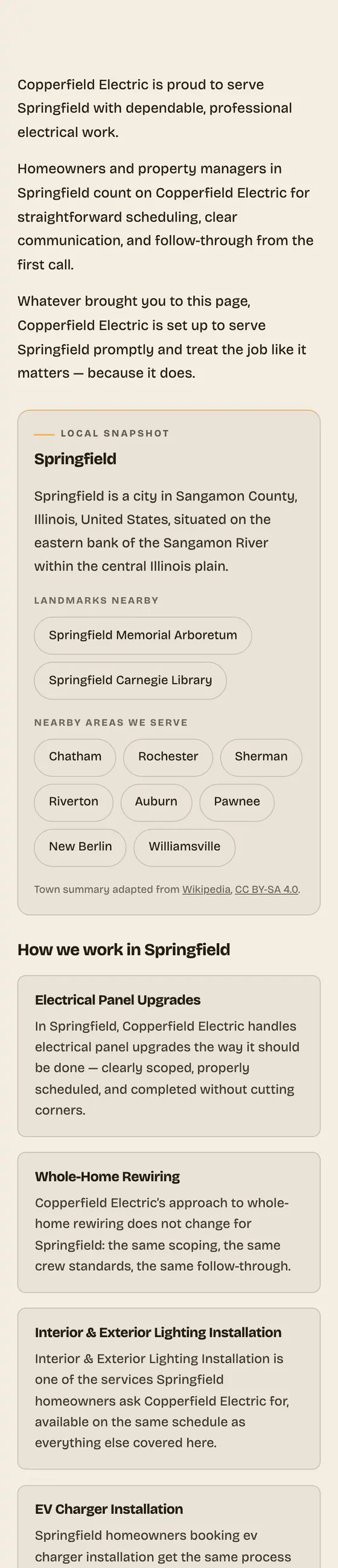
prismara-dental, landmark page for Springfield Carnegie Library.
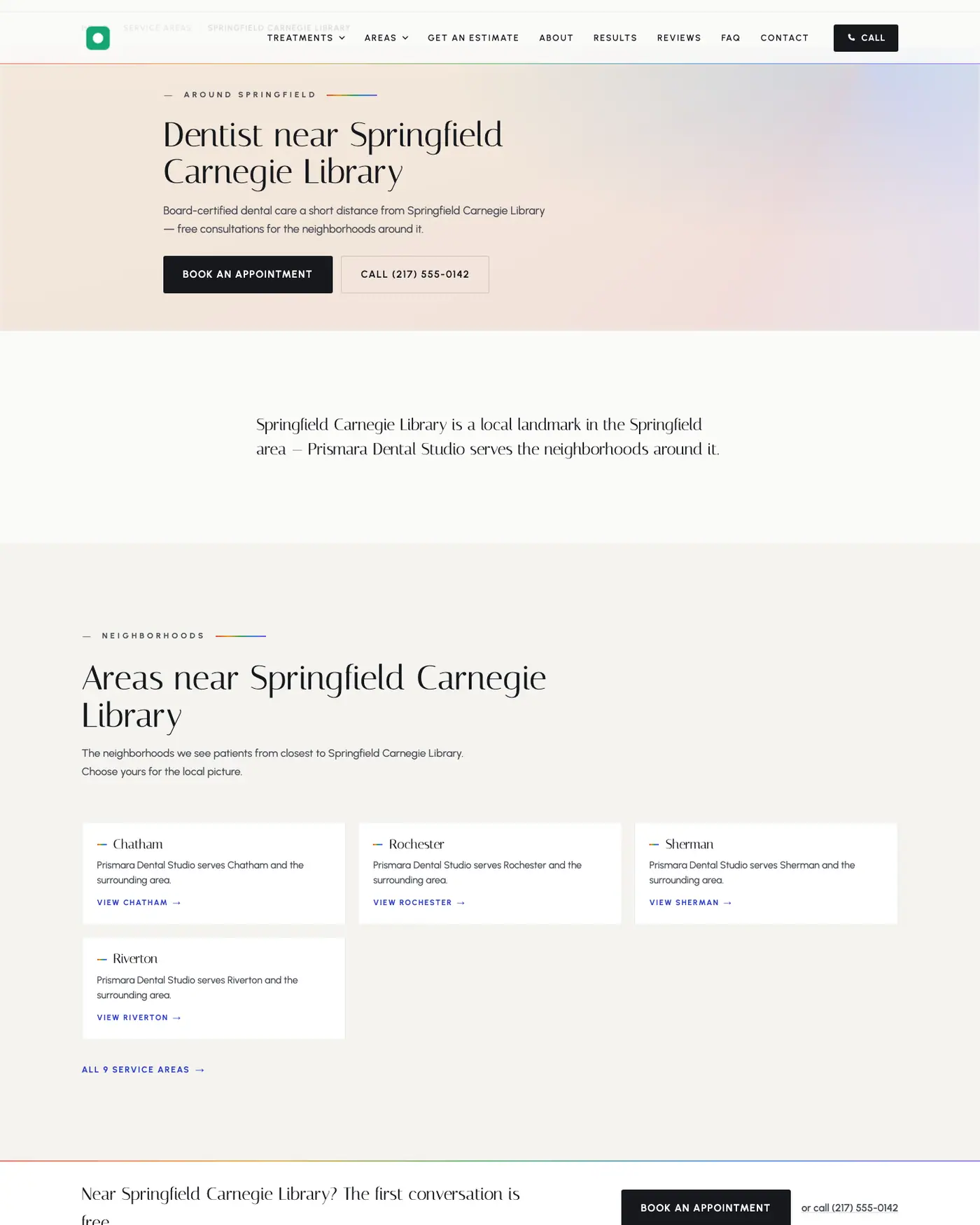
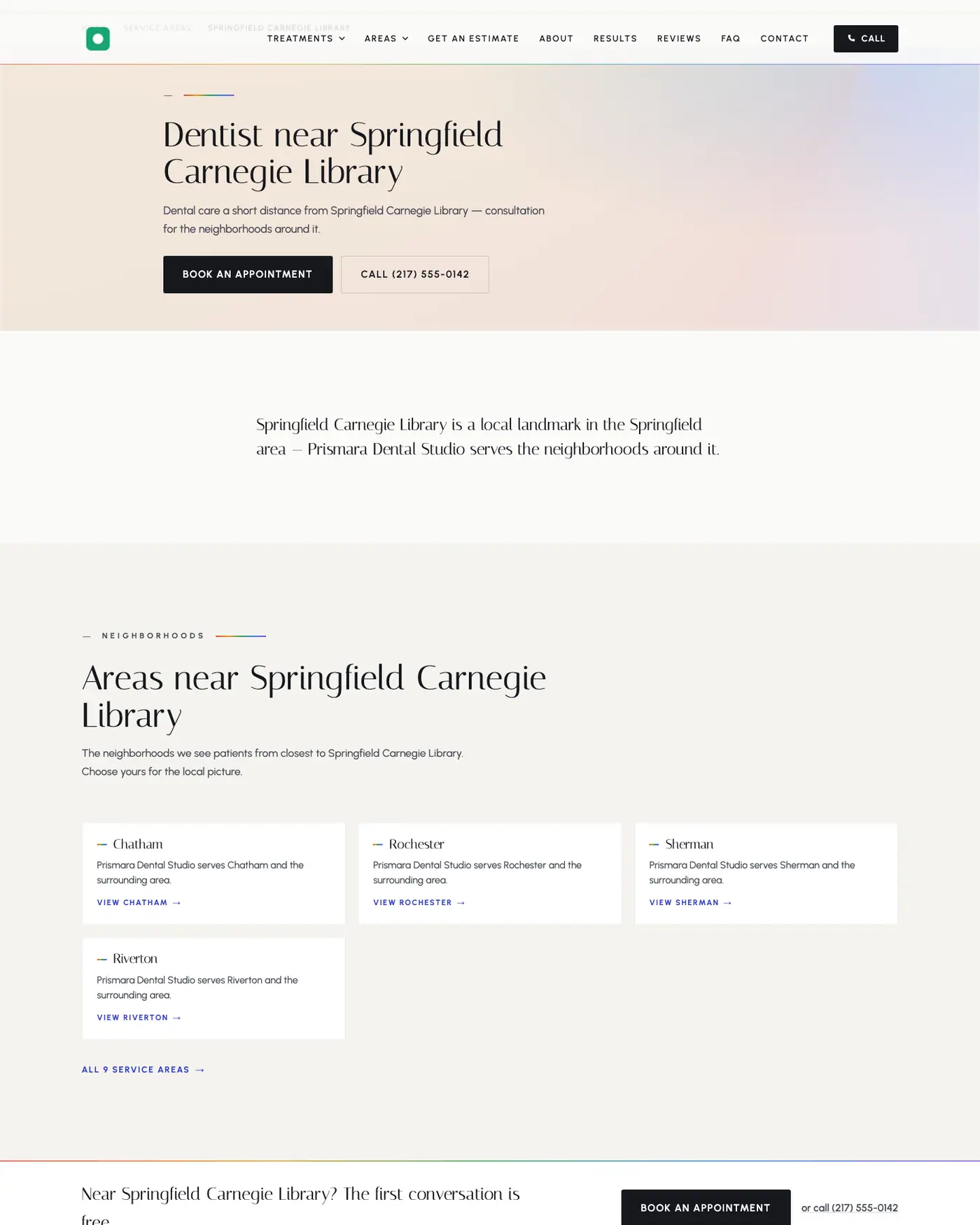
The same landmark page at 390px.
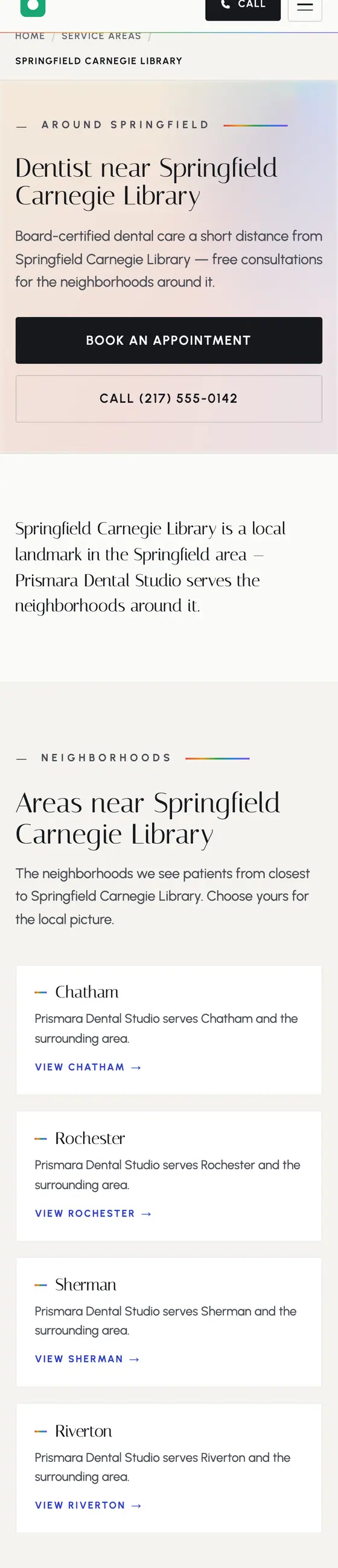
campave-heritage, landmark page.
5 Category pages, related services and real per-service depth
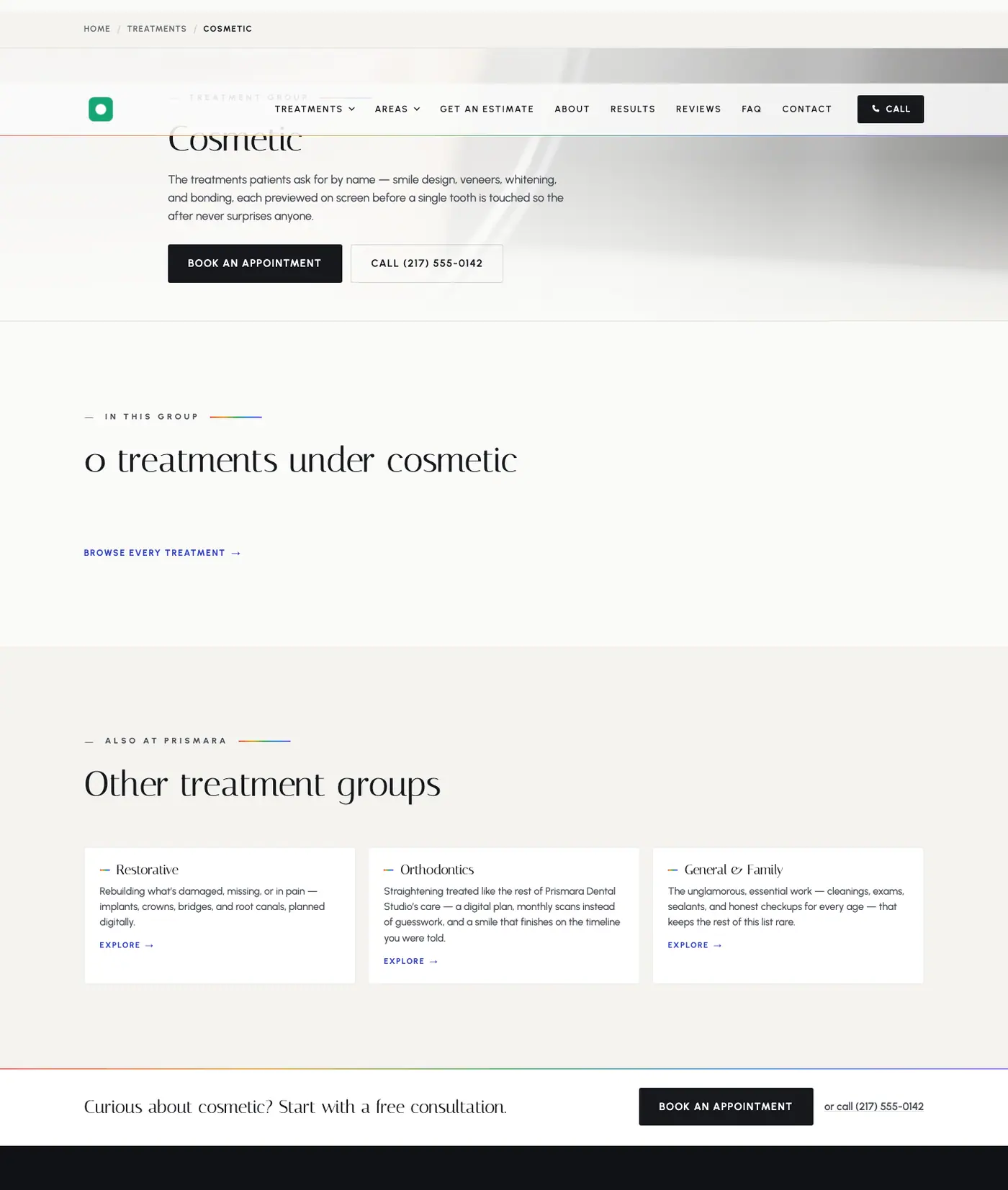
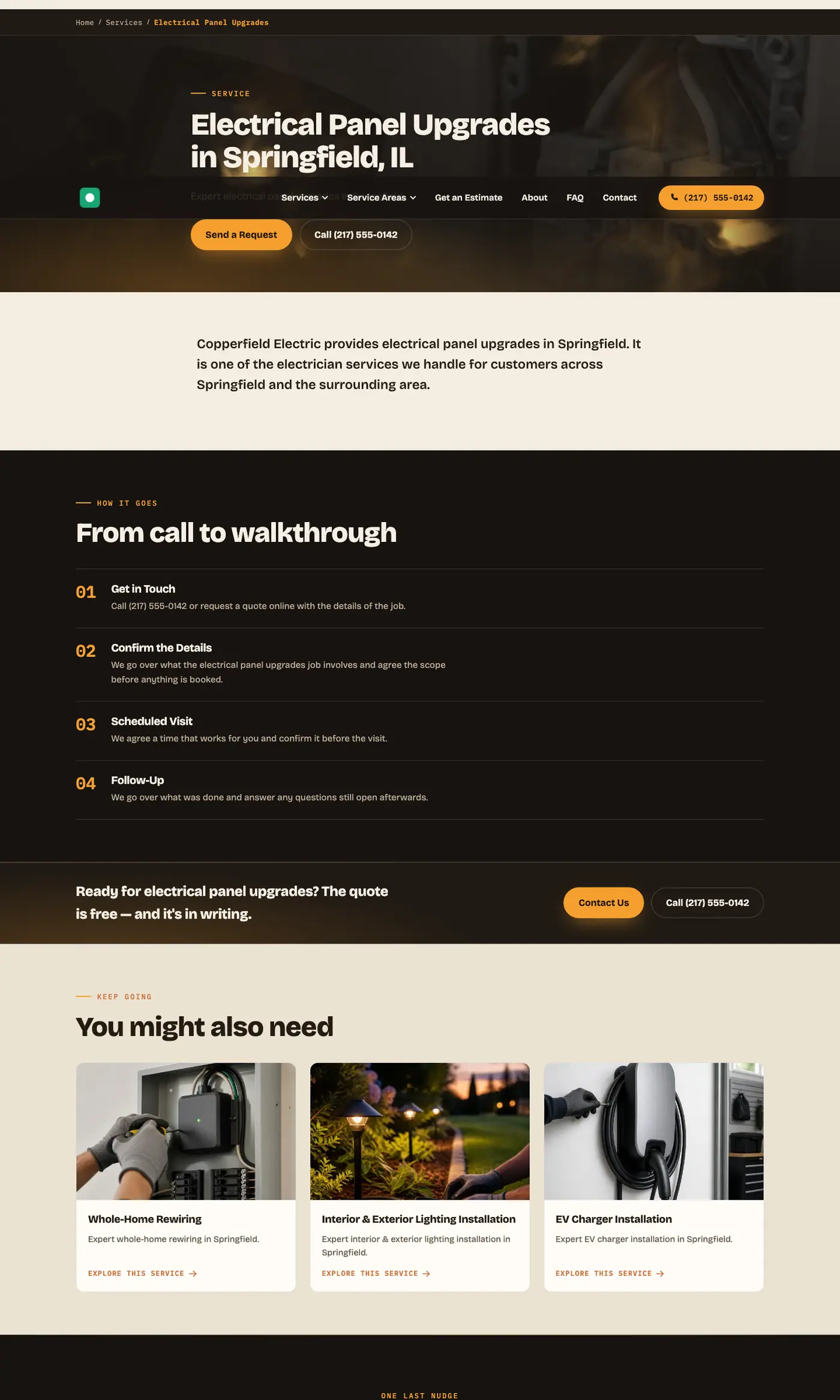
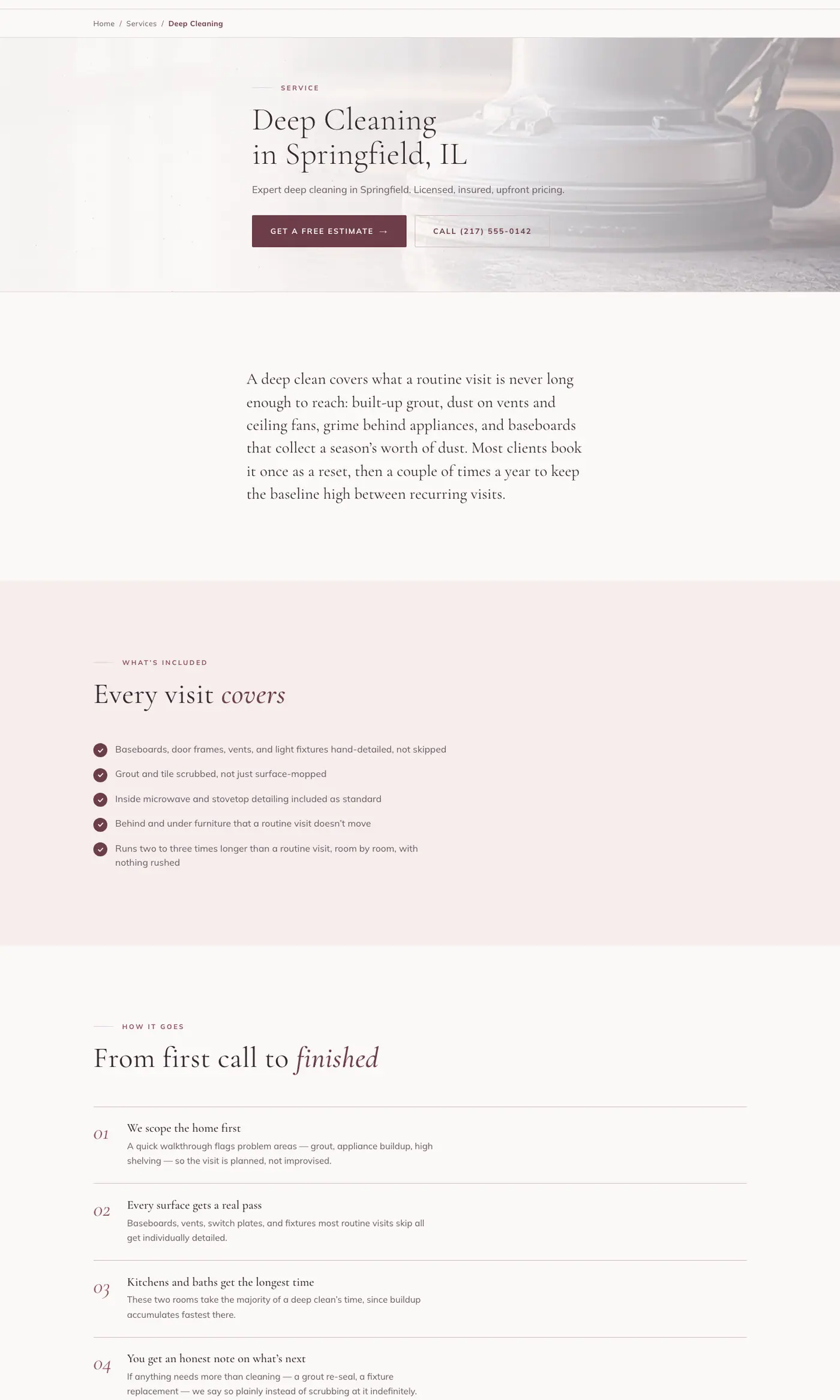
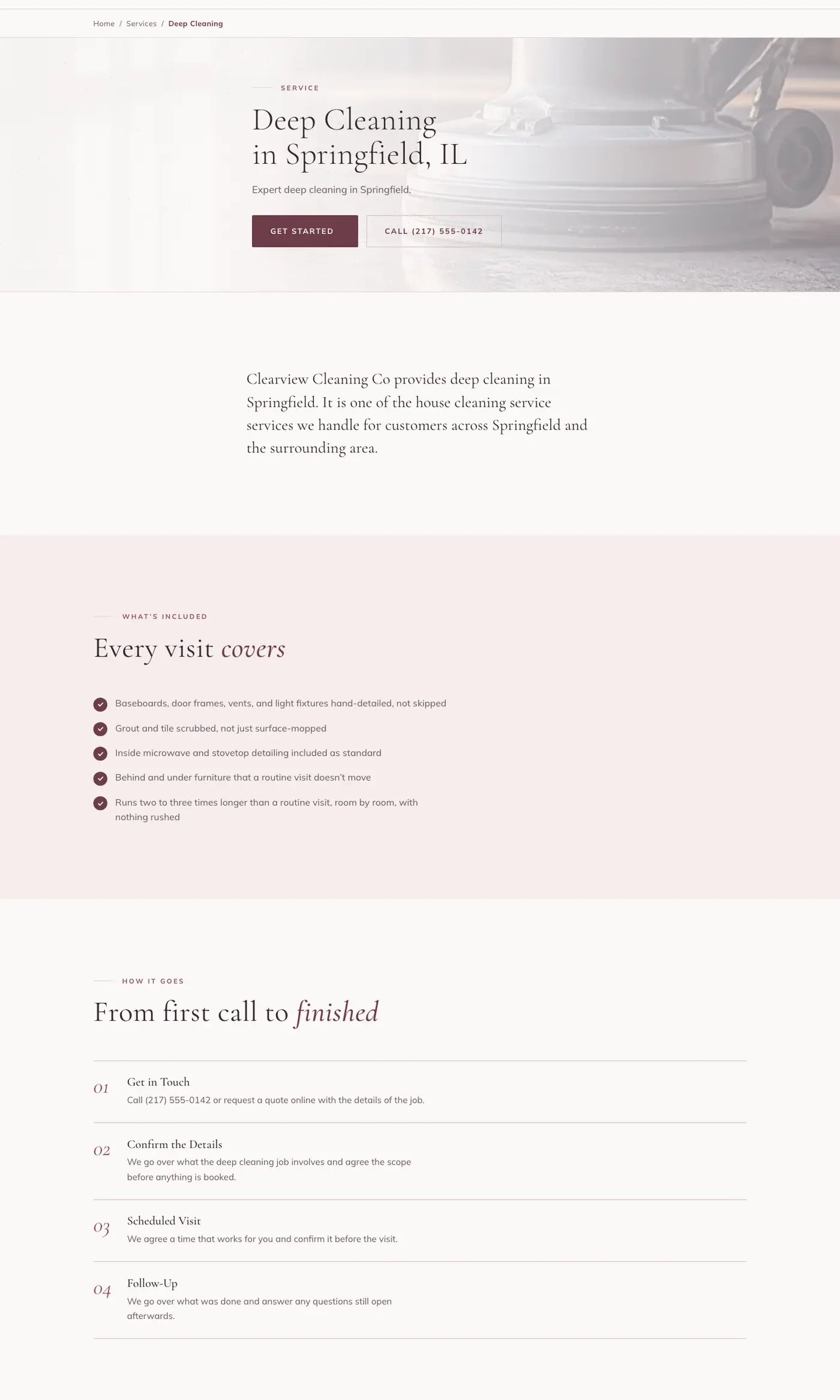
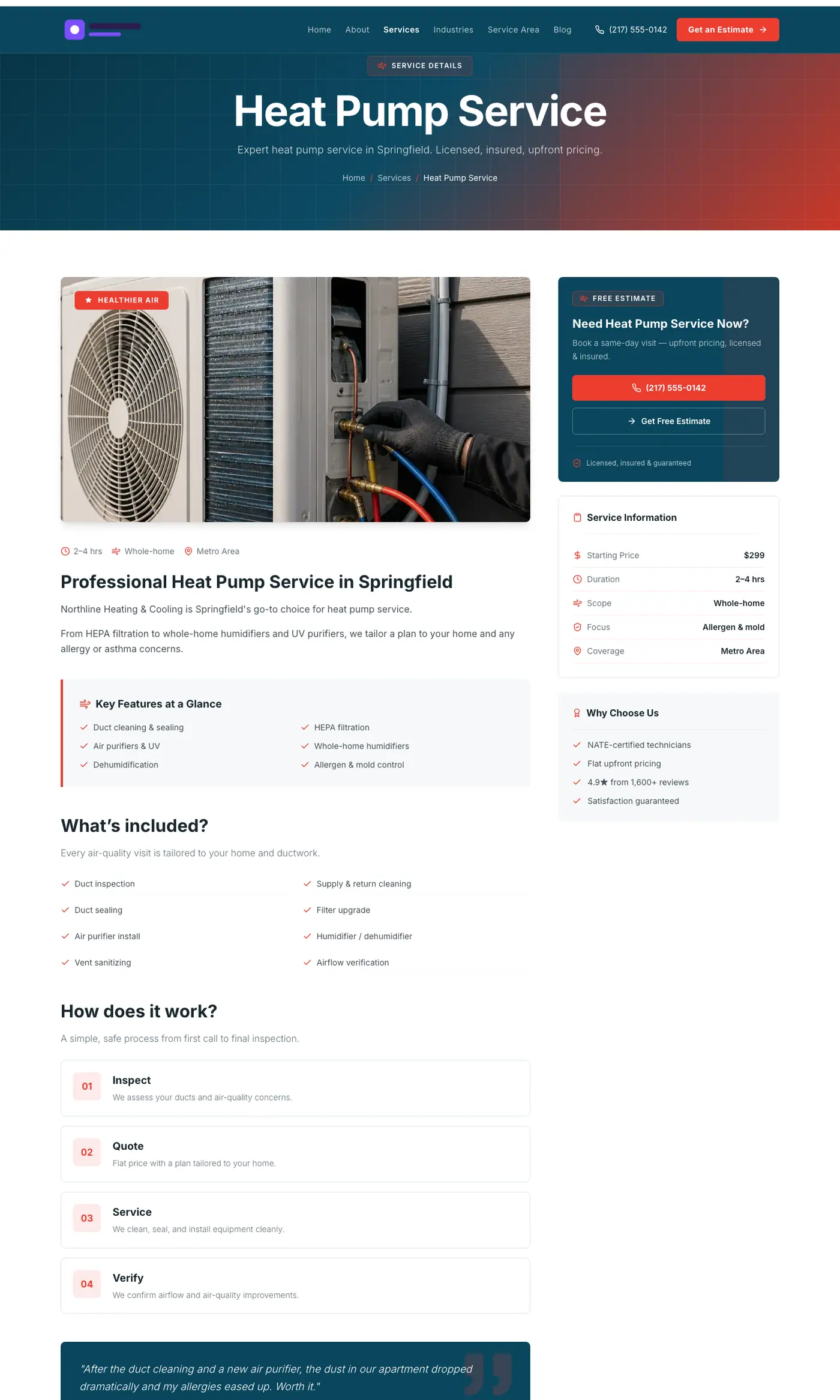
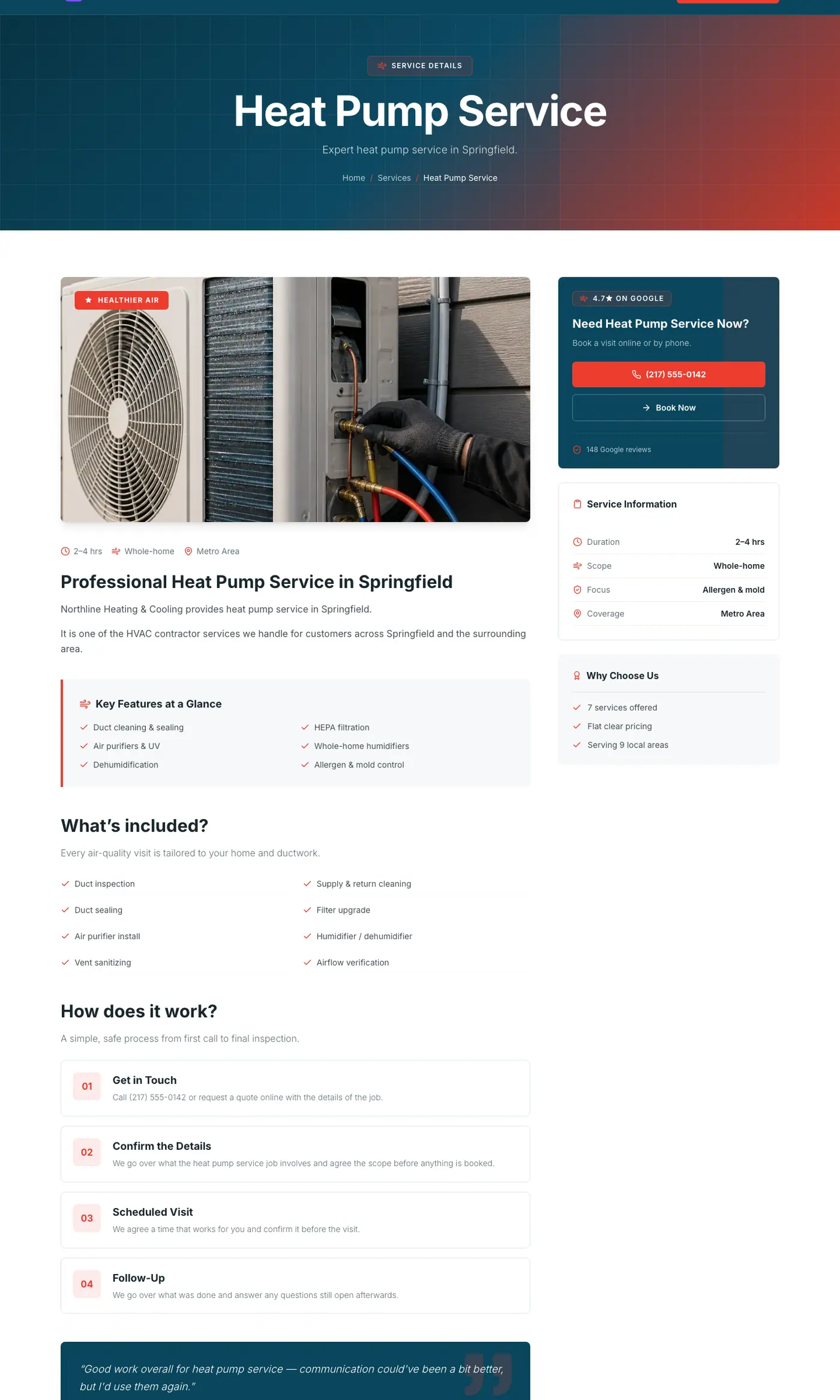
What was done. Category pages are rebuilt from the client's own services instead of the template's demo set — a page that said "0 treatments under cosmetic" now lists all seven. Service pages gained a related-services rail, process steps and FAQs, filled from siteJson.serviceDetail by an AI pass with an honest deterministic floor behind it.
Why it matters. This is the internal-linking silo the whole ranking plan rests on: category → service → area, and back. An empty category page is a dead end that wastes a crawl and loses the visitor. A related rail keeps both moving.
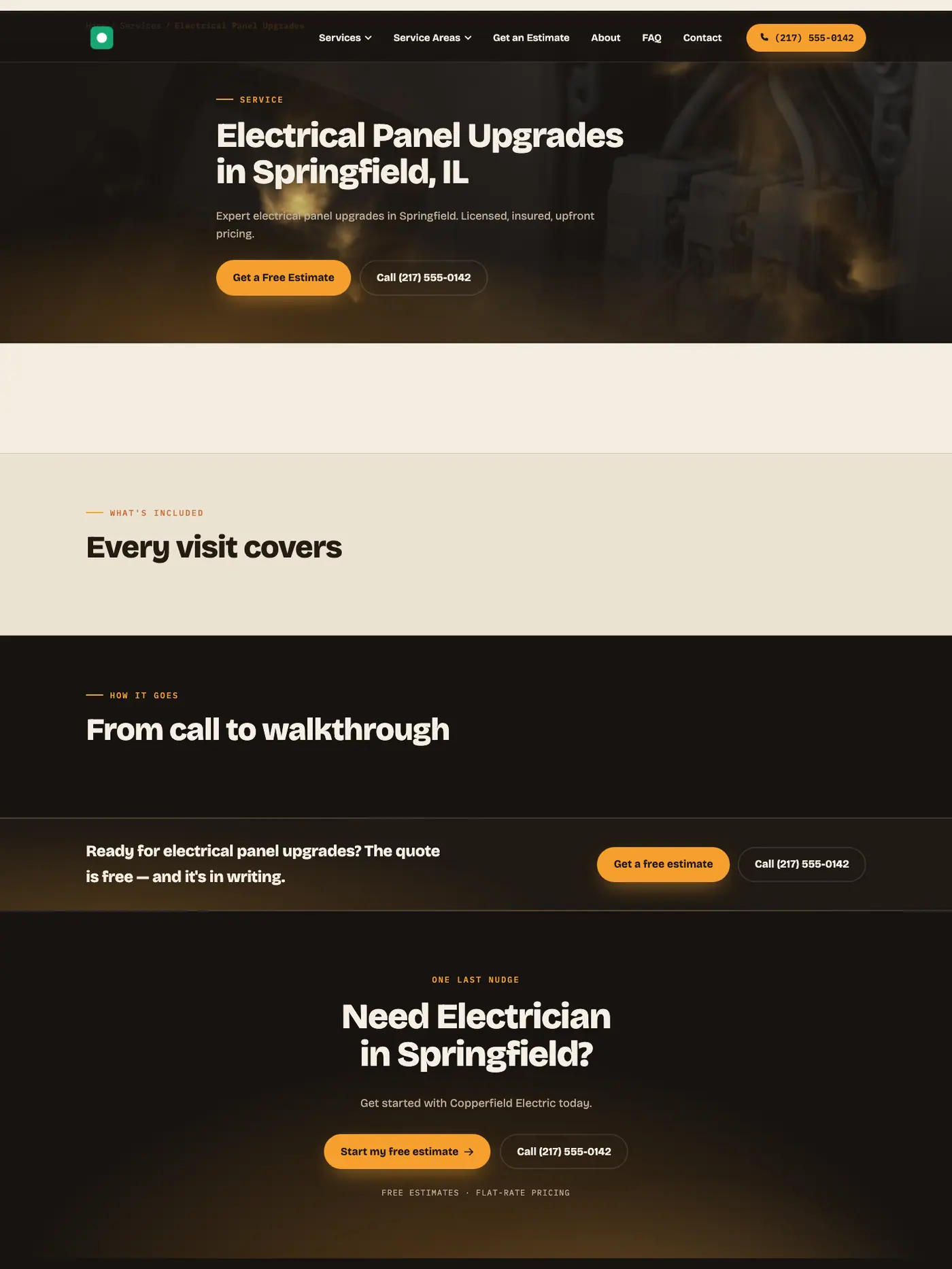
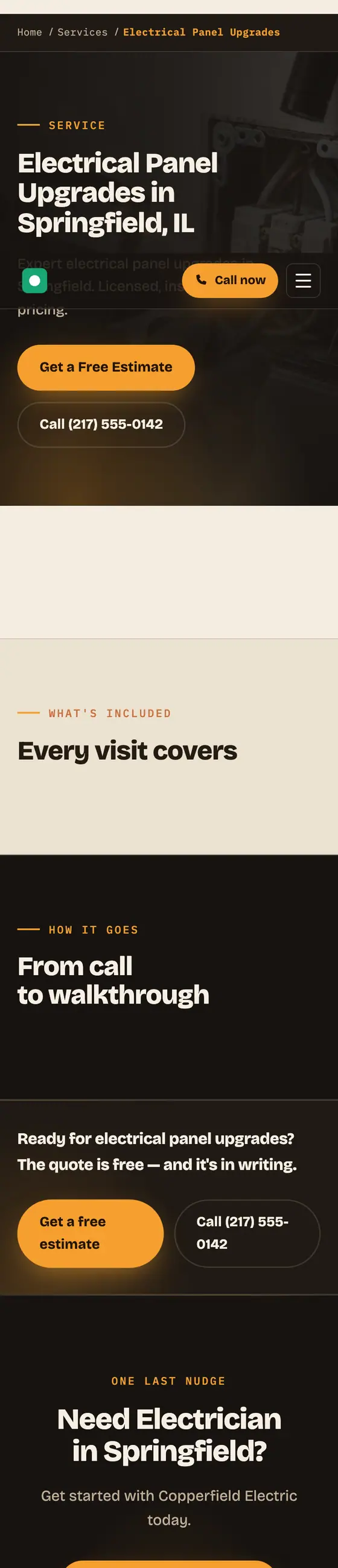
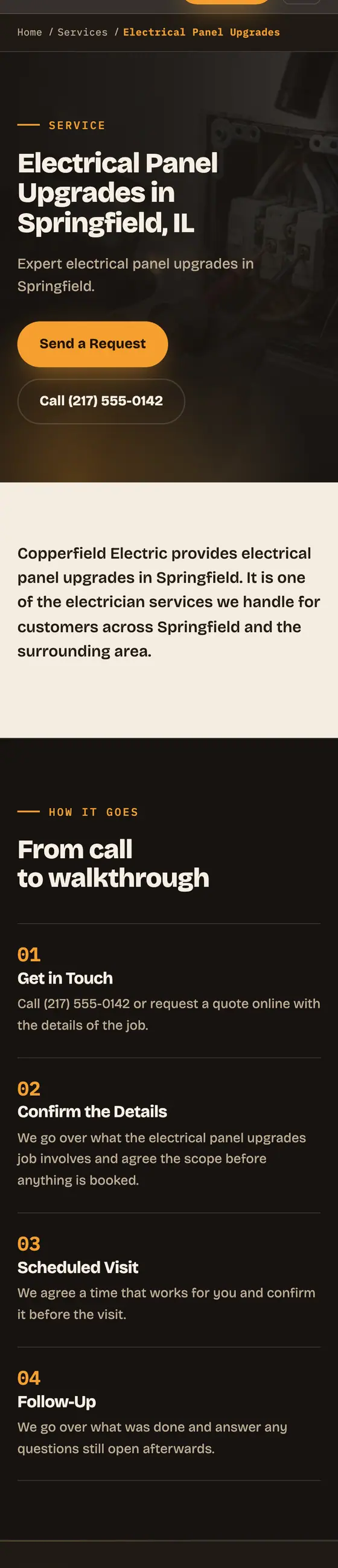
Measured. Category pages with real content 24/109 → 75/75. Service pages with a related rail 39/245 → 238/245. Service pages with process steps 62/245 → 231/245. My own re-measure of the two built sets, using a stricter "three or more sibling service links" test: 7/238 → 203/245.
prismara-dental, /categories/cosmetic/ — "0 treatments under cosmetic" and an empty grid, versus seven real treatments.

copperline-electric, /services/electrical-panel-upgrades/ — the after adds a "You might also need" rail.
The same service page at 390px.
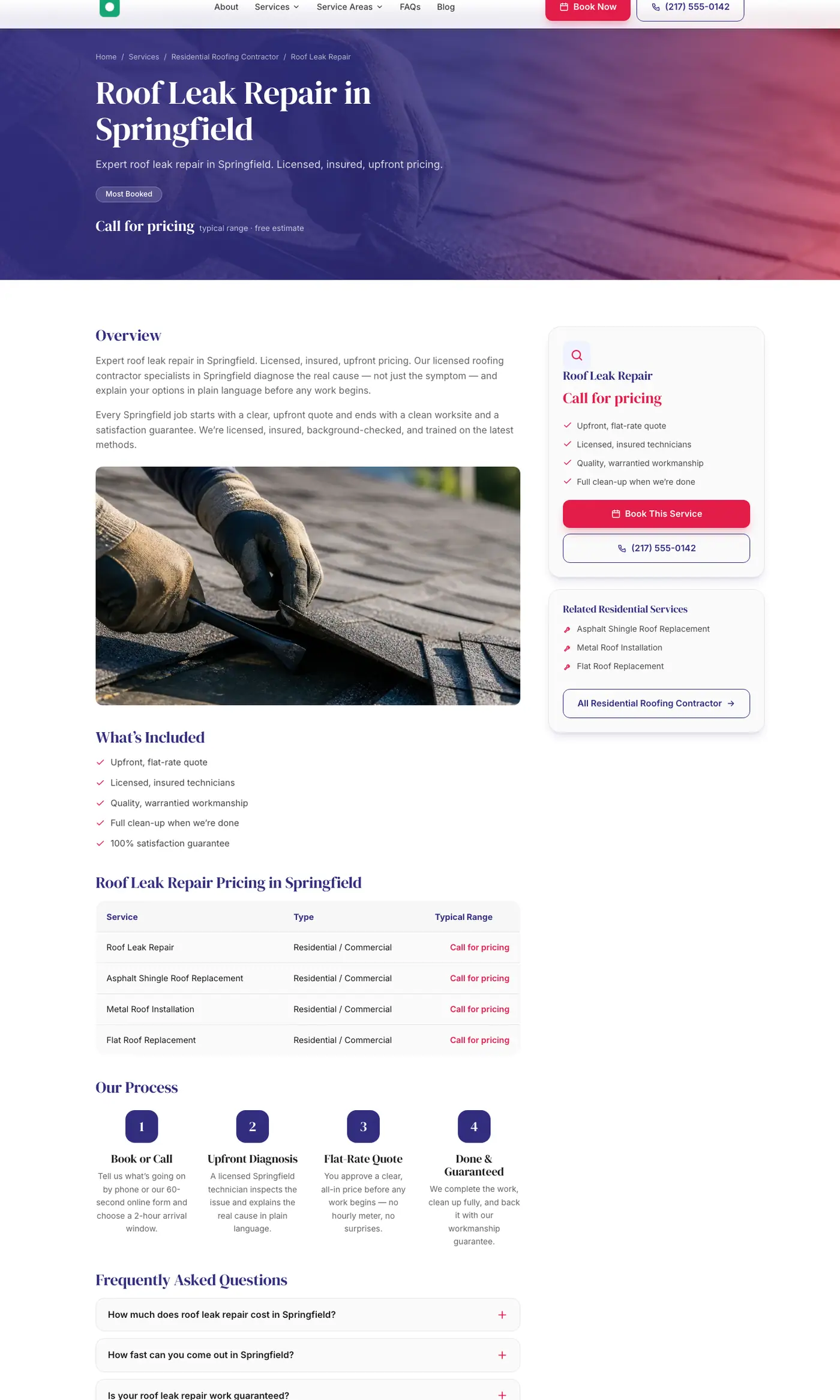
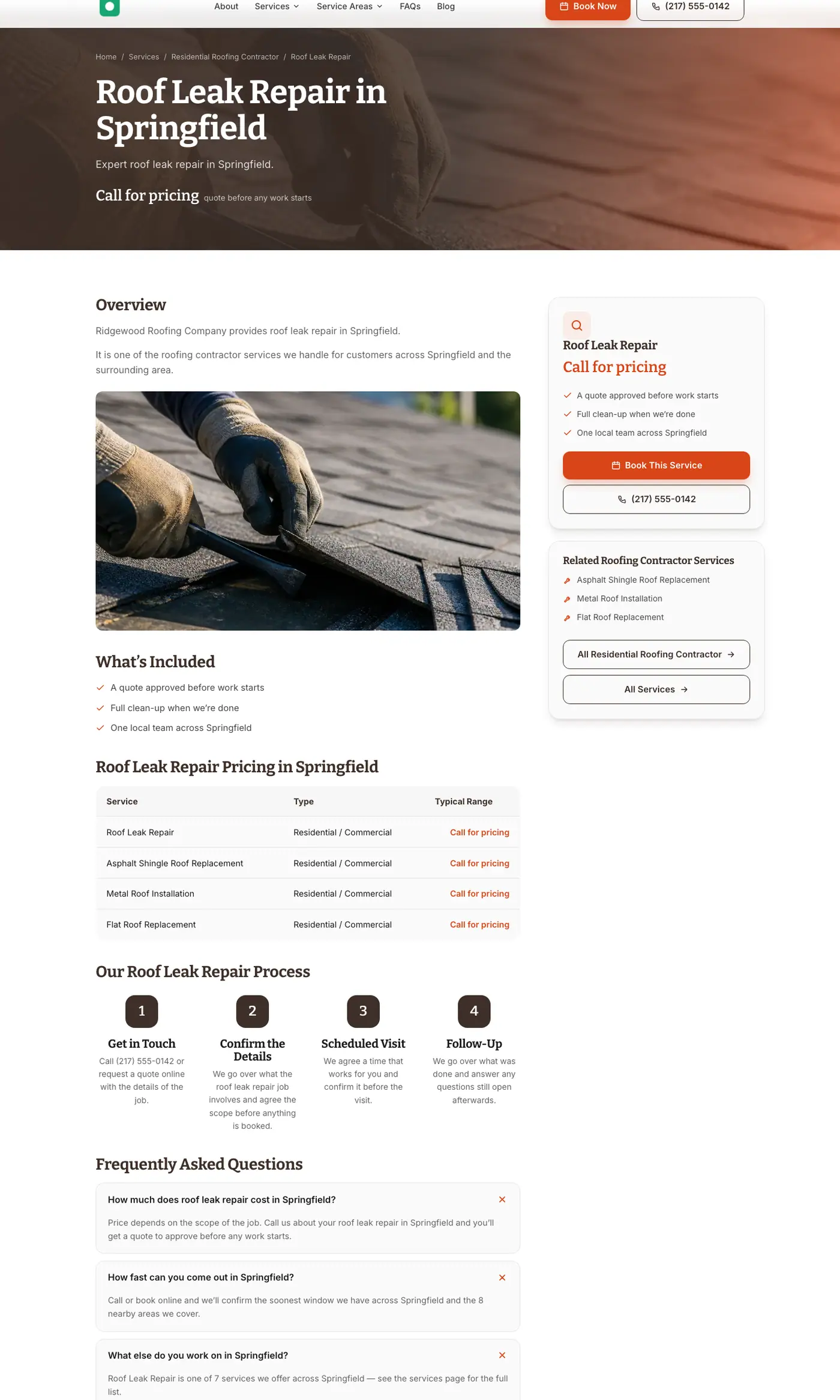
home-3, /services/roof-leak-repair/.
primrose-cleaning, /services/deep-cleaning/.
home-2, /services/heat-pump-service/. home-2 still has no rail slot in its template — a known, recorded gap.
6 Empty data hides its section
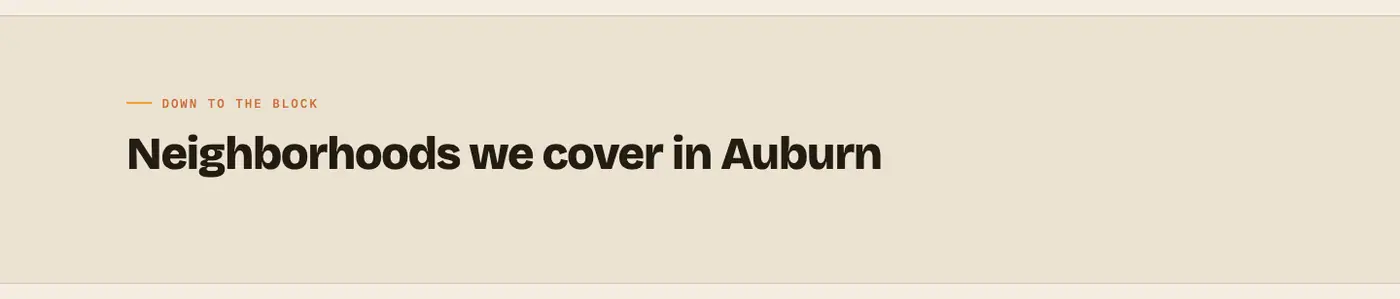
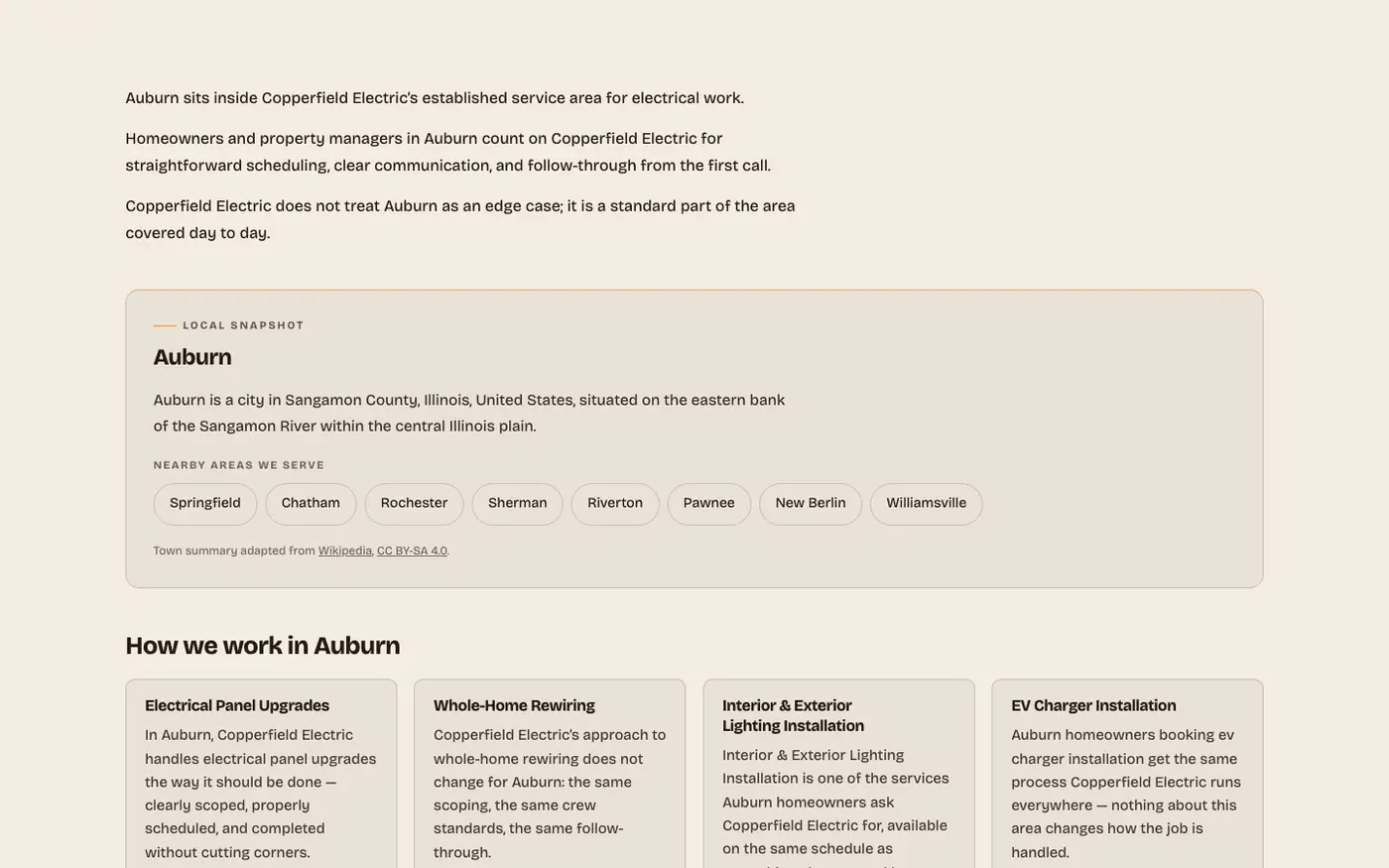
What was done. A section, band or list whose data is empty is no longer rendered. Templates wrap it in a conditional using their own idiom, and the writer is forbidden from padding an empty list with another service's demo prose.
Why it matters. A heading with nothing under it looks broken, and it is the single clearest tell that a site was generated rather than built. It also wastes screen space on mobile, where every band costs a scroll.
Measured. Empty <ul>/<ol> across the fleet: 878 → 0 (my independent count on the two built sets, limited to <main>: 661 → 0). Heading-only bands: 9 per affected variant → 0. Harness rules EMPTY-LIST and EMPTY-SECTION.
copperline-electric, /locations/auburn/ — a band headed "Neighborhoods we cover in Auburn" with nothing under it. The after shows what now occupies that part of the page.
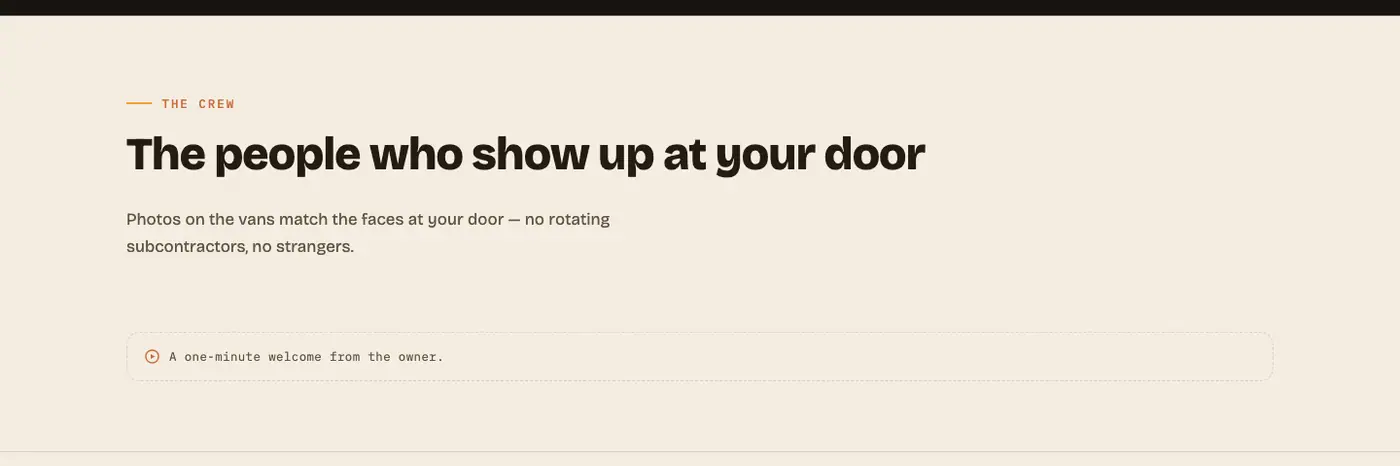
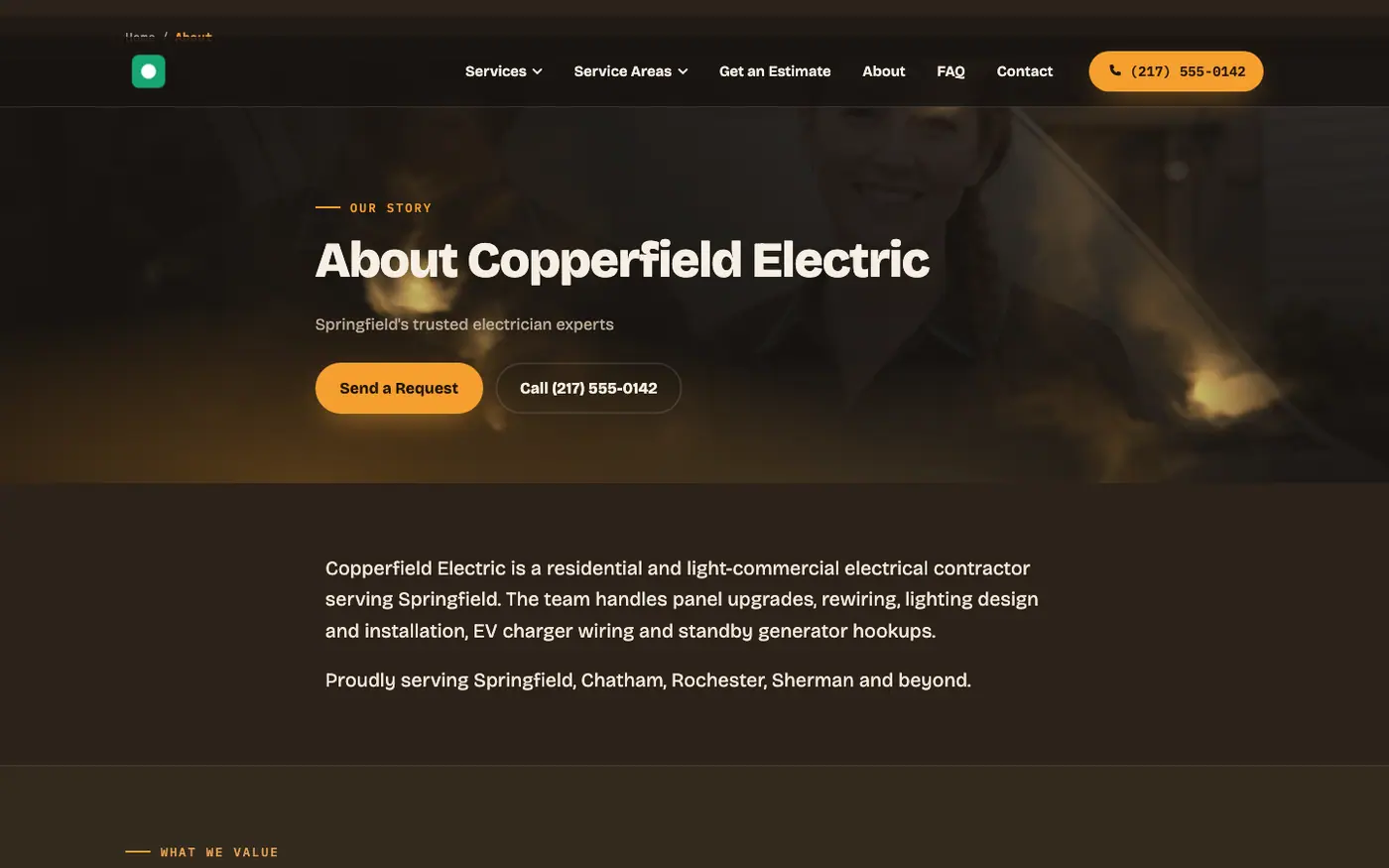
/about/ — a "The crew" band promising photos of the team, with an empty grid where the cards should be. Removed.
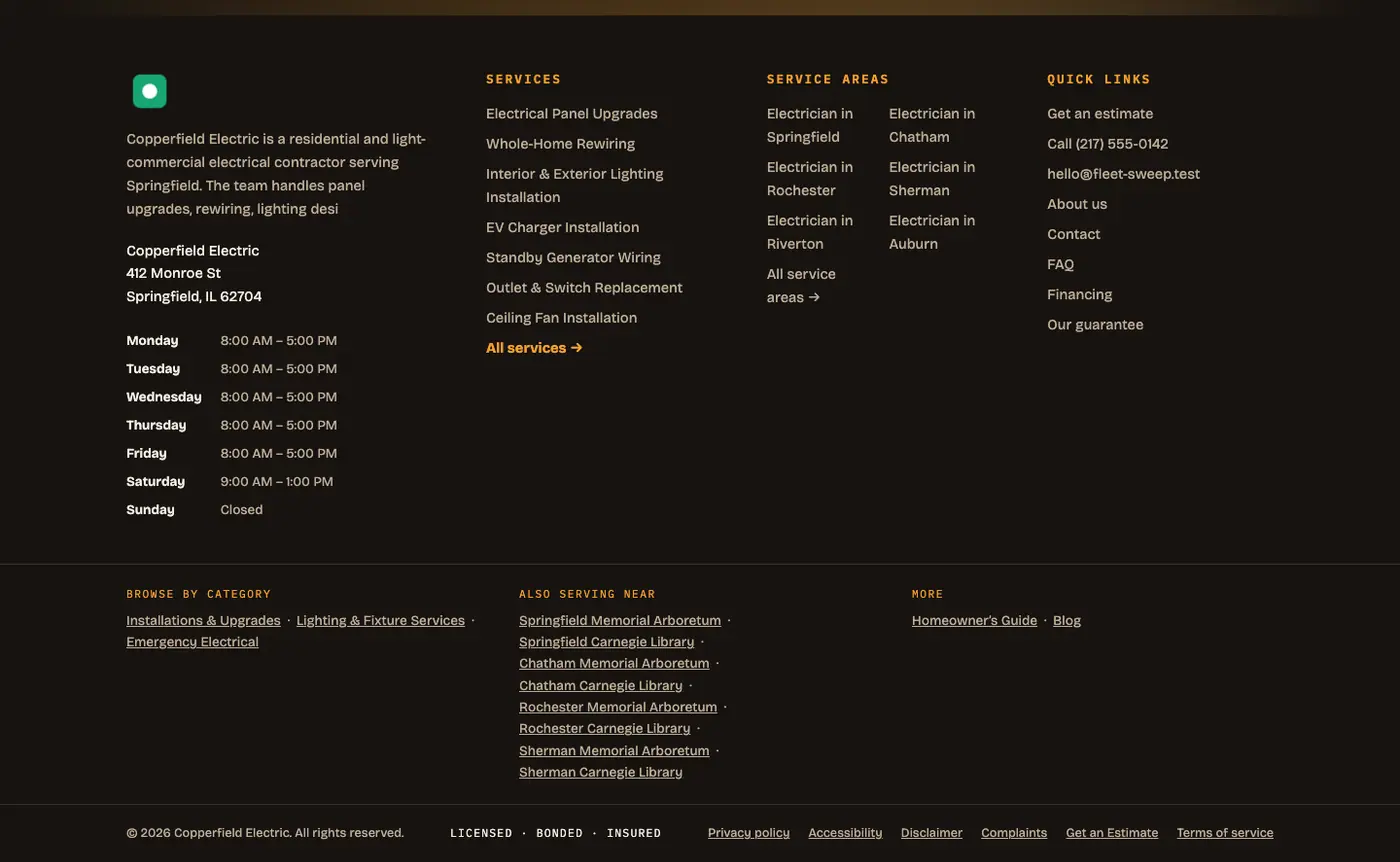
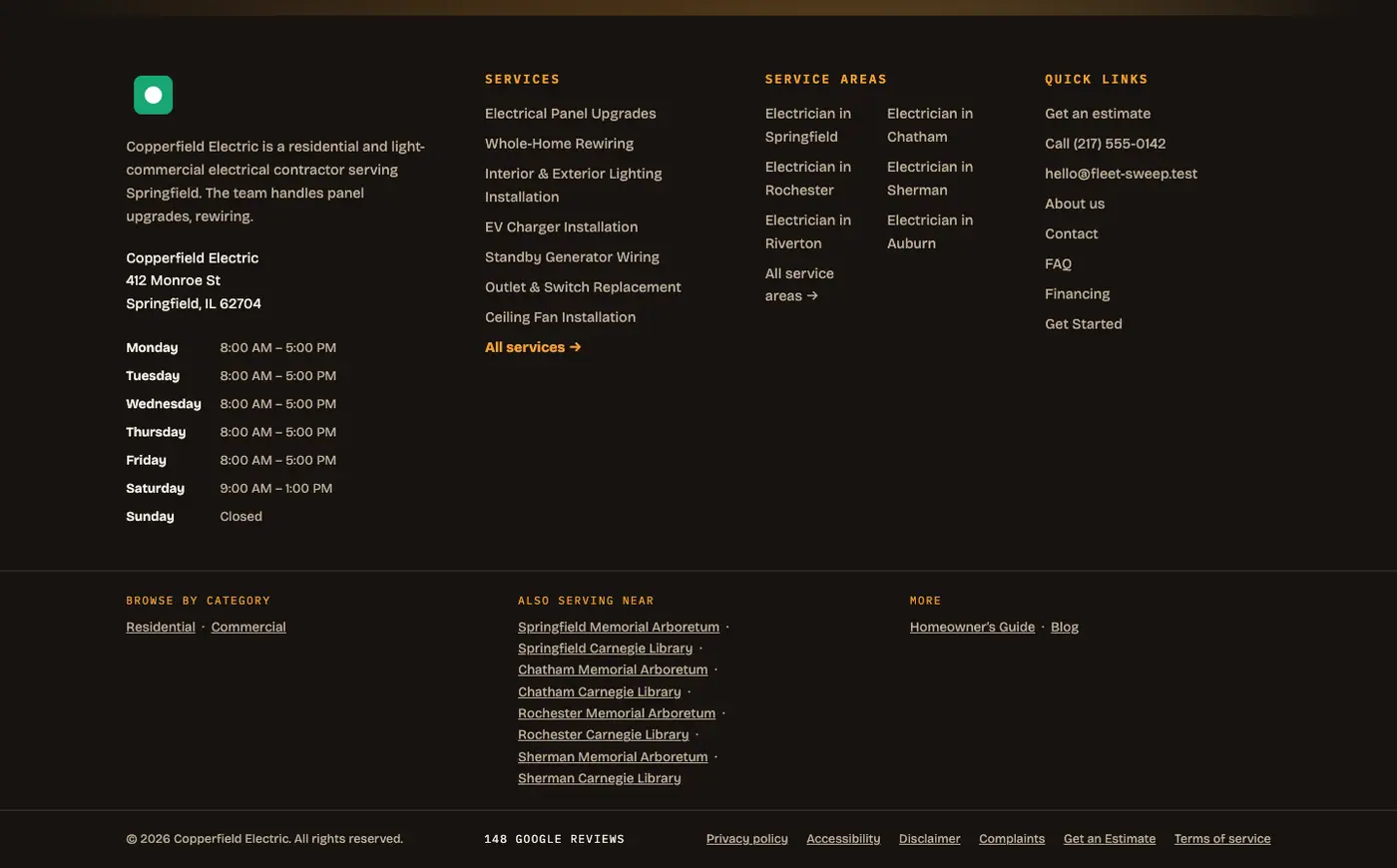
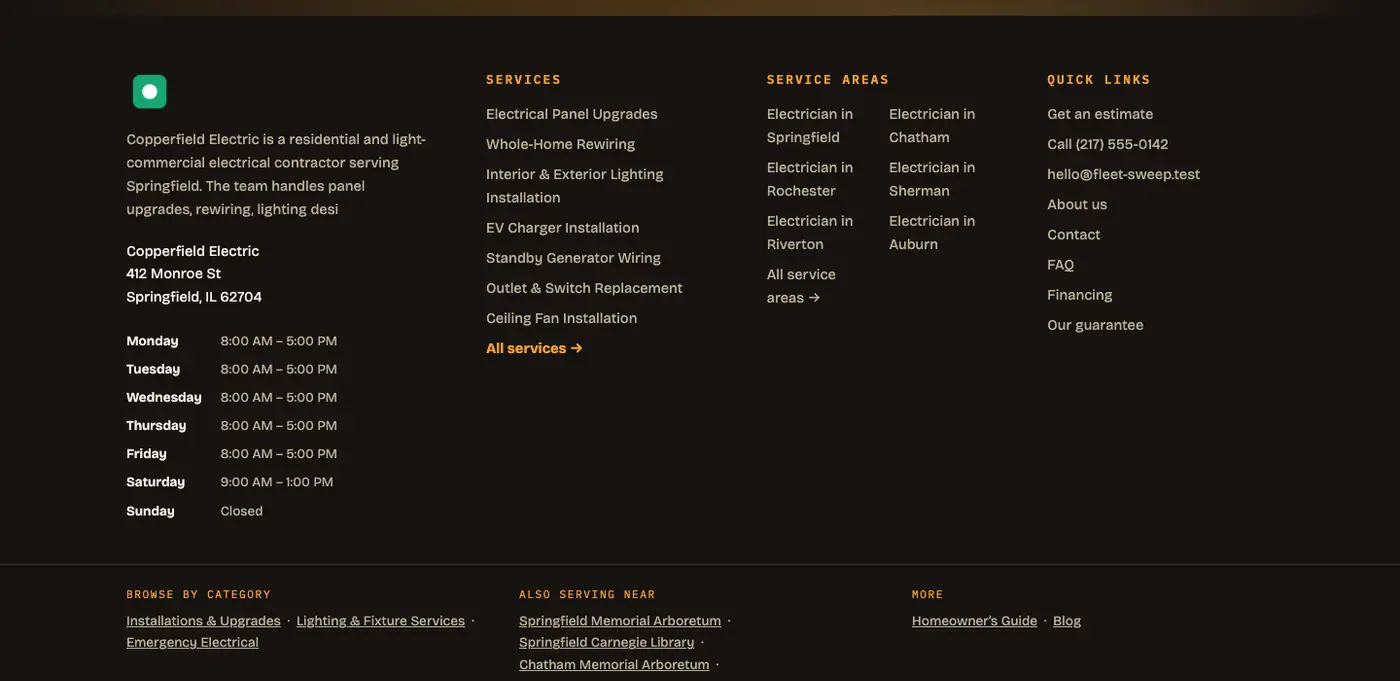
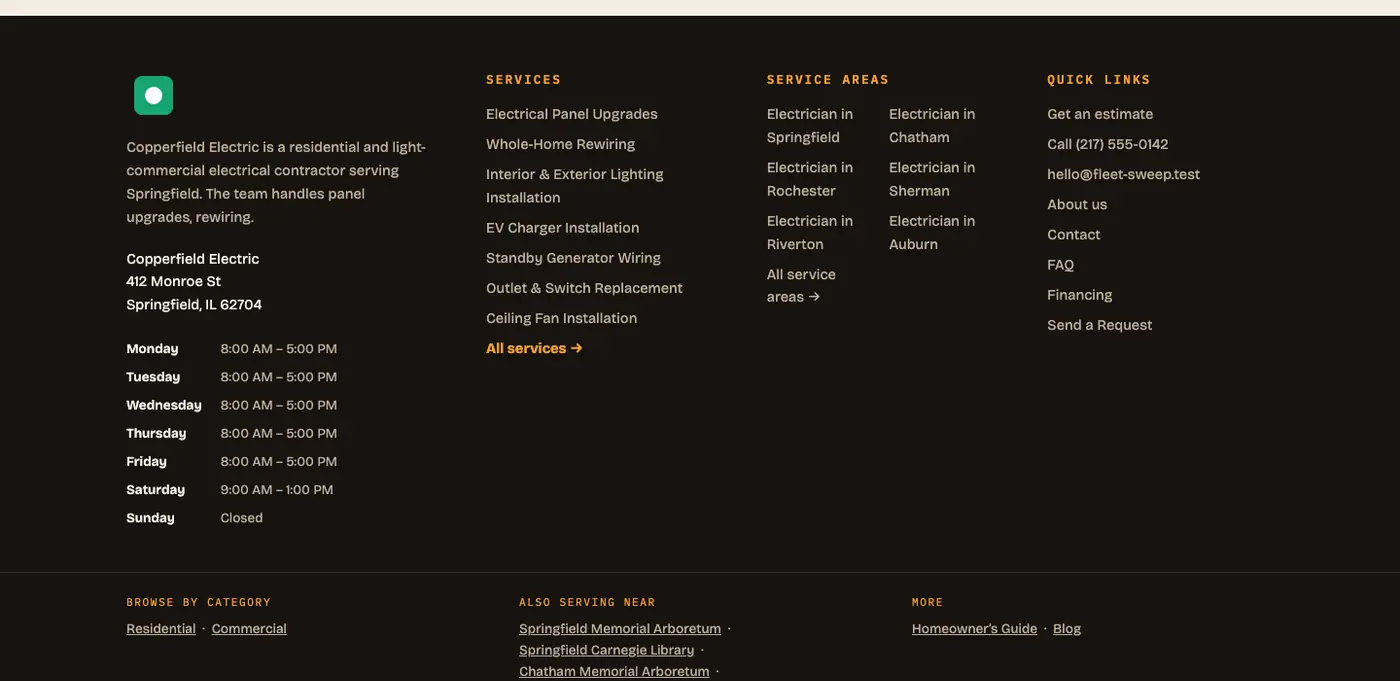
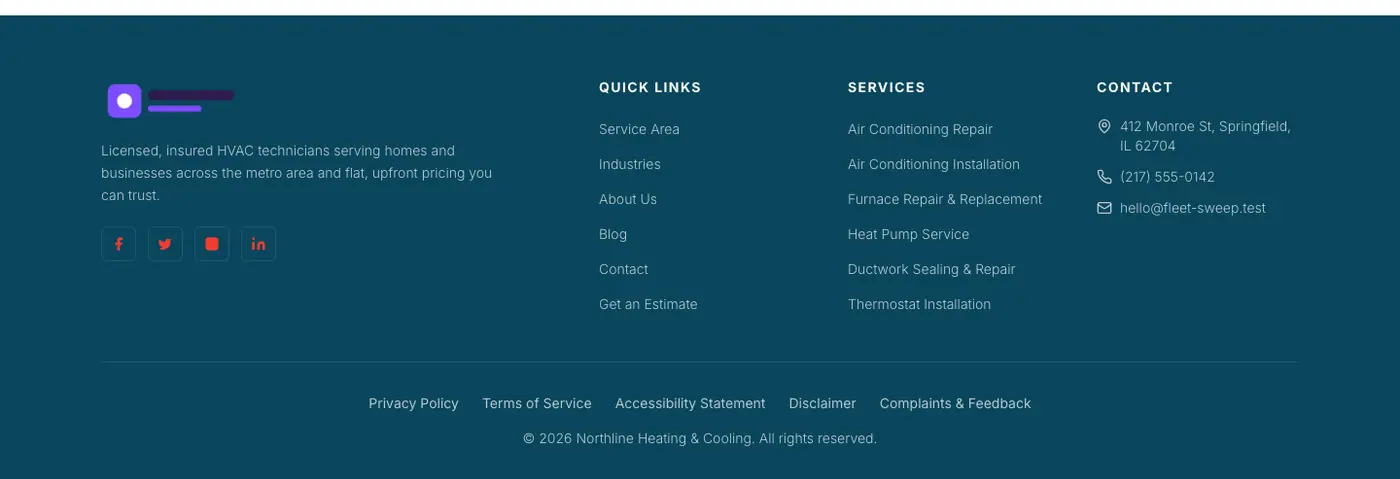
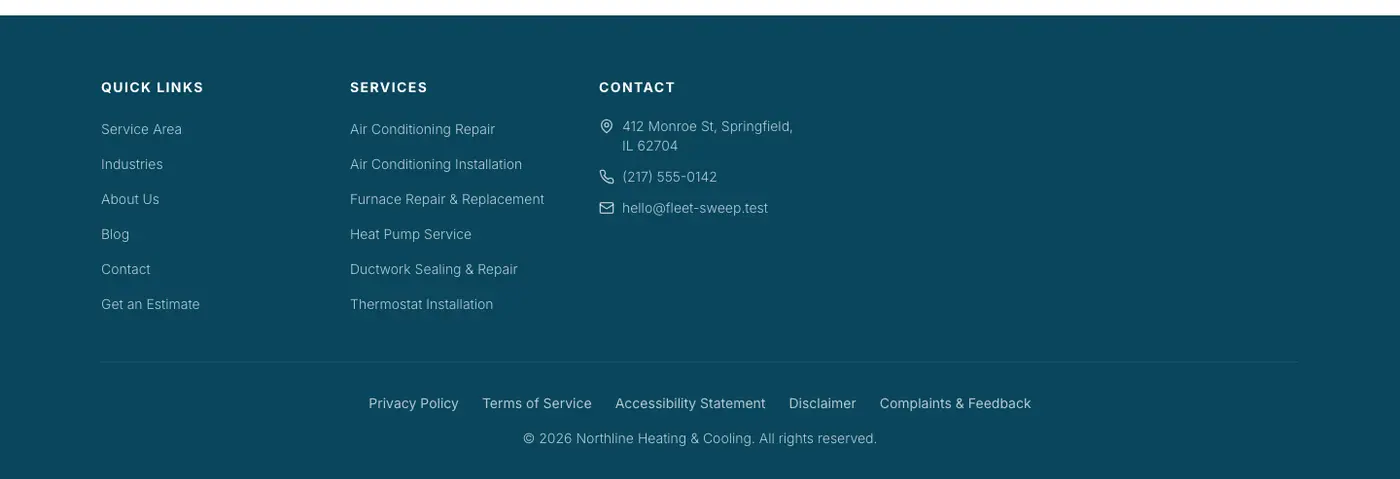
The footer carried an empty social-links list on every page of the site.
7 Logos sized by area, and drawn in the template's own type and colour
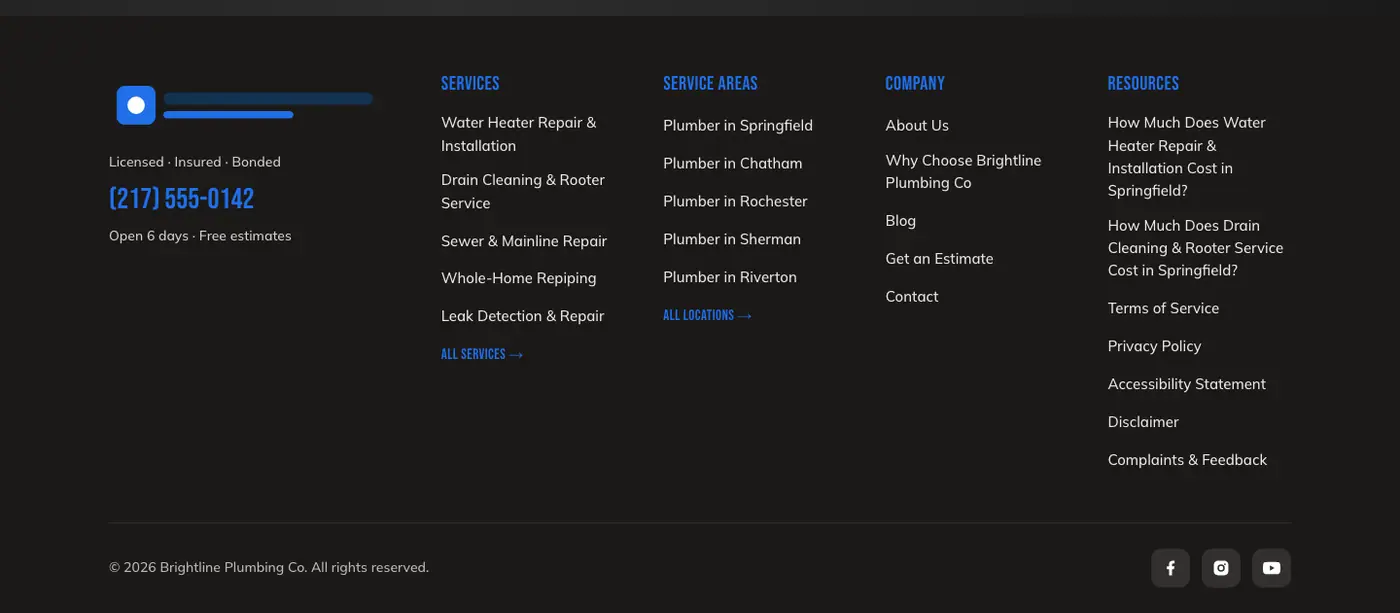
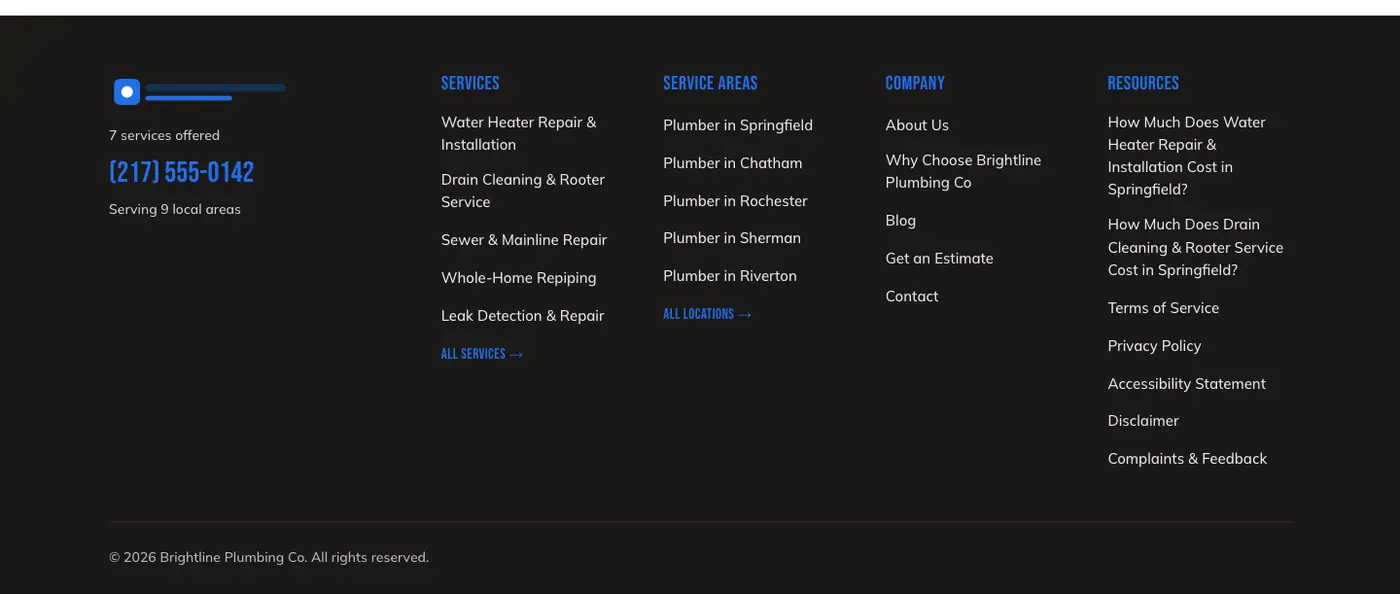
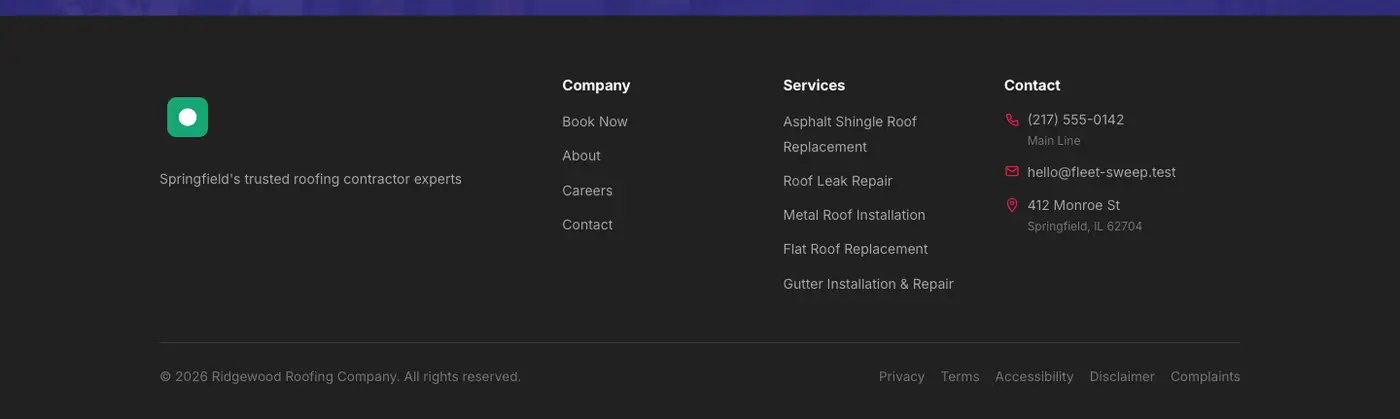
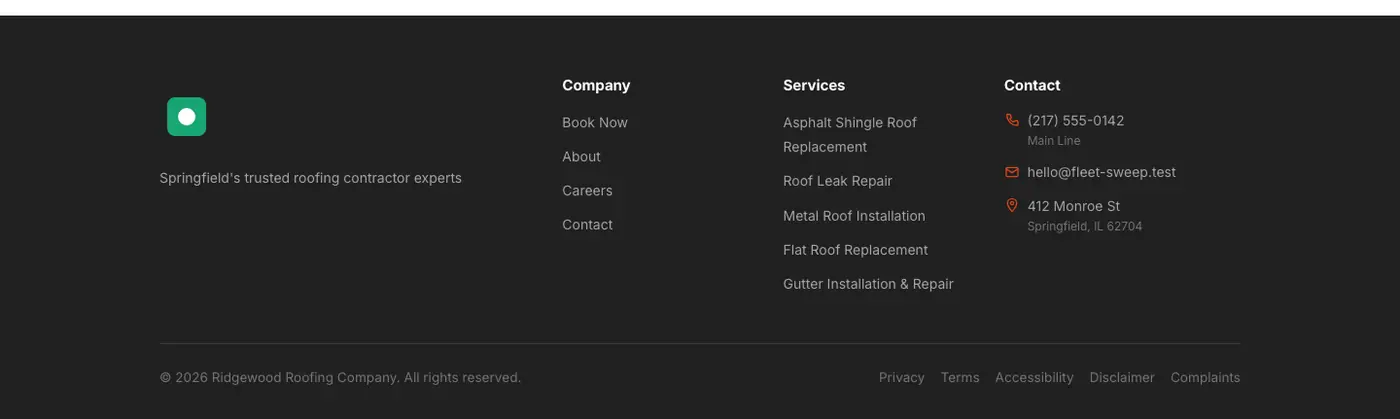
What was done. Header and footer logos are sized to a constant visual area rather than a fixed height, so a wide 5:1 wordmark and a square 1:1 mark end up looking equally present. The rules are injected as one stylesheet block; no logo <img> is hand-sized. Separately, the logo prompt now carries the template's real heading font and its real palette.
Why it matters. Sizing by height makes a wide logo enormous and a square one tiny. Sizing by area makes them read as the same weight. And a logo drawn in a font the site never uses looks pasted on — the one element a business owner judges first.
Measured. Header desktop 6000px² (28–48px tall, max 200 wide); header mobile 3600px² (max 40 tall, 150 wide); footer 7000px² (max 56 tall, 220 wide). On the old code the harness logged G1 failures: home-1's mobile header logo measured 160px wide against a 150px cap, pro-1 failed twice.
Header and footer sizing
home-1 header — fixture logo is a wide 5:1 wordmark.


home-1 header at 390px. The old build ran 160px wide, over the 150px cap.


home-1 footer.
home-3 header — fixture logo is a square 1:1 mark. A 1:1 logo gets a smaller box by design: same area, not same height.


home-3 footer.
copperline-electric header, square mark on a dark chrome.


copperline-electric header at 390px.


copperline-electric footer.
home-2 header — 3:1 banner fixture.


home-2 footer.
pro-1 header.


pro-1 footer.
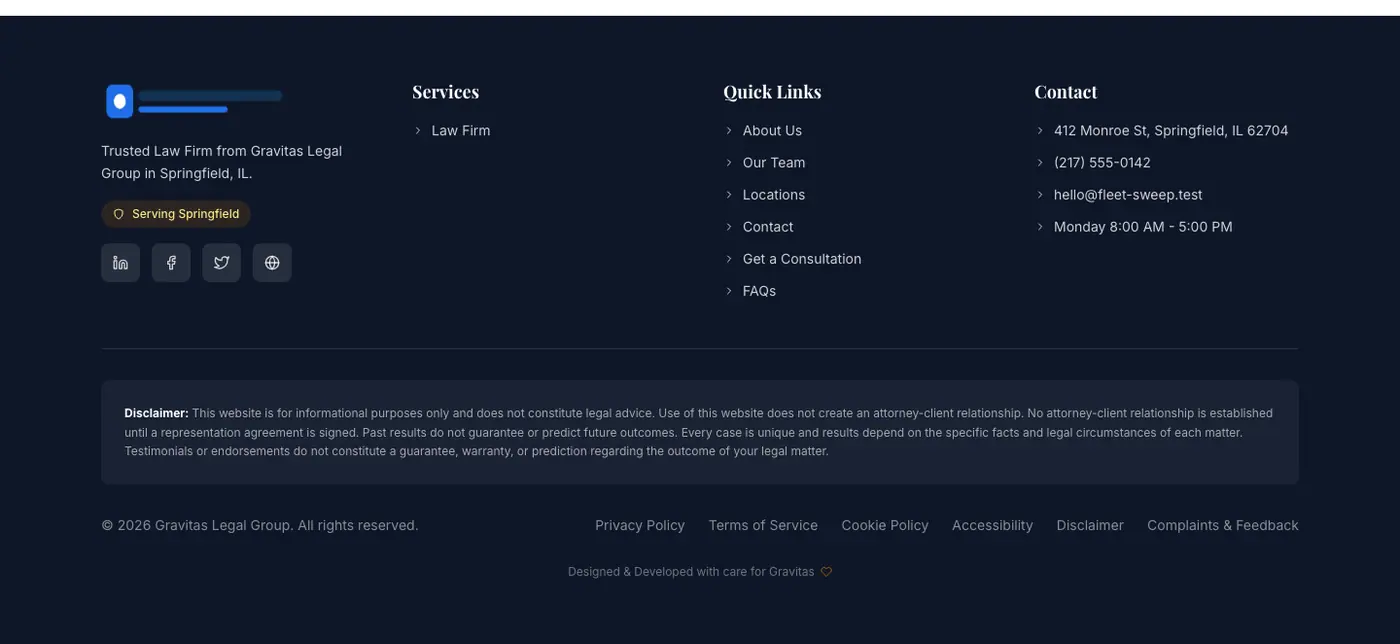
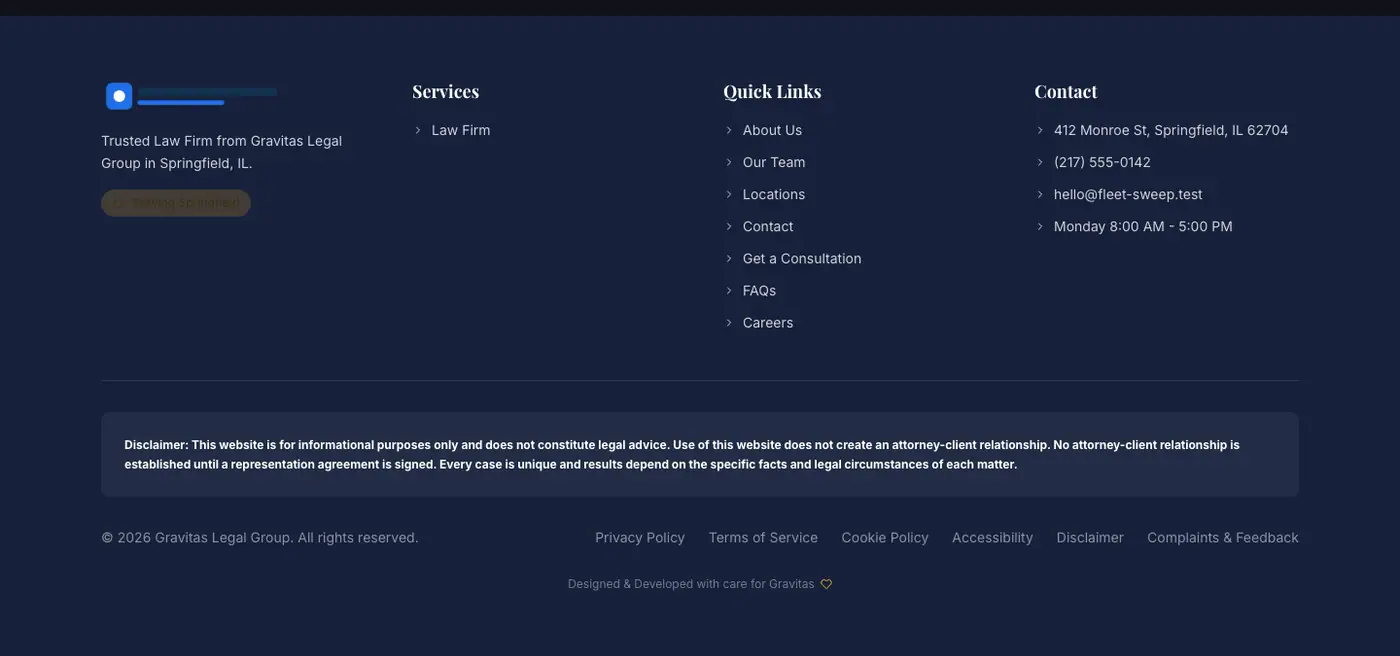
campave-heritage header.


What the prompt change does to a generated logo
These six marks were generated for this page with the real image model, same size and quality tier, same business, same palette input. The only difference is the brief: the old code sent the first clause of the template's style note and dropped its typography entirely; the new code sends the whole brief plus a descriptor of the template's actual heading font.
prismara-dental. Its heading font is a high-contrast display serif. The old brief said "bold rounded sans".


home-3. Ships a display serif; the old brief asked for "friendly bold sans".


pro-2. Ships a classic display serif; the old brief asked for "warm modern sans".


8 Claims the business cannot prove are removed, not reworded
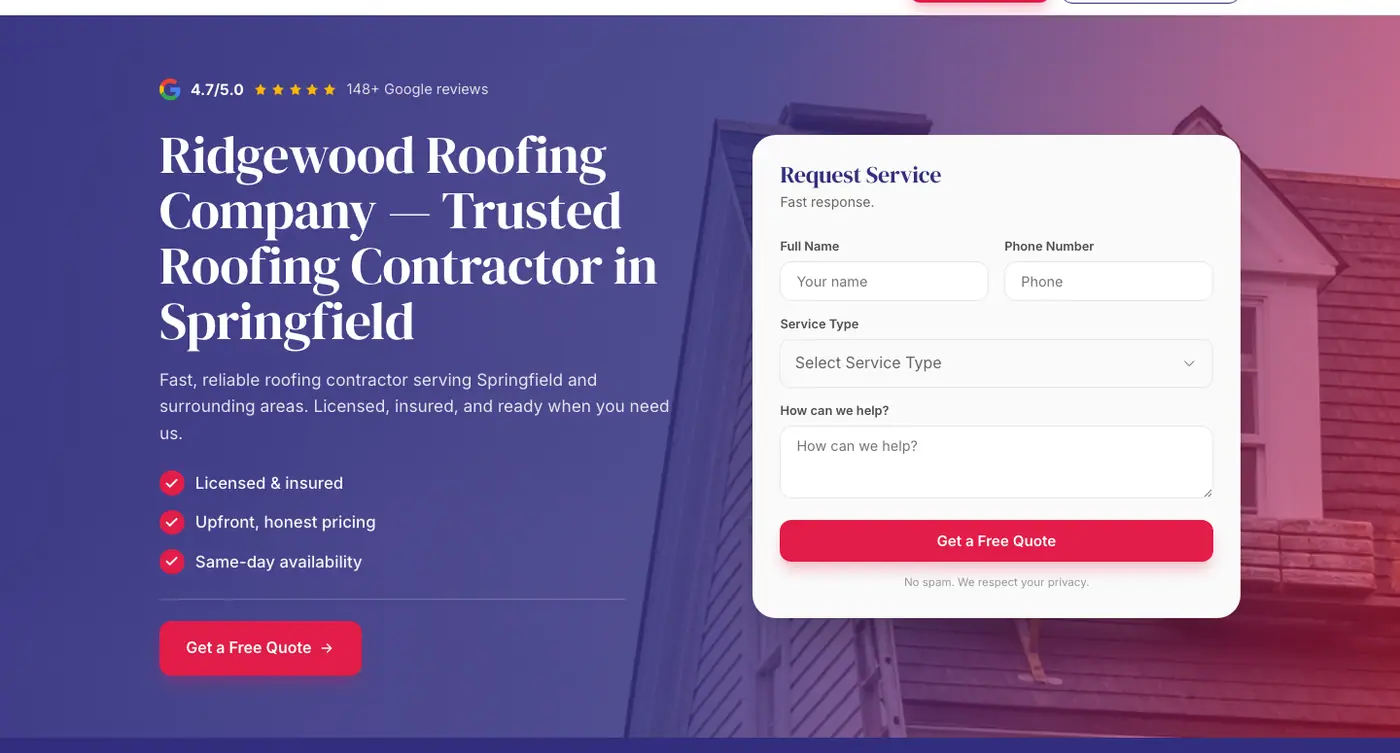
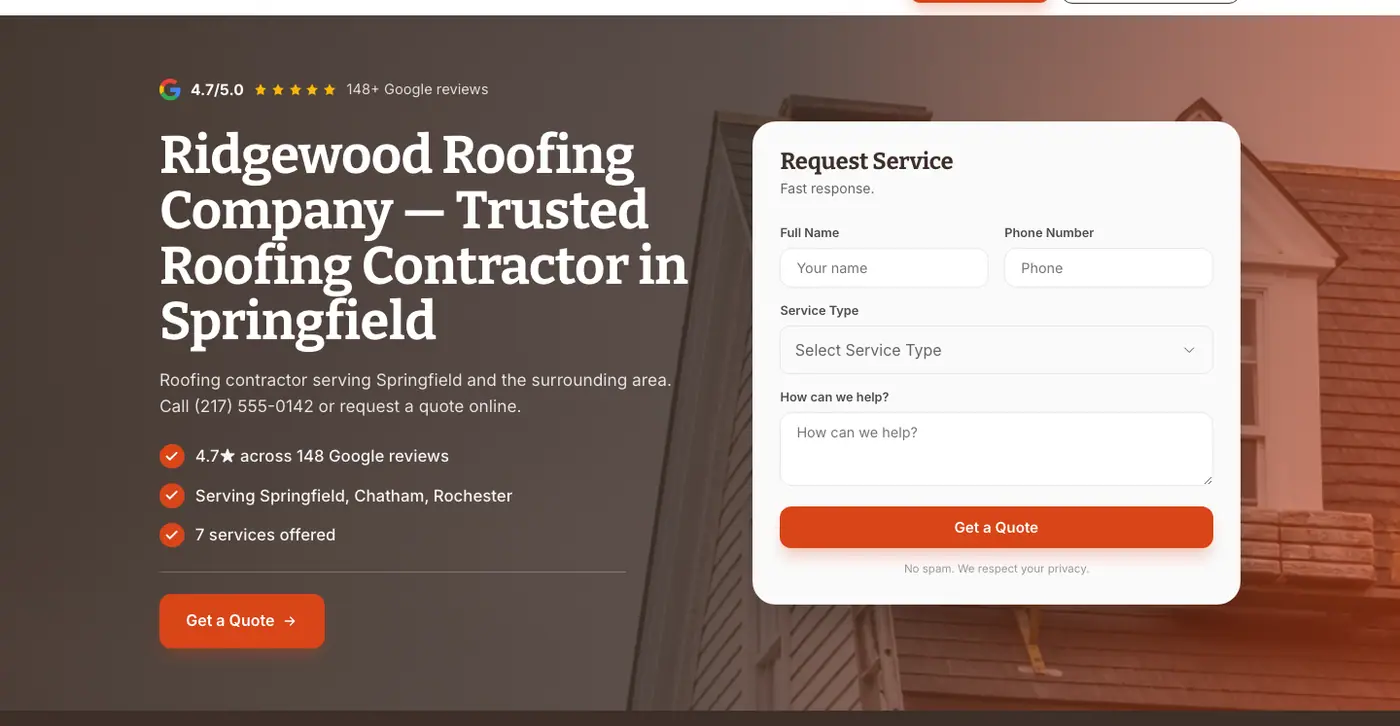
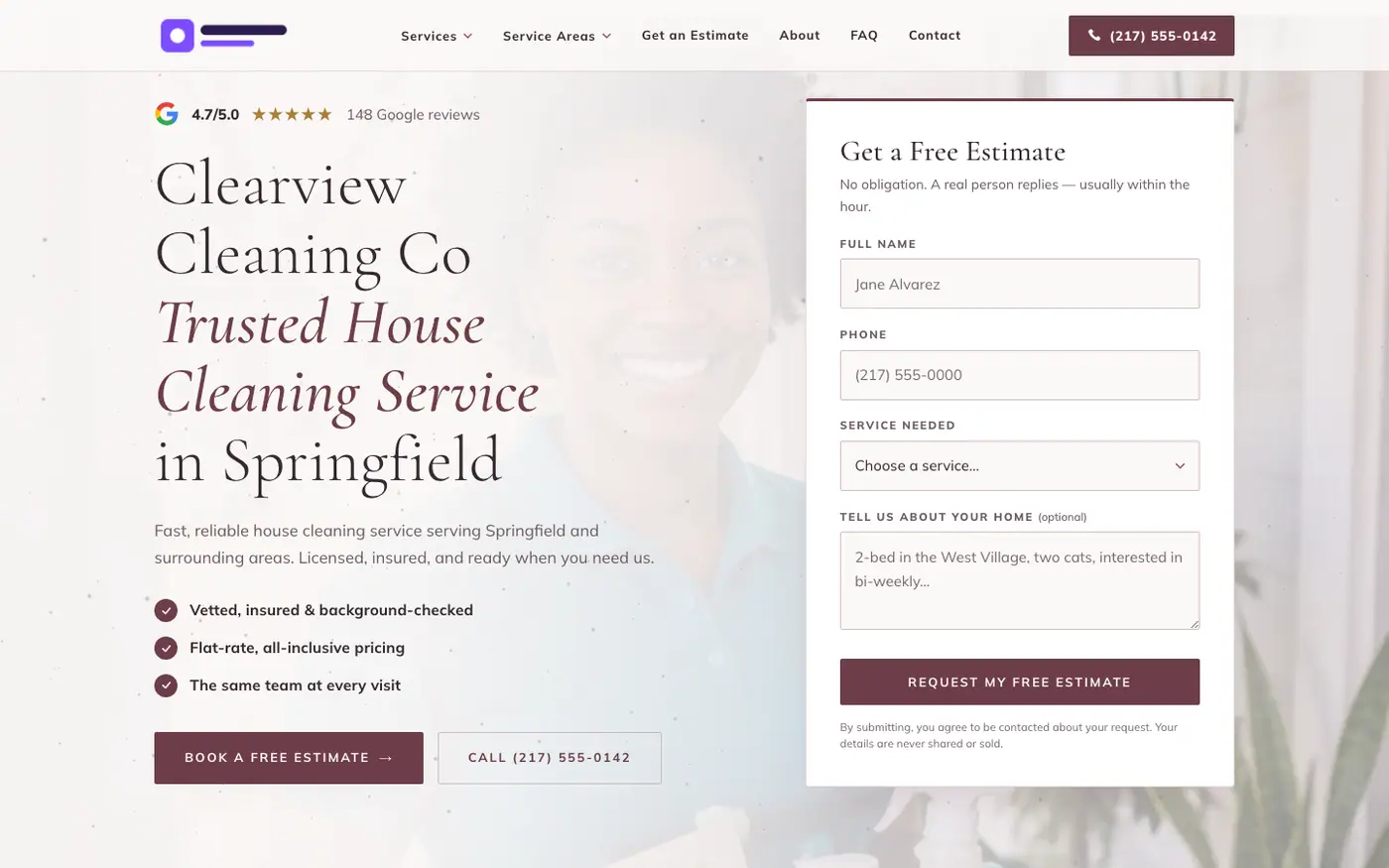
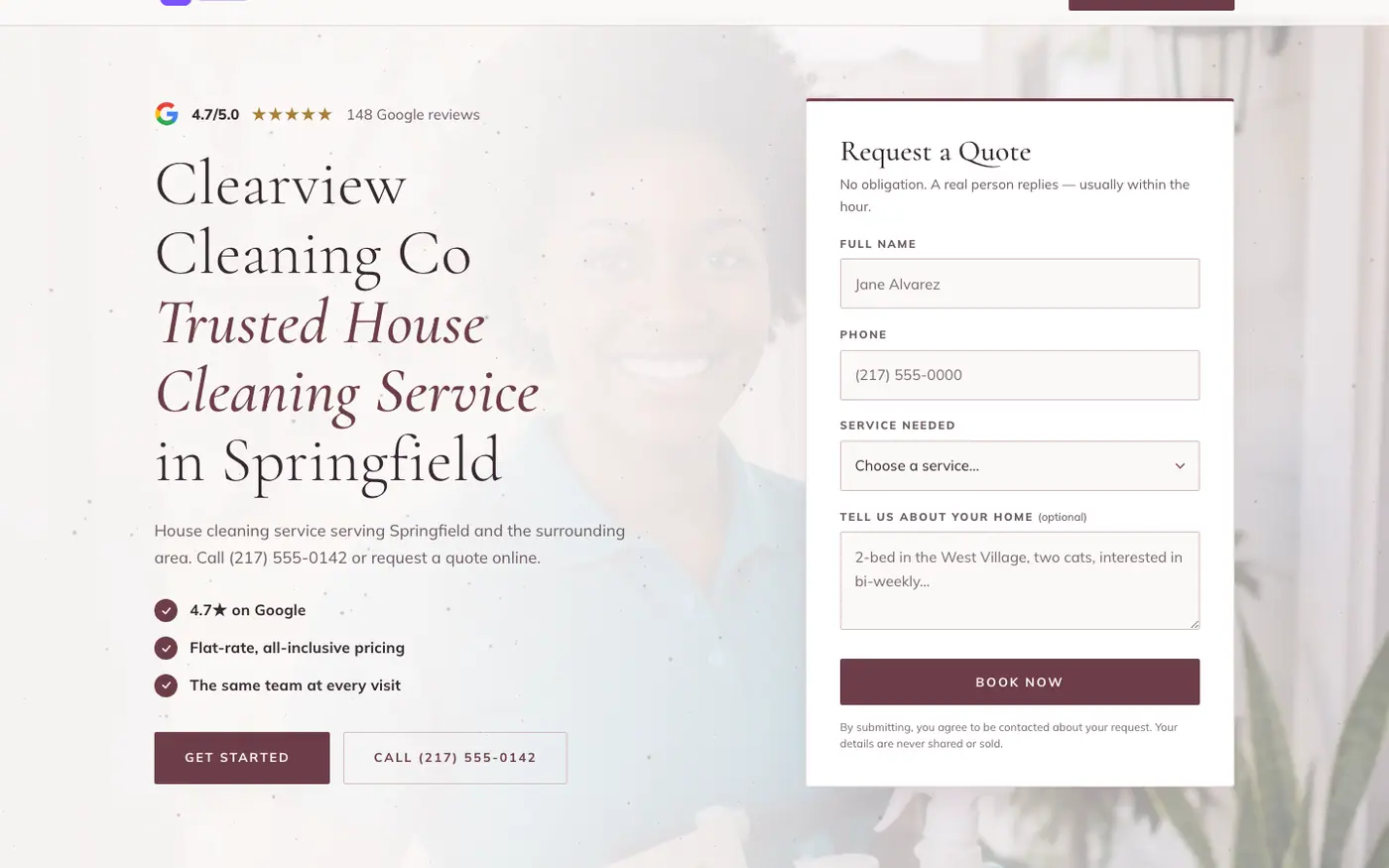
What was done. Trust claims — licensed, insured, years in business, guarantees, same-day, 24/7, free estimates — ship only when the intake actually evidences them. Where one is removed, the badge row is refilled from real facts first (Google rating, review count, how many areas and services), and only then is an item dropped. A form heading that lost its claim gets a call-to-action heading, never a brand slogan. The homepage <h1> leads with the business name and is trimmed, never deleted.
Why it matters. Templates bake trust badges as decoration. On a real client site those become claims the business has to stand behind, and a "Free Estimates" badge nobody authorised is a liability, not a conversion. Replacing them with the business's real Google rating is both safer and more persuasive.
Measured. 0 form headings now read "Why <brand>" (26 across 11 variants during the fix). 0 duplicate <h1> within any variant. 1540 pages, 0 missing an <h1>.
home-1 hero form heading. "Get a Free Quote" is an offer the fixture business never made, so it becomes a plain call to action.


home-3 hero. "Licensed & insured", "Upfront, honest pricing" and "Same-day service" give way to "4.7★ across 148 Google reviews" and "Serving Springfield, Chatham, Rochester" — facts the site can show its source for.
pro-1 hero.
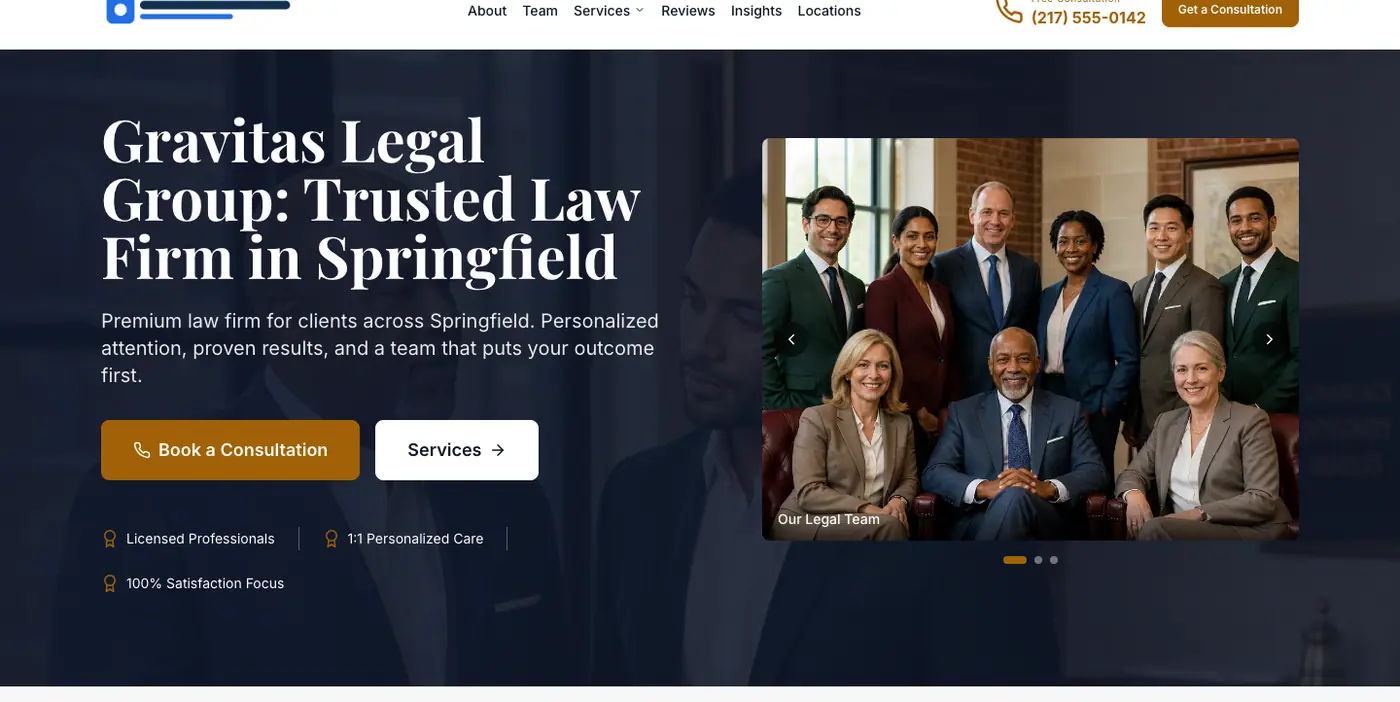
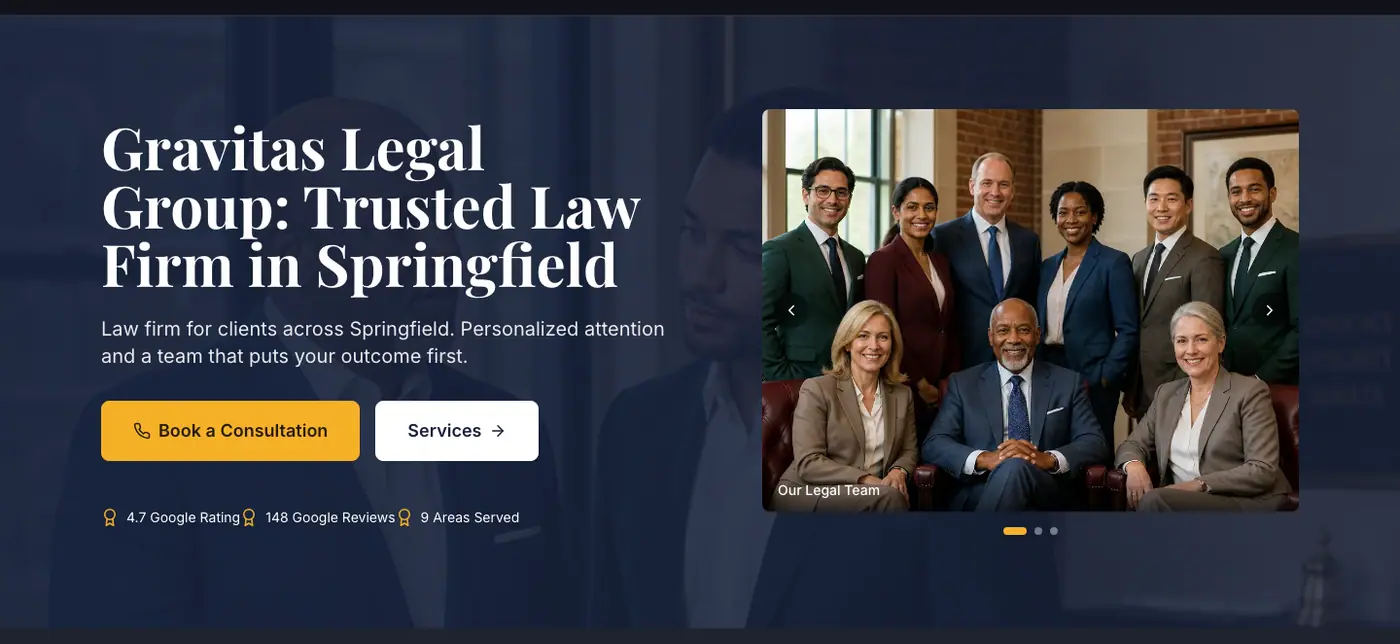
copperline-electric hero.
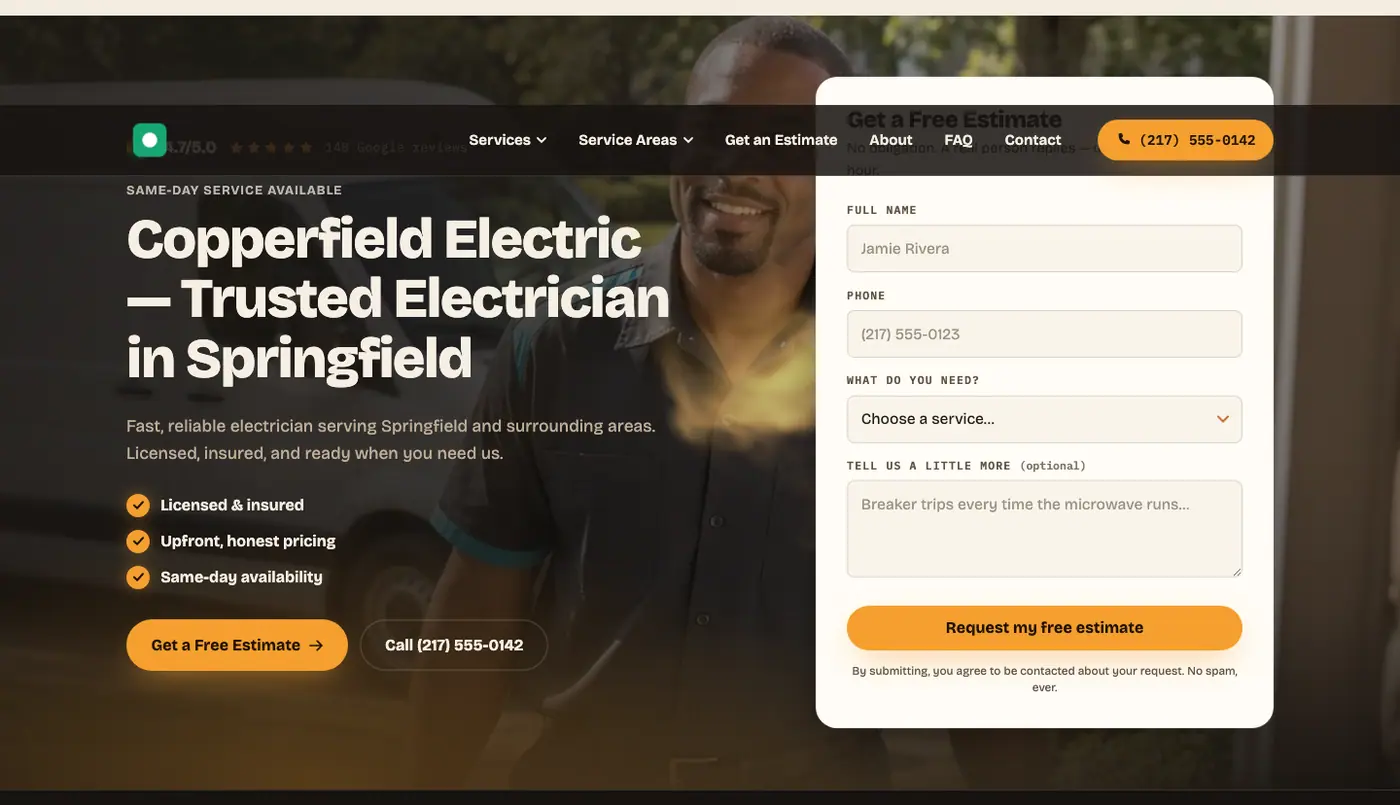
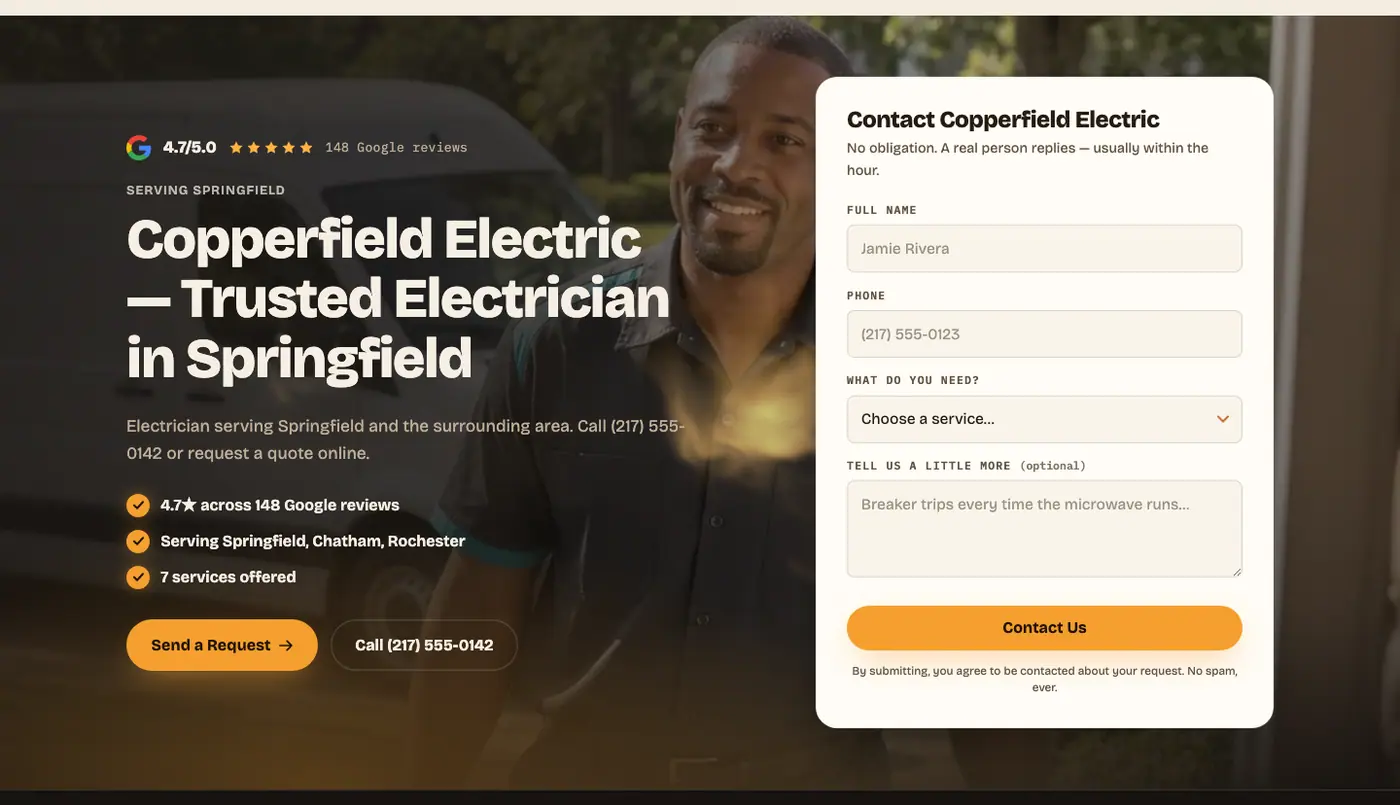
primrose-cleaning hero.
9 Meta descriptions that end in a sentence
What was done. Every clamp now cuts at a sentence, clause or word boundary and ends in a period. It never ends in an ellipsis and never cuts a phone number in half. Inner-page titles go through a separate clamp and a de-duplication pass.
Why it matters. The meta description is the line a searcher reads before deciding to click. "…with upfront pricing. Call (217)" is the sales copy Google shows, and the phone number is the one thing on the page that should never be broken. Over-long descriptions get truncated by Google anyway, which is how the ellipsis got there in the first place.
Measured. Across the two built sets: descriptions over 160 characters 555 → 0; cut mid phone number 49 → 0; not ending in a sentence mark 151 → 2; ending in "…" 1 → 0. The project report counts 145 ellipsis endings and 115 phone cuts against its own wider corpus.
home-1/blog/how-much-does-whole-home-repiping-cost-in-springfield/
How Much Does Whole-Home Repiping Cost in Springfield — here's the straight answer from local whole-home repiping pros, plus what drives the price and when to call.
What shapes the cost of whole-home repiping in Springfield: scope, access and timing, plus what to ask before you book.
home-2/services/air-conditioning-repair/
Fast, reliable hvac contractor serving Springfield and surrounding areas. Licensed, insured, and ready when you need us.
Expert air conditioning repair in Springfield.
copperline-electric/guide-to-electrical-safety/
Most electrical problems give a warning before they become an emergency — a breaker that trips a little too often, a switch plate that’s warm to the touch, a panel that hums louder than it used to. This guide covers what those warning signs mean, what’s worth fixing now versus watching, and how to tell a fair quote from an inflated one.
Most electrical problems give a warning before they become an emergency — a breaker that trips a little too often.
copperline-electric/locations/auburn/
Copperfield Electric provides licensed electrician service in Auburn, IL. Copperfield Electric provides electrician service across Auburn and the surrounding area.
Electrician in Auburn, IL. Copperfield Electric provides electrician service across Auburn and the surrounding area.
home-3/services/roof-leak-repair/
Expert roof leak repair in Springfield. Licensed, insured, upfront pricing. Upfront flat-rate pricing, licensed Springfield technicians, and a workmanship guarantee. Free estimate.
Expert roof leak repair in Springfield. Serving Springfield and 8 nearby areas.
prismara-dental/services/dental-implants/
Looking for dental implants in Springfield? Prismara Dental Studio delivers expert dental implants with upfront pricing. Call (217) 555-0142.
Looking for dental implants in Springfield? Prismara Dental Studio provides dental implants across Springfield and nearby areas. Call (217) 555-0142.
campave-heritage/services/hot-towel-shaves/
Looking for hot towel shaves in Springfield? Regent Barbershop delivers expert hot towel shaves with upfront pricing. Call (217) 555-0142.
Looking for hot towel shaves in Springfield? Regent Barbershop provides hot towel shaves across Springfield and nearby areas. Call (217) 555-0142.
primrose-cleaning/services/move-in-move-out-cleaning/
Looking for move-in & move-out cleaning in Springfield? Clearview Cleaning Co delivers expert move-in & move-out cleaning with upfront pricing. Call (217)
Looking for move-in & move-out cleaning in Springfield? Clearview Cleaning Co provides move-in & move-out cleaning across Springfield and nearby areas.
home-1/about/
Brightline Plumbing Co is a family-owned plumbing company working across the Springfield area. The team handles water heaters, drain and sewer lines,…
Brightline Plumbing Co is a family-owned plumbing company working across the Springfield area.
10 Dark mode actually renders dark
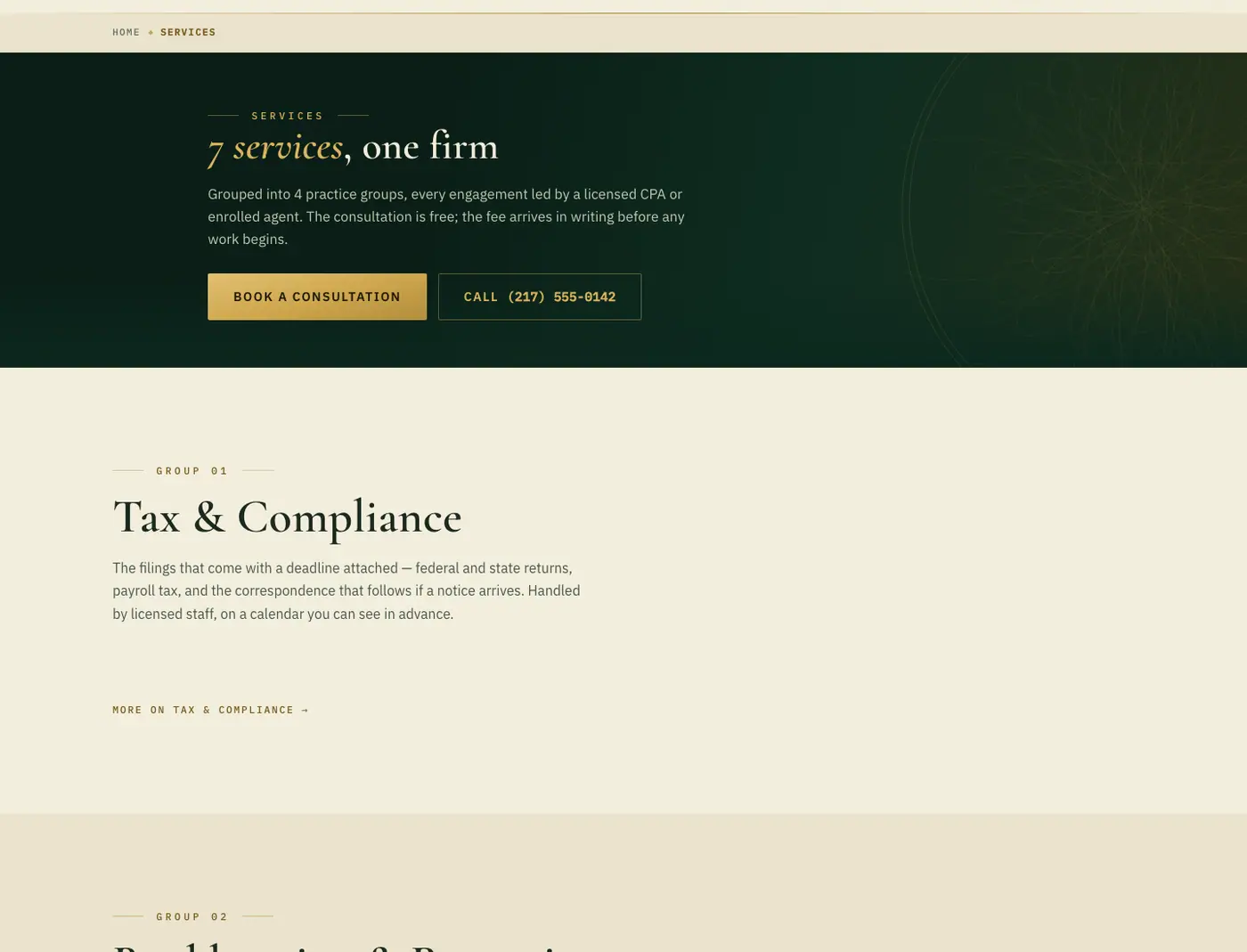
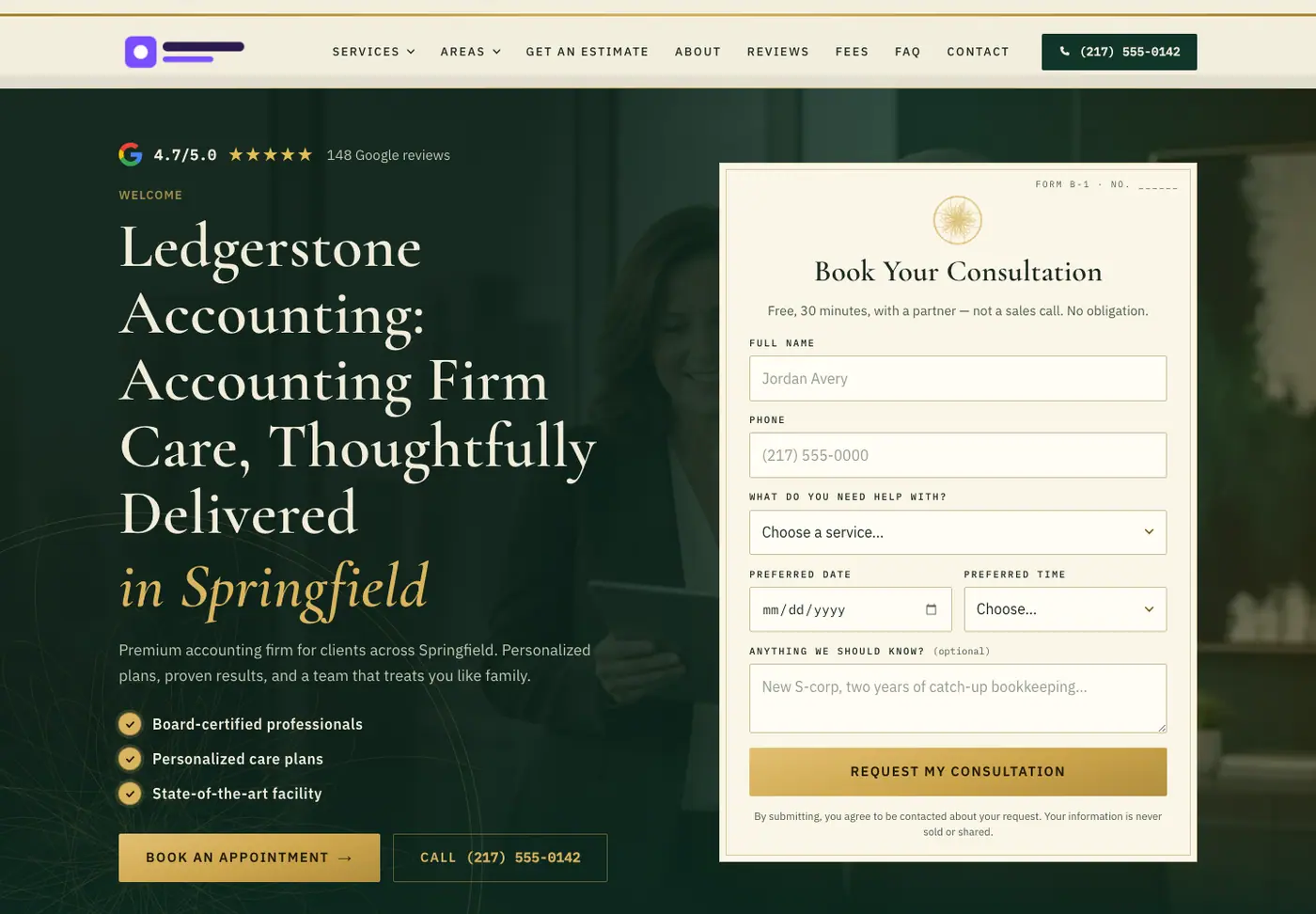
What was done. A dark build is selected by stamping data-theme on the page. Each showcase template's Layout.astro carried a hard-coded allow-list of theme names, and a name that was not on the list was silently dropped — so the build said "dark" and the page came out light. All 31 allow-lists were corrected, home-2's dark block got its own fix (cssRuleBody), and a test now asserts every template against every preset it ships.
Why it matters. A client who picks the dark skin and gets a cream page has been sold something that does not exist. It is also the kind of fault nobody catches by eye across 31 templates, because you have to build each one and look.
Measured. 31 of 31 Layout.astro allow-lists fixed. showcase-layout-presets.test.mjs — 188 assertions. Dark fleet run: 31/31 PASS with THEME-DARK reading the painted background, highest luminance 0.021 against a 0.2 ceiling.
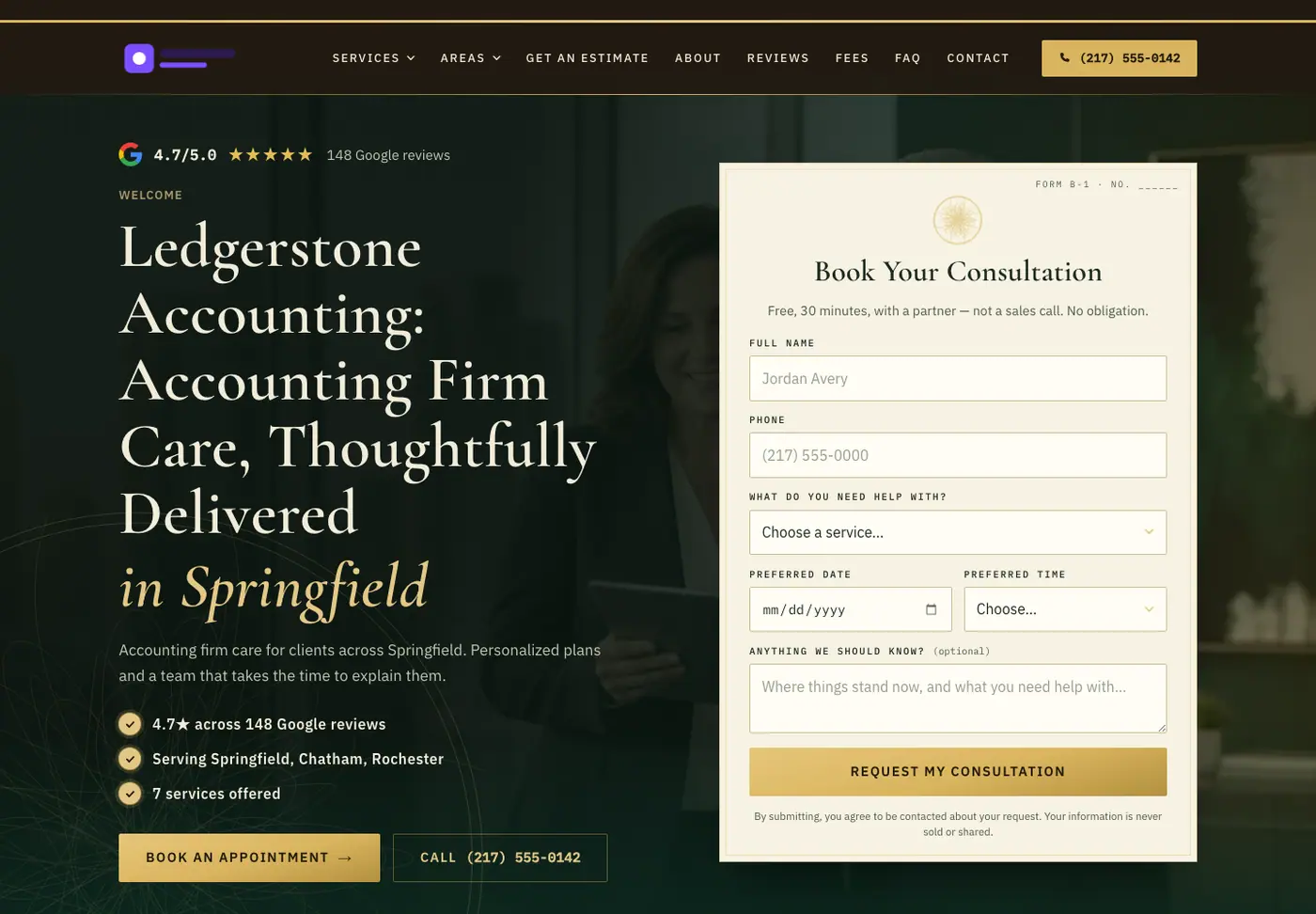
ledgerstone-accounting, --theme=dark, the /services/ page. The before is the dark build: cream page, dark-text cards. Its preset is "vault", and the Layout allow-list only accepted ['ledger-noir', 'archive-blue'].

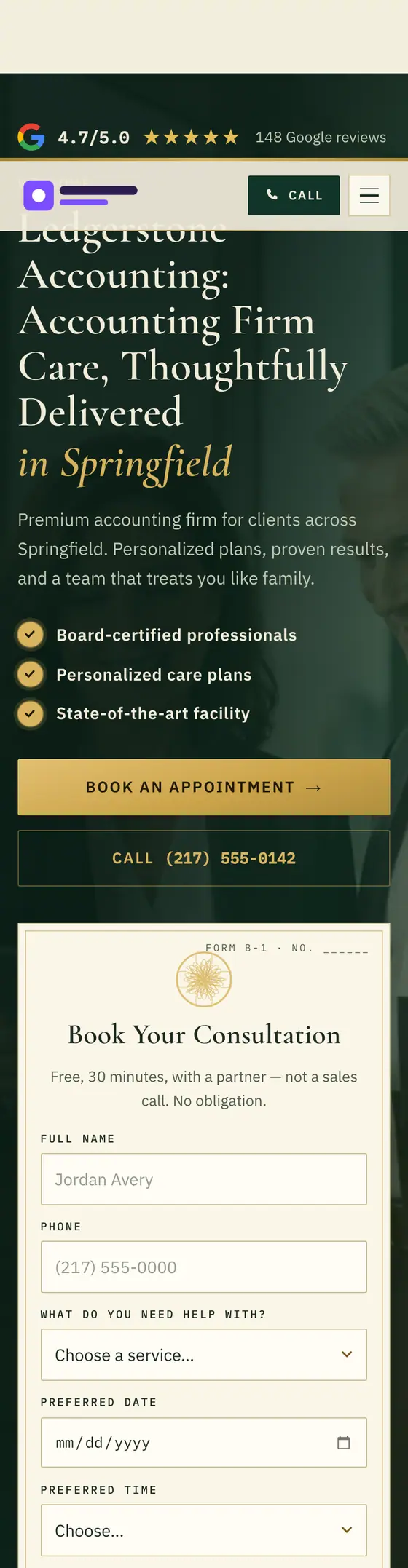
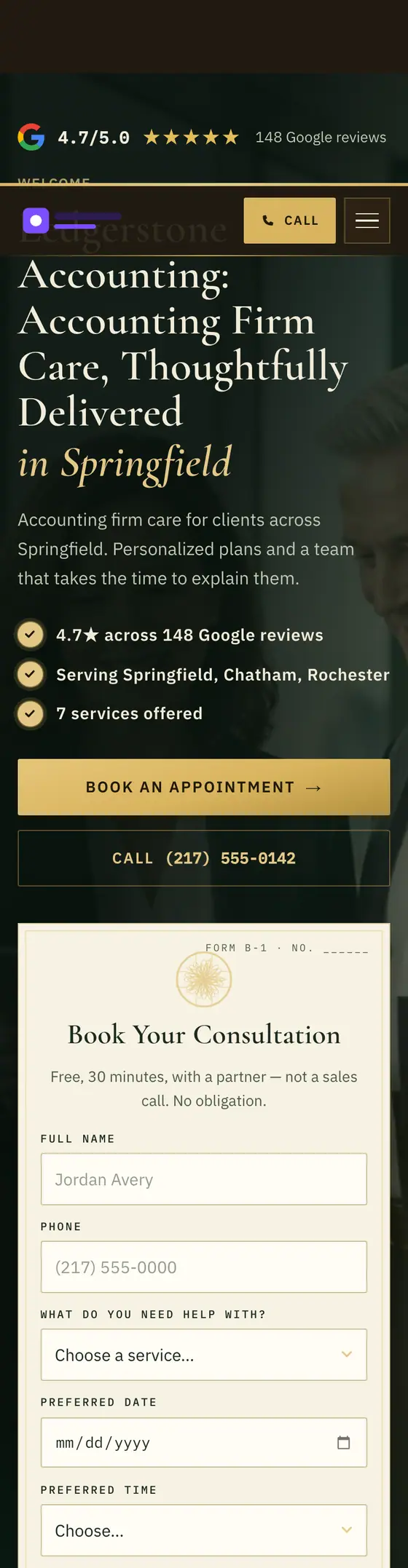
The same dark build's homepage. The hero sits on a dark photo either way — the tell is the header bar above it, and the body behind everything. The after also shows the honesty badge swap from section 8.
The same dark build at 390px.
11 No Google data, no rating band
What was done. A hero or review band that shows a star rating is rendered only when there is a real Google aggregate behind it. With no profile and no reviews the band is removed rather than drawn empty.
Why it matters. An empty star row reads as "this business has no reviews", which is worse than saying nothing. A rating with no number beside it is also the sort of thing that gets a page flagged for a structured-data mismatch.
Measured. Built from the same fixture with the Google fields stripped from the intake, so the whole pipeline sees a business that genuinely has none.
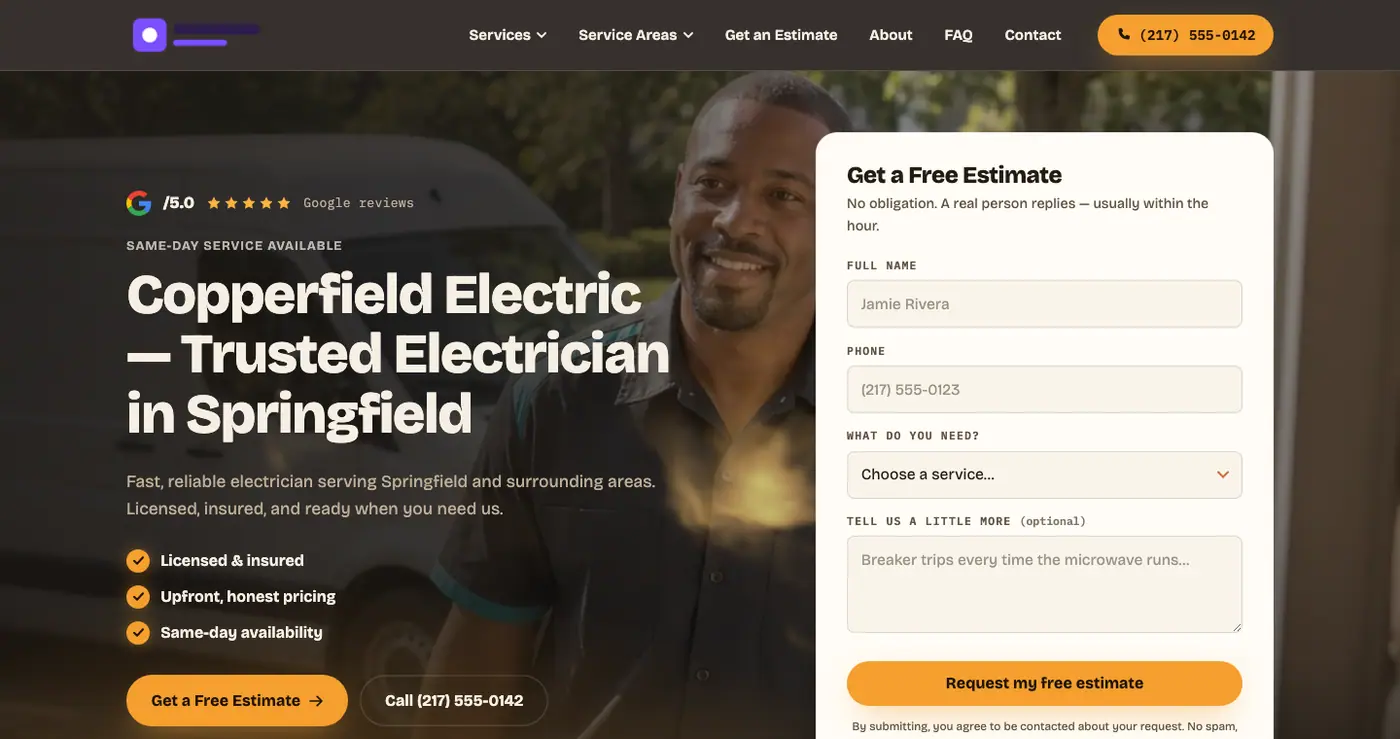
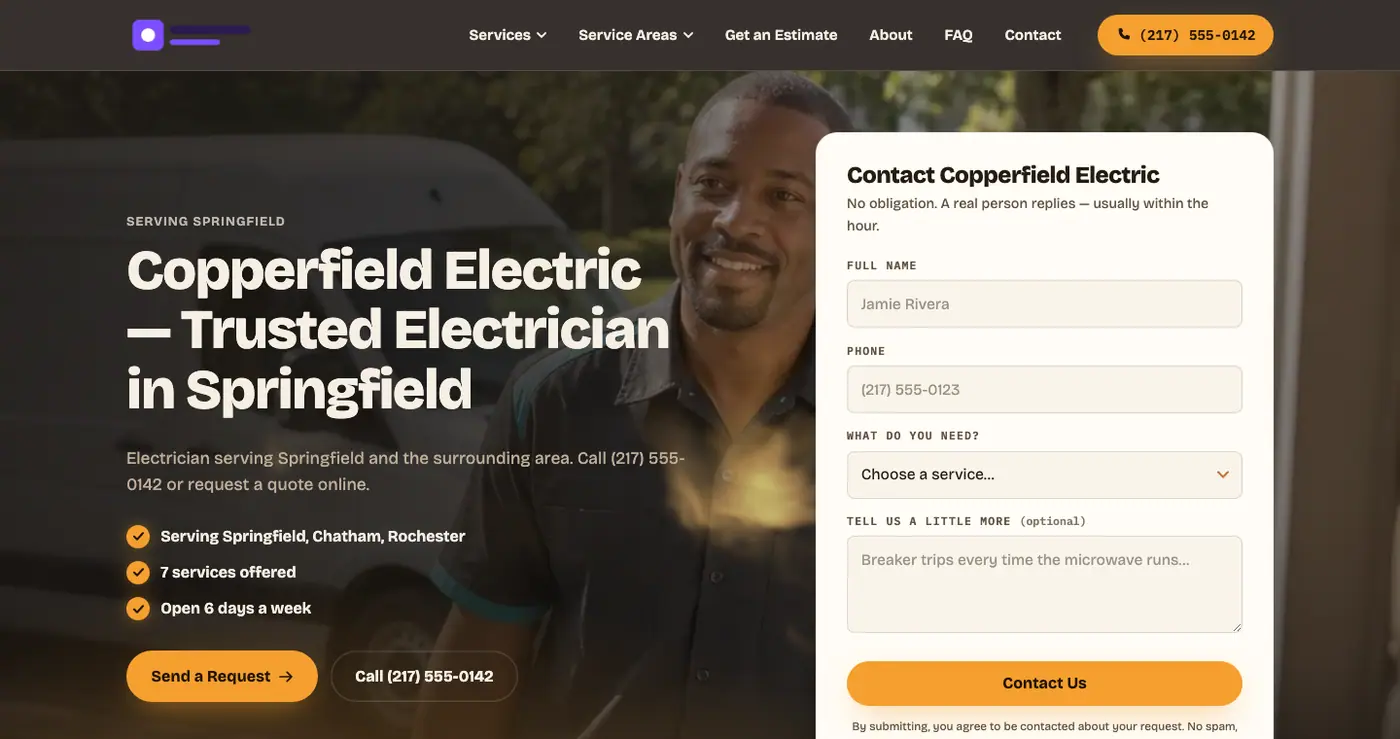
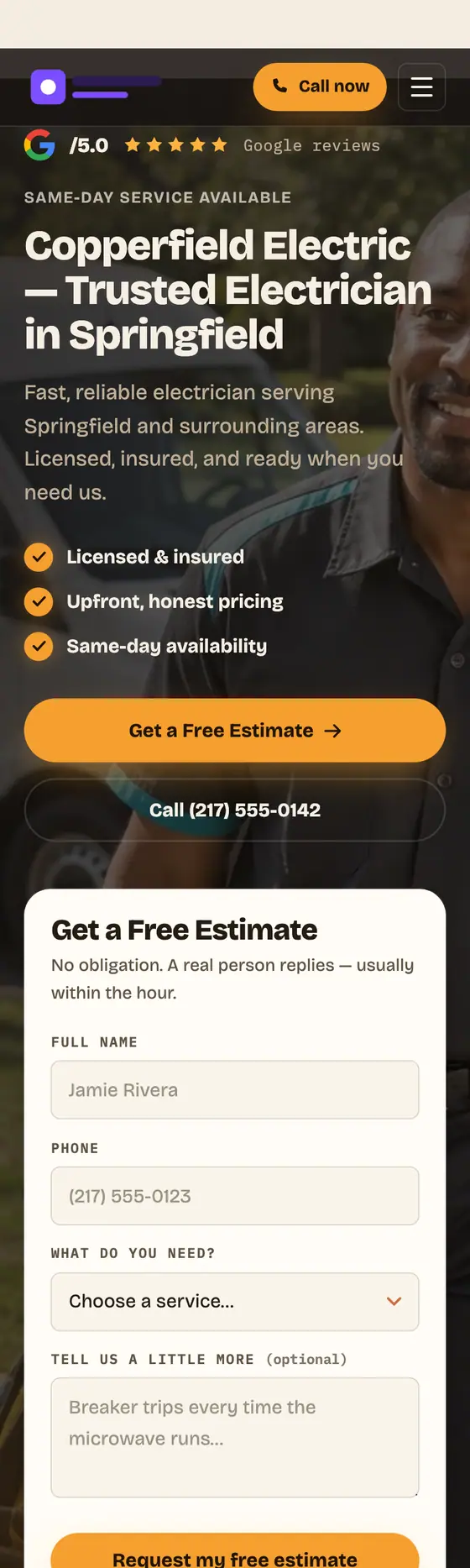
copperline-electric, built with no Google profile and no reviews. Before: the badge renders as "/5.0 ★★★★★ Google reviews" — five stars, no rating, no count. After: the band is gone and the space goes to facts the site can stand behind.
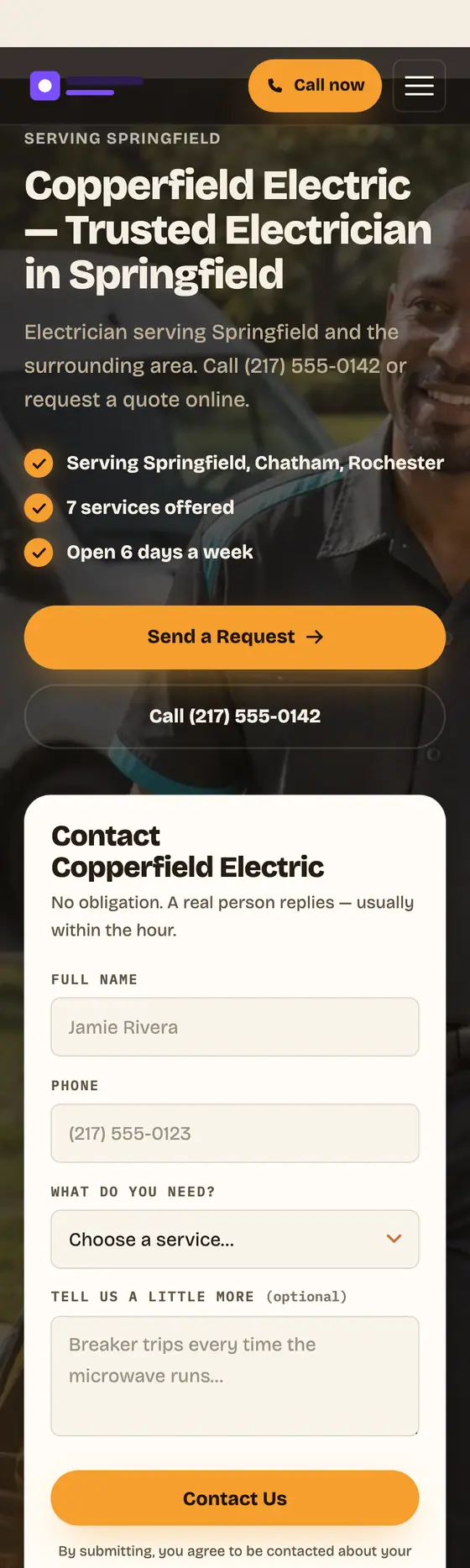
The same build at 390px.
And with real Google data the band still renders — same template, same build, the normal fixture: "4.7/5.0 · 148 Google reviews". The fix hides an empty band, it does not hide the feature.
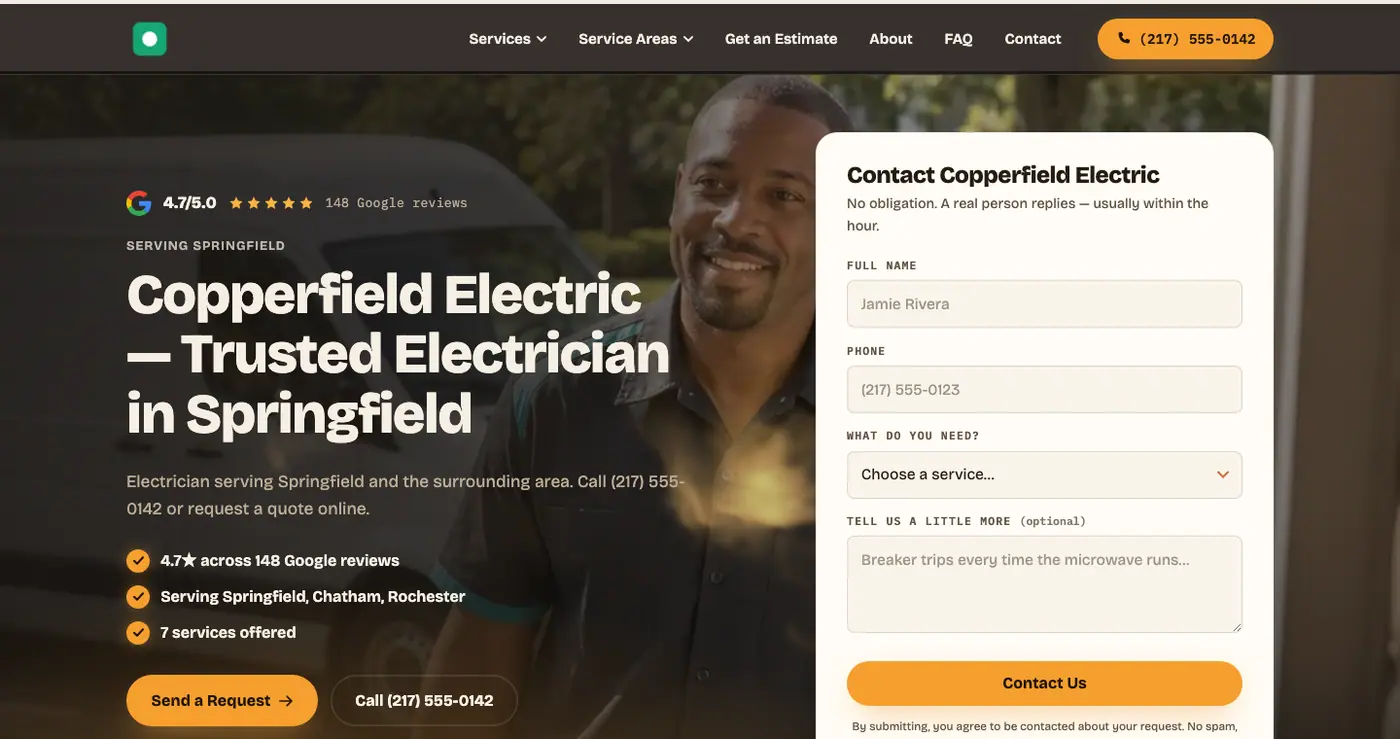
12 Every page keeps exactly one honest heading
What was done. Claim-scrubbing used to be able to take a heading down with the claim inside it. Now a heading is only pruned together with the block it belonged to, an <h1> is never removed, and a heading that loses its claim gets a call-to-action heading that fits the page — "Request an Estimate" on an estimate page, "Contact <business>" on a contact page.
Why it matters. The <h1> is the single strongest on-page signal of what a page is for. A page with none, or a contact page headed with a brand slogan, loses that for nothing in return.
Measured. 1540 fleet pages, 0 without an <h1>, 0 duplicate <h1> inside any variant, 0 form headings reading "Why <brand>".
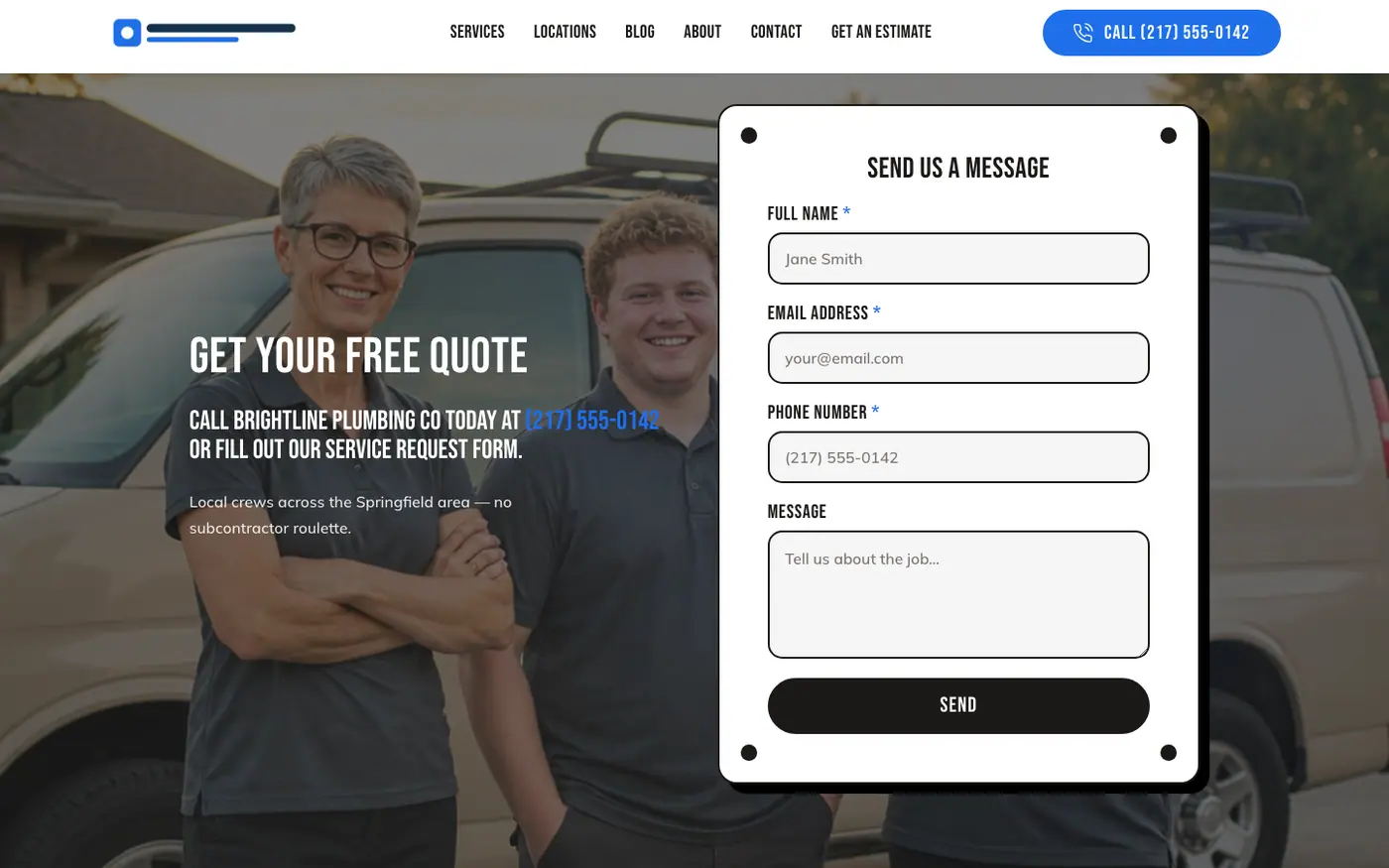
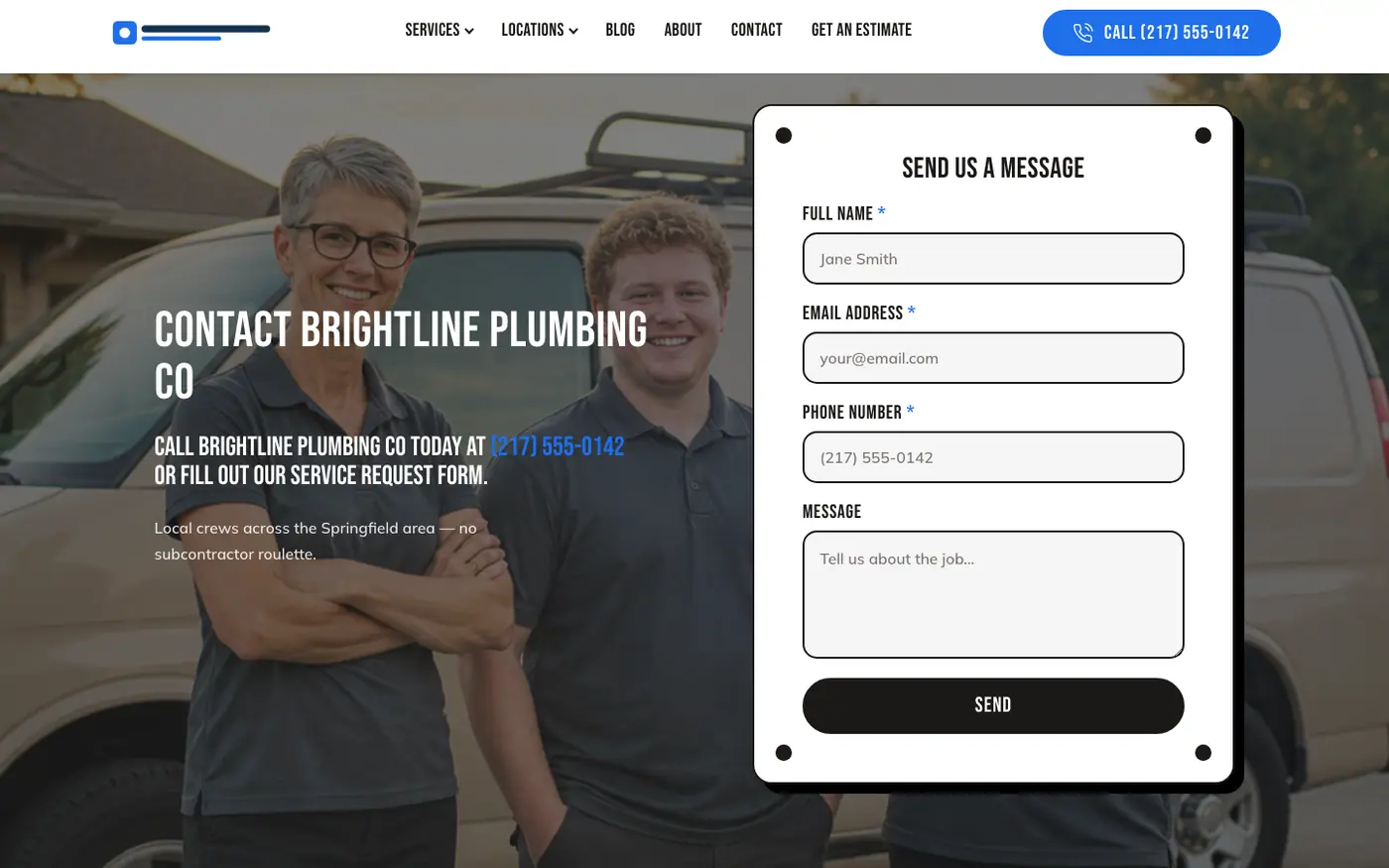
home-1 /contact/. The page was headed "Get Your Free Quote" — an offer the business never made — and is now headed with what the page actually is.
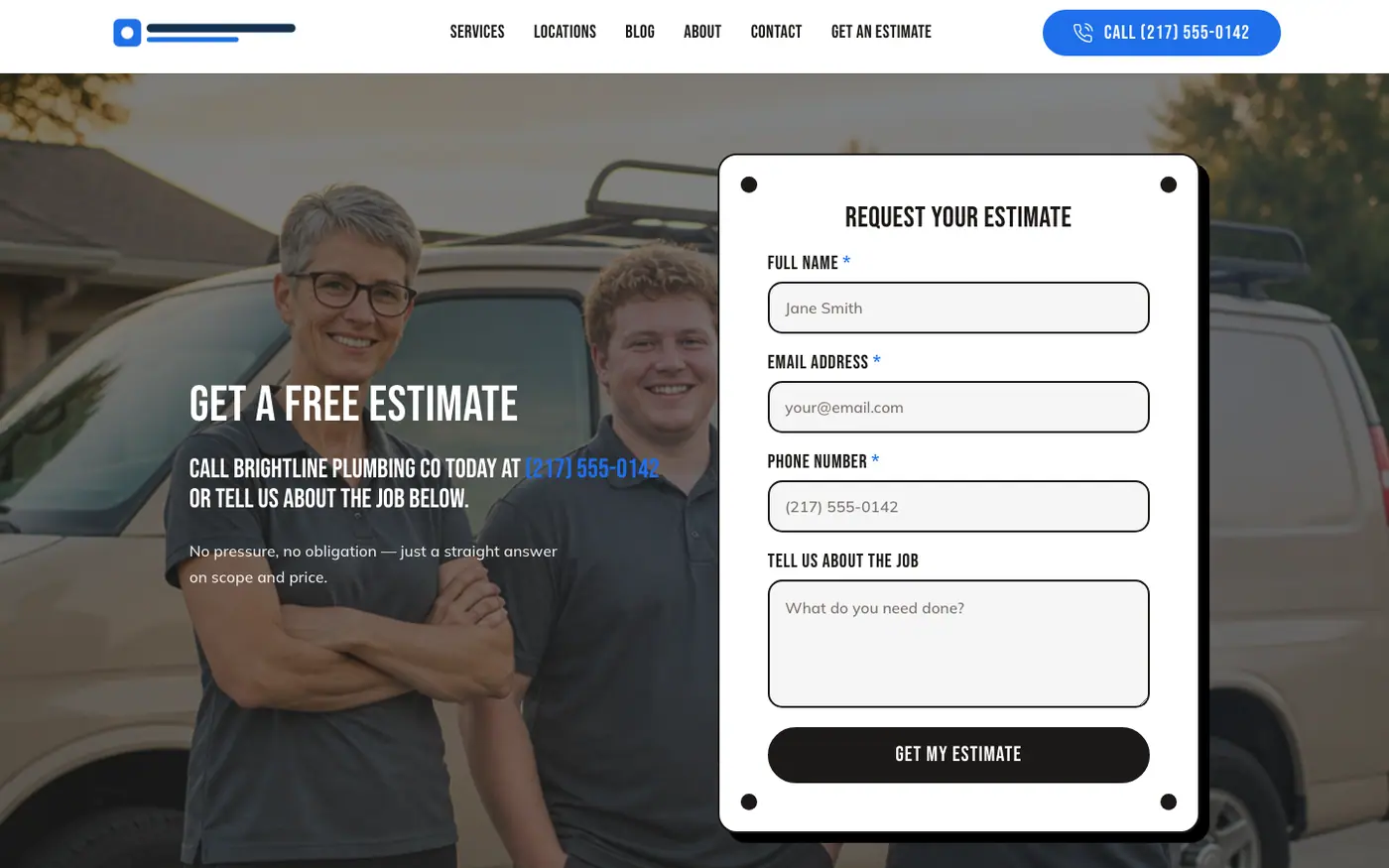
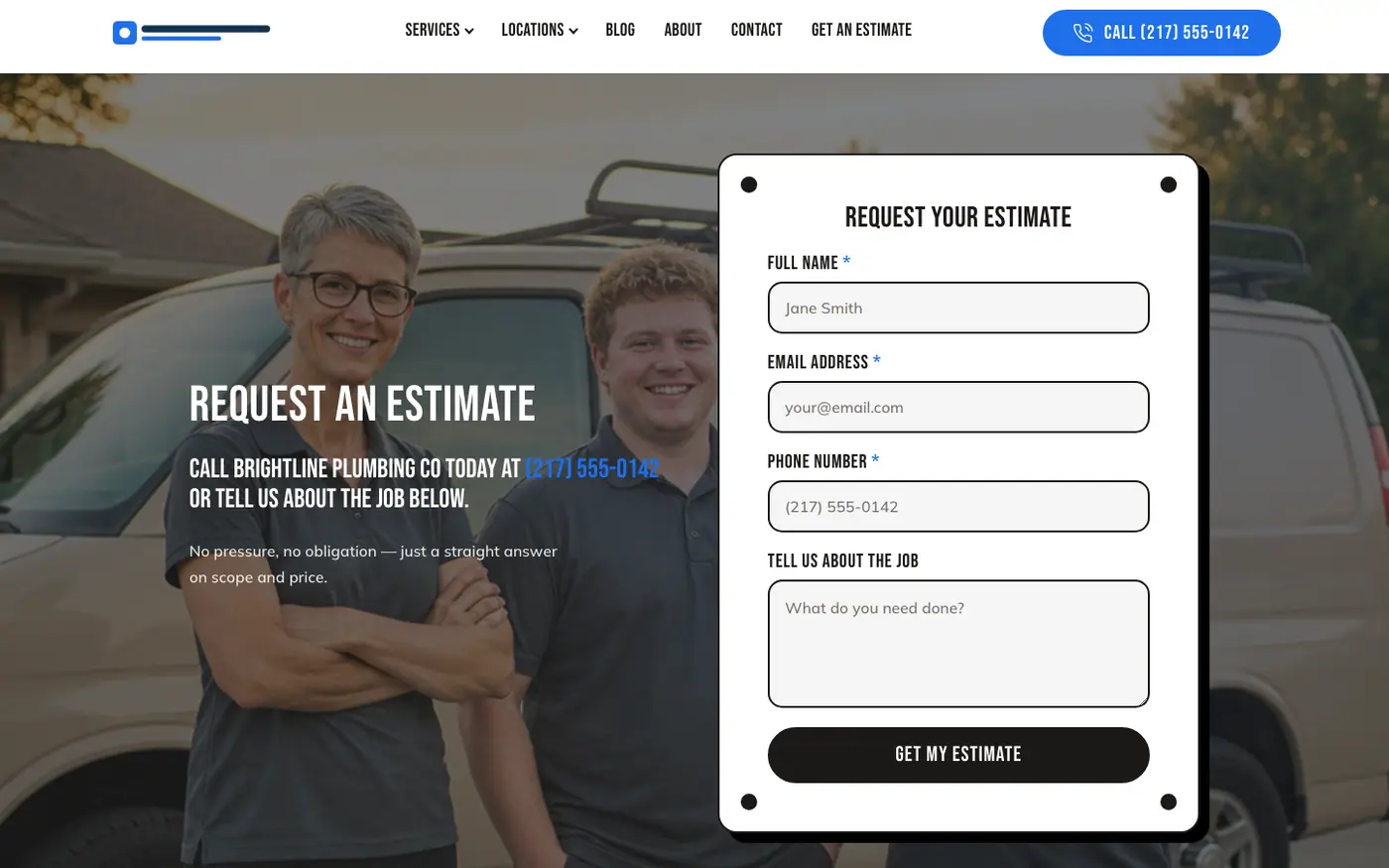
home-1 /estimate/. "Get a Free Estimate" → "Request an Estimate".
The home-1 hero form heading, shown again here because it is the same rule: the claim goes, the call to action stays.
Two faults in this area were introduced and fixed inside the
sweep itself, so they have no baseline "before" to photograph. The figure scrub read home-1's evidenced
"74+ Years in Business" as fabricated, removed it, climbed to the enclosing hero and took the homepage
<h1> with it; and the claims gate briefly replaced 26 form headings across 11 variants
with a band-style "Why <brand>". Both are fixed at source, and a guard now keeps a page's original
bytes if any pass would leave it without an <h1> — it fires zero times on the current
fleet.
13 No evidenced emergency work, no emergency page
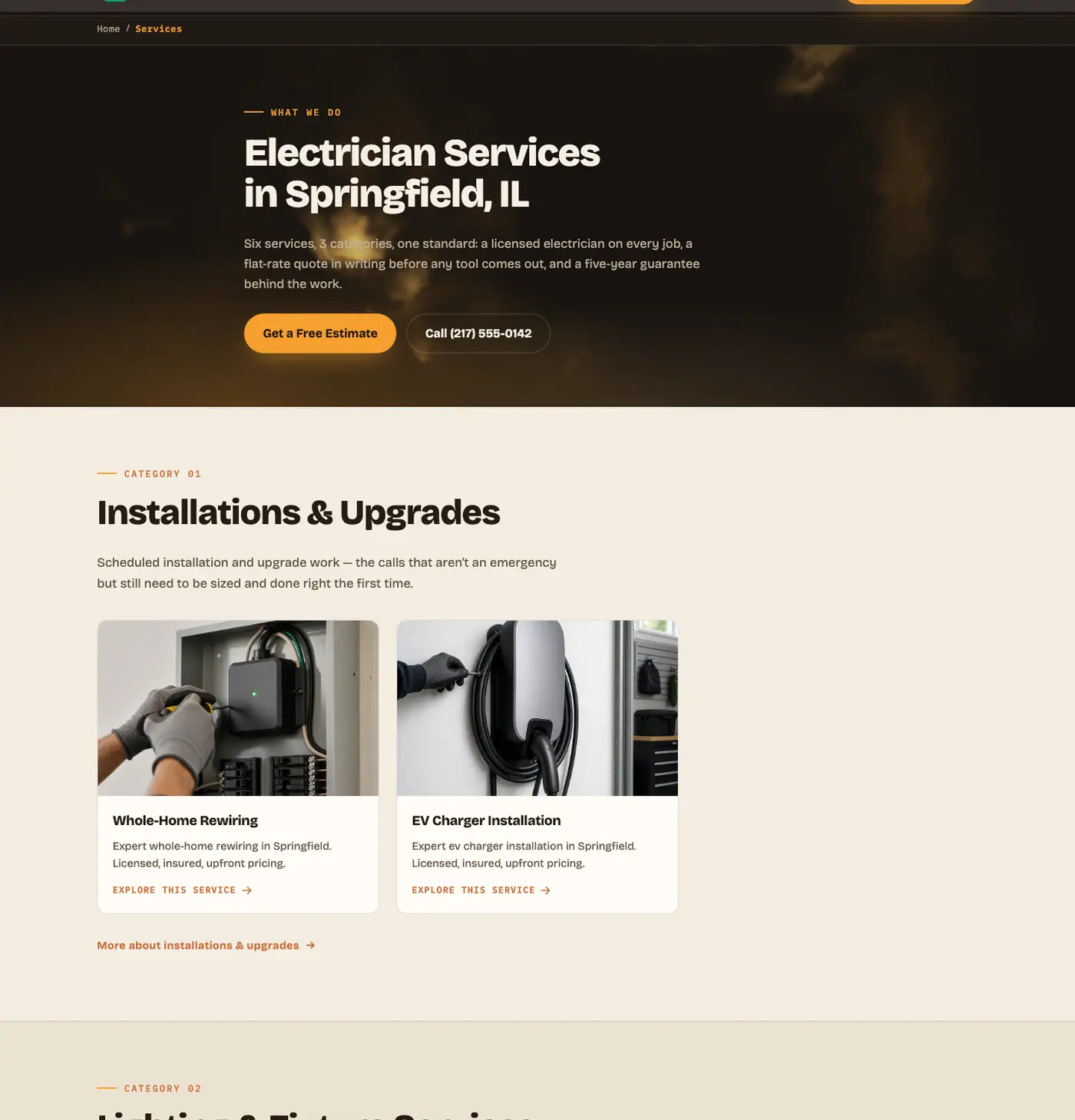
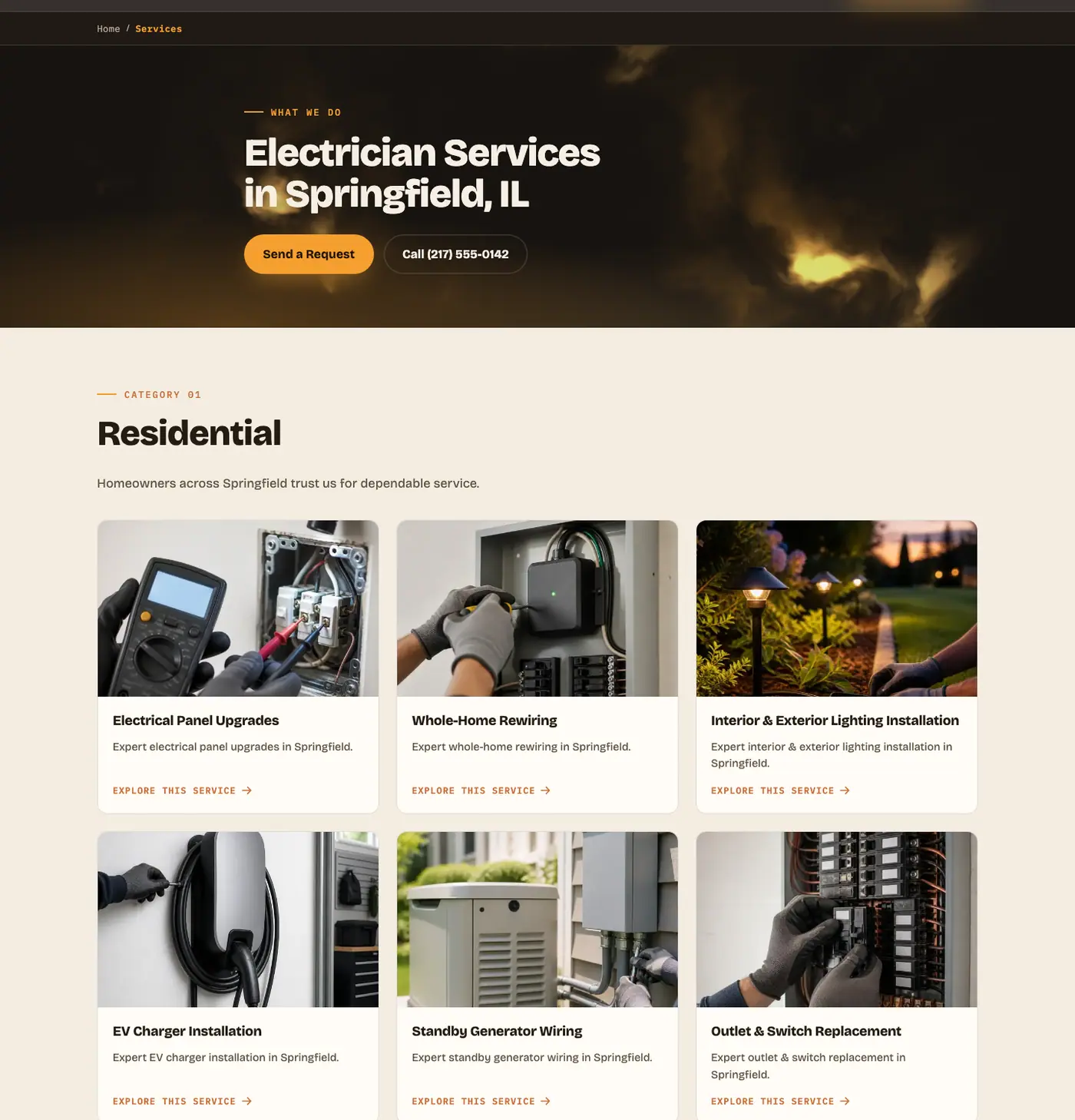
What was done. Emergency service is gated on evidence in the intake. A business that has not shown it does emergency work no longer gets an emergency service page, an emergency category, a nav entry or any 24/7 wording — the gate runs in fill.ts and again in the service planner, so it cannot be reintroduced by a generated service list.
Why it matters. An emergency page is a promise to answer the phone at 3am. Generating one because the template had the slot is the most expensive unevidenced claim on the whole site, and the one a customer will actually test.
Measured. Emergency category pages across the fleet: 4 → 0 (copperline-electric, marlow-plumbing, slatepeak-roofing, camber-garage). No page in any variant now carries emergency wording in its navigation.
copperline-electric, the /services/ hub. The before groups the work under "Installations & Upgrades / Lighting & Fixture Services / Emergency Electrical" — that third group was invented by the template. The after groups it the way the business actually sells: Residential and Commercial.
14 Internal linking: the last two gaps closed
What was done. The original report left two linking gaps open. Both are now done: home-2 service pages carry a related-services rail, and home-3 reads per-service detail from siteJson.serviceDetail instead of printing one generic process block on every service.
Why it matters. These were the two templates where a service page was still a dead end or said the same thing as its six siblings. Duplicate process copy across seven pages is near-duplicate content; a rail is what turns a set of service pages into a silo.
Measured. home-2 related-services rail: 0/7 → 7/7 service pages. home-3 per-service detail: 0/7 → 7/7.
home-2 /services/heat-pump-service/ — the after gains a "Related Services" rail.
home-3 /services/roof-leak-repair/ — "Our Process", identical on all seven service pages, becomes "Our Roof Leak Repair Process" written for this service.
15 Works with the SEO skills and bridge wiring
The site generator uses six SEO writing guides as live instructions for its AI steps — service planning, page copy, supporting articles, and the editor's "add a section" and "add a page" tools. We checked every fix in this report against those guides and against the code that connects them.
What we confirmed
| Check | Result |
|---|---|
| All six guides load from disk at call time; none falls back to placeholder text | OK |
| Each guide reaches its intended step — planner, page copy, articles, compose section, compose page | OK |
| Length rules line up: the guides ask for 150–158-character meta descriptions and 50–90-word FAQ answers, and the trims sit at or just above those, so copy that follows the guide is never cut | OK |
| One evidence list — built from the owner's own facts, never rewritten by AI — is read by the prompt, the service-page cleaner and the final page scrub | OK |
| Emergency-service rules: guide, planner and build all refuse emergency pages and 24/7 wording without evidence | OK |
| Planner output — service list, 2–3 hero services, 6 categories at most, merged near-duplicates — matches the guide's contract | OK |
| Composed pages: one H1, taken from the page title; the sanitizer is stricter than the guide, so no guide-legal output is rejected | OK |
| Related tests: 740 at review time, 1,397 after the fixes below | all pass |
What we found and fixed
-
Was The copy prompt contradicted itself. It listed the real Google rating as something the writer may repeat, and in the same breath banned review numbers. A later honesty check then deleted the paragraph — sometimes the whole service intro.
Now The writer gets only the owner's own credentials.
-
Was Pull-quotes in blog articles were treated like customer reviews, so the trust-claim check skipped them.
Now Article quotes carry a marker and are checked. Real customer reviews stay untouched.
-
Was The planner's per-service buyer terms — "licensed", for example — reached the writer with no warning attached.
Now They are labelled as search terms, and never become claims unless the owner's facts evidence them.
-
Was Pages added from the chat editor could go live with over-long titles and descriptions until the next rebuild.
Now They are trimmed at creation, at a sentence end.
-
Was The writing guides had drifted from what the system actually enforces.
Now They match it: the homepage leads with the business name and inner pages lead with service plus city, and the planning guide no longer suggests "licensed & insured" as a default or invents an emergency service in its example.
Verified. All 36 templates pass the fleet audit. The lead-gen sweep is 36/36 with 0 unproven claims.
— Notes and open items
- Every business, phone number, address and review figure on this page is a deterministic test fixture. No client data appears anywhere.
- Both columns use the same mocked town facts and the same placeholder logos, so a difference you see is a code difference.
- Tall mobile screenshots are cropped to the top of the page, marked where that happened.
- Open follow-up: a build-script helper that stamps the colour preset reads the first
<htmlin the layout file, which in 21 templates is inside a comment. Harmless today — the real tag sets the theme itself — and queued for cleanup. - Two gaps listed as open in the original report are now closed — see section 14. Still open and recorded: one third copy of the meta clamp lacks a period; two pro-1 role-label descriptions have no period.